49 works in this view — arrow keys or swipe to move between them.
Dance in Art
The pet of the ballet
Unknown artist
- Collection:
- Prints depicting dance
- Source:
- New York Public Library
- Rights:
- Public domain — free to use, share and adapt.
- Recorded as:
- Public Domain
This image is essential for understanding how Romantic-era ballet dancers were presented and consumed by the public, and it preserves the silhouette, posture, and aesthetic conventions of the period with precision. For historians and dancers studying the evolution of ballet technique and presentation, it provides direct visual evidence of how the body was idealized and how performers understood themselves as objects of aesthetic display.
What you are looking at
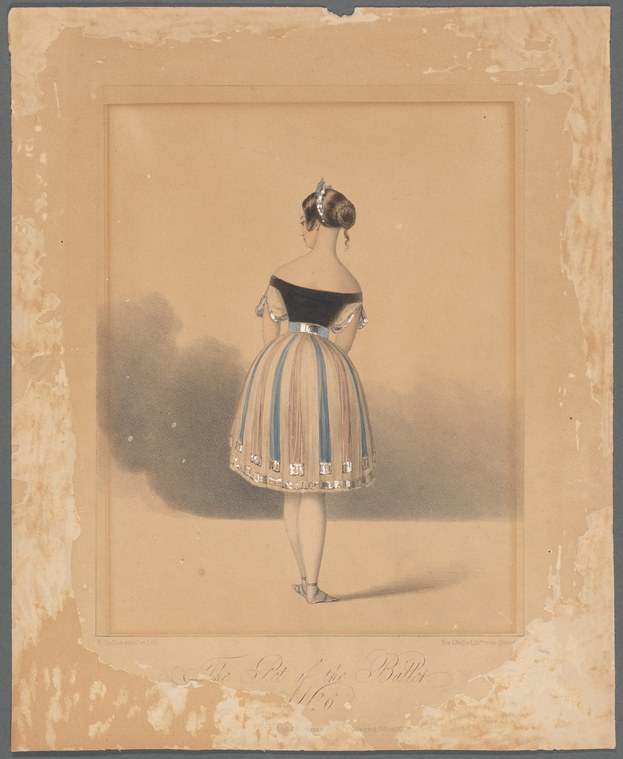
A young female dancer stands alone against a neutral background, viewed from behind and slightly to the side. She wears a black off-shoulder corsage or bodice and a voluminous skirt of pale fabric—likely silk or tulle—gathered or pleated in vertical panels and trimmed at the hem with what appears to be white or cream banding. Her hair is styled up in the fashion of the early 19th century. She stands in a relaxed but graceful pose, one leg bearing weight while the other is subtly extended, her arms at rest. The composition is intimate and studilike, with soft modeling of shadow beneath her figure and plain framing lines around the perimeter of the sheet. The work is rendered in a technique that creates soft, subtle tonal gradations.
The dancing
The single dancer's posture suggests ease rather than formal presentation. Her weight appears settled on her supporting leg, with the other leg extended in a position that suggests either a momentary rest between movements or a held attitude. Her arms hang naturally at her sides; neither arm is raised or extended in a theatrical gesture. The pose suggests a moment of stillness rather than active dance—the kind of pause a performer might hold for a portrait or rest position in a choreographed sequence.
The dance depicted
This is most likely a portrait of a Romantic-era ballet dancer, executed in a style consistent with early 19th-century dance documentation. The white tulle skirt, off-shoulder bodice, and delicate presentation align with the aesthetic of Romantic ballet as it emerged in the 1830s–1840s, when ballerinas adopted the ethereal, sylph-like silhouette. The pose—neither in active motion nor in a formal first or fifth position—suggests this may be a character portrait of a named or celebrated performer rather than documentation of a specific choreography. The sitter's identity remains unknown, though the title 'The pet of the ballet' implies she was a recognized or favored dancer of her time.
How it was made
This appears to be a hand-colored lithograph or aquatint, executed with careful attention to tonal subtlety. The soft blending of tones, the delicate rendering of fabric texture, and the subtle modeling of the figure suggest a technique that allowed for gradual transitions and fine detail work—consistent with hand-colored lithographic prints of the 1830s–1840s. Such prints were the primary means of circulating images of celebrated performers and were collected by dance enthusiasts, theater patrons, and the general public. The technical quality and careful finish suggest a commercial print intended for a market audience, not a casual sketch.
About this work
This is a portrait of an early 19th-century ballet dancer, executed as a hand-colored print and preserved in the New York Public Library's collection of dance imagery. The work documents both a specific performer—likely celebrated enough to warrant a commercial portrait—and the aesthetic ideals of Romantic ballet: the ethereal, otherworldly female form in pale, weightless tulle. The work belongs to a widespread tradition of dance portraiture from the 1830s–1840s, when lithographic prints made the likenesses of famous dancers available to a broad audience. It stands as evidence of how ballet dancers were marketed, celebrated, and visualized for their contemporaries.
How to look at it
Look at the moment the artist chose to freeze: not a leap or a turn, but a moment of rest or composure. The dancer faces away from the viewer, a choice that emphasizes the silhouette and the contour of the torso and skirt—the dominant visual language of Romantic ballet. Notice the subtlety of the pose: there is almost no dramatic gesture, only a slight extension of the leg and a natural hang of the arms. This restraint—the refusal to show the dancer in active, acrobatic motion—was itself a convention of early Romantic-era portraiture, which valued grace and ease over athletic display.
The period
This work was created during the height of the Romantic era in European ballet (c. 1830–1850), when the aesthetic of the ethereal, otherworldly female dancer reached its peak. Works such as the ballets *La Sylphide* (1832) and *Giselle* (1841) established the visual and kinetic vocabulary of Romantic ballet: the pale tulle skirt, the off-shoulder bodice, the emphasis on weightlessness and spirituality. During this same period, lithography made possible the mass production of dance imagery, and portraits of celebrated dancers became a major commercial and cultural product. Stars such as Marie Taglioni and Fanny Elssler were among the most recognizable public figures of their day, and their likenesses circulated widely in printed form.
Where it lives
This work is held in the New York Public Library's Prints collection, catalogued within their holdings of materials depicting dance. It was acquired as part of a broader collecting effort to document the history of theatrical and concert dance through contemporary visual evidence.
Dance in this work
Questions about this work
When was this print made?
The catalogue record does not provide a date, but the style, technique, and aesthetic—the Romantic-era silhouette, the hand-colored lithographic printing method, and the fashion of the early 19th century—all suggest a date in the 1830s–1840s, the golden age of Romantic ballet. A full technical analysis could narrow this further.
Who is the dancer in this portrait?
The dancer's identity is not recorded. The title 'The pet of the ballet' suggests she was a celebrated or favored performer of her day, but her name does not survive in the catalogue record. Dance history researchers may be able to identify her by comparing this image with other contemporary portraits and performance records.
Why is the dancer facing away from the viewer?
Turning the dancer's back to the viewer was a deliberate aesthetic choice. It emphasized the silhouette of the torso, the delicate line of the arms, and the volume and texture of the skirt—the key visual elements of Romantic ballet beauty. It also created a sense of privacy or introspection, fitting the otherworldly, dream-like quality that Romantic ballet cultivated.
How was this image made and distributed?
This appears to be a hand-colored lithograph, a printing process that allowed for the rapid and affordable production of multiple copies. Such prints were sold in theaters, at print shops, and through the mail, making dancers' likenesses accessible to the theater-going public and to collectors of dance imagery.
More dance artwork





