49 works in this view — arrow keys or swipe to move between them.
Dance in Art
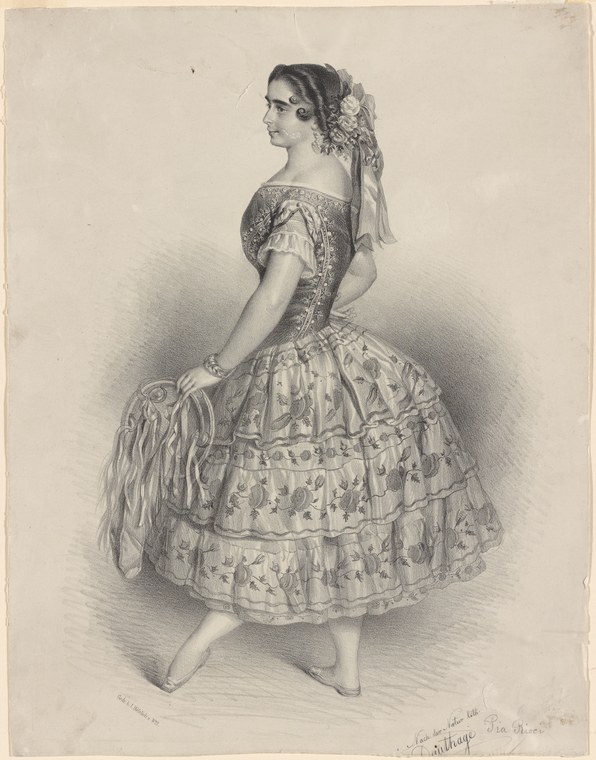
Pia Ricci [written in pencil at lower right]
Unknown artist
- Collection:
- Prints depicting dance
- Source:
- New York Public Library
- Rights:
- Public domain — free to use, share and adapt.
- Recorded as:
- Public Domain
This image documents the reality of mid-nineteenth-century stage costume and the way theatrical dancers were memorialized and circulated to the public as celebrated performers. It provides specific visual evidence of romantic-era ballet dress and the conventions of dance portraiture at a formative moment in theatrical dance history.
What you are looking at
A single female figure is shown in three-quarter view against a plain background, posed as if mid-performance. She wears a voluminous mid-calf skirt with bold floral or botanical patterning, gathered full at the waist and articulated with horizontal tiers and ruffles. The skirt is the visual center, dominating the composition. Her bodice is fitted with off-shoulder sleeves characteristic of mid-nineteenth-century dress. She has a delicate scarf or shawl draped across her left arm and trailing behind her, suggesting movement or grace. Her dark hair is swept back and adorned with flowers or a floral ornament. The figure stands with weight settled, one leg slightly forward, and gazes downward in a composed, theatrical manner. The work is a fine pencil or engraved line drawing with careful shading that gives the figure dimensional form; the background is left nearly blank, throwing full attention on the costume and pose.
The dancing
The dancer is a single standing figure, viewed from her left side. Her posture is upright and composed rather than dynamic, with a gentle S-curve to her torso. The weight appears settled into her back leg, with the front leg relaxed. Her arms are not in an active dance frame—one trails the scarf, the other rests at her side—suggesting this is a posed portrait moment rather than a captured movement. The overall carriage is dignified and statuesque rather than actively mobile.
The dance depicted
This appears to be a portrait of a theatrical dancer, likely a romantic-era ballerina or stage performer from the mid-nineteenth century, posed in costume. The name penciled at lower right, "Pia Ricci," identifies her as the subject. The full skirt, off-shoulder bodice, and floral ornament suggest romantic ballet costume conventions of approximately the 1840s–1850s, a period when tutus had lengthened to mid-calf and such patterned skirts were fashionable on stage. However, the pose itself—standing still, composed, without evidence of technique like turnout or the strain of sustained position—suggests this is a portrait of the performer in her costume rather than a depiction of dance in action. Without further context on Pia Ricci, the specific ballet or style of her performance cannot be determined from the image alone.
How it was made
This is a finely executed line engraving or pencil drawing on paper, recognizable from the precise hatching, fine parallel lines, and careful tonal gradation that model the figure. The technique allows delicate articulation of textile detail—the ruffles and pattern of the skirt, the texture of the fabric—and the subtle shading gives the garment volume and the figure sculptural presence. The blank background and focused single figure suggest this was produced as a theatrical portrait or print for circulation, likely as a souvenir of a celebrated performer or a record of costume design. The technique and finish are consistent with mid-nineteenth-century dance portraiture.
About this work
This is a mid-nineteenth-century theatrical portrait of the dancer Pia Ricci, rendered as a finely detailed engraving or pencil study. The work captures her in the costume of what appears to be a romantic ballet, with the characteristic full patterned skirt, off-shoulder bodice, and floral ornament of that era. It is a portrait of a performer in her stage identity rather than an action scene, and belongs to the tradition of dance portraiture that documented celebrated dancers for public memory and admiration. The work is valuable as both a record of costume practice and a testament to the celebrity of stage performers in the nineteenth century.
How to look at it
Attend to the costume detail: the construction of the skirt in horizontal tiers, the botanical or floral pattern, the fit of the bodice. These are the material facts of romantic ballet dress. Note also the pose itself—static and composed rather than caught in motion—which tells you this is a posed portrait in the tradition of theatrical celebrity portraiture, not a scene of dance in action. The scarf trailing behind suggests the kind of light, flowing properties valued in romantic choreography, even in stillness.
The artist
The artist is not recorded. The execution is professional and skilled, consistent with commercial theatrical portraiture of the mid-nineteenth century, when prints of celebrated dancers were mass-produced and sold to theatregoers. The work likely originated from a studio specializing in theatrical illustration or a theater archive.
The period
This portrait was made during the height of romantic ballet in Europe, when dancers like Marie Taglioni and Fanny Elssler had achieved international celebrity. The 1840s and 1850s saw the standardization of ballet costume—the lengthened, full skirt, the off-shoulder bodice—that became iconic of the era. Theatrical portraiture flourished in this period as a commercial enterprise; prints of popular dancers were collected and traded much as photographs would be later. This image sits within that tradition, documenting both the performer and the visual codes of her art.
Where it lives
The work is held in the NYPL's collection of prints depicting dance. It was accessioned as a loose sheet with minimal cataloguing, and the pencil inscription at lower right remains the only identification of the subject. It represents the type of ephemeral theatrical portraiture produced in quantity for public consumption during the nineteenth century.
Dance in this work
Questions about this work
Is this a real ballet, or a portrait of a costume?
This is a posed portrait of the dancer Pia Ricci in her stage costume, not a depiction of a specific ballet scene or choreography. The figure stands still in a composed, statuesque manner rather than executing steps or exhibiting the technique of active dance. It is a record of the performer's celebrity and her costume design.
What does the costume tell us about the era?
The full mid-calf skirt, horizontal tiers, floral pattern, and off-shoulder bodice are all characteristic of romantic ballet in the 1840s–1850s. The lengthened skirt and soft, flowing silhouette were a deliberate move away from earlier neoclassical ballet, and became synonymous with the ethereal aesthetic of works like La Sylphide and Giselle.
Who was Pia Ricci?
Pia Ricci was a theatrical dancer of the nineteenth century, known enough to be documented in a professional theatrical portrait. Beyond this image and the handwritten inscription, no further biographical details are recorded in the holding collection.
More dance artwork





