49 works in this view — arrow keys or swipe to move between them.
Dance in Art
Grecque
Unknown artist
- Collection:
- Prints depicting dance
- Source:
- New York Public Library
- Rights:
- Public domain — free to use, share and adapt.
- Recorded as:
- Public Domain
This work preserves evidence of how classical mythology was performed as dance-theatre in the early 19th century, and of the actual appearance of Romantic performers and their costumes. For historians of dance, it is a rare direct visual record of stage practice from a period when choreography was transmitted through performance and memory rather than notation or video.
What you are looking at
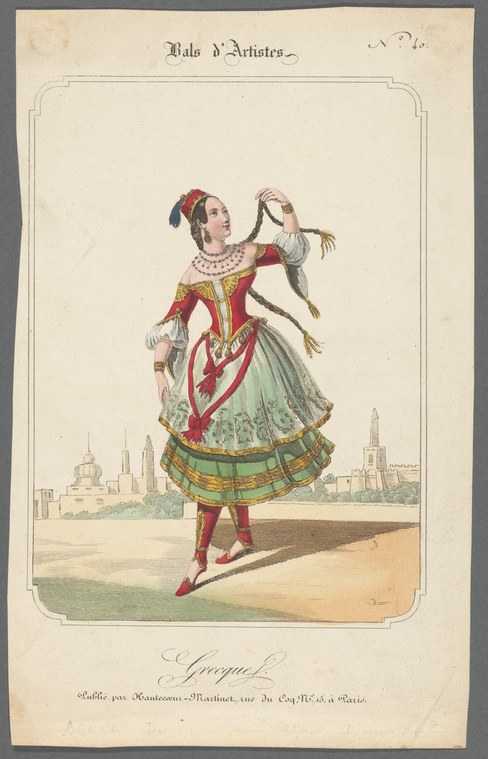
A young woman in elaborate early 19th-century dress stands in a theatrical pose against a cityscape background, holding aloft a small bird—likely a dove or similar creature—in her raised right hand. She wears a striking red silk bodice with gold embroidered trim, a white skirt with a deep green and gold striped border at the hem, and red stockings with red shoes. A red ribbon or headpiece adorns her dark hair. Her body is tilted in a graceful contrapposto, with her left arm extended downward and slightly back, creating an elegant S-curve through the torso. The background shows a classical European city skyline with domed buildings and church spires rendered in soft watercolor tones. The composition is framed within a decorative bordered rectangle, and the overall effect is one of refined theatrical spectacle.
The dancing
The single figure stands in a classical theatrical stance with weight shifted onto the back leg, creating an elegant line from head to foot. The raised arm holding the bird creates an upward vector that the viewer's eye follows; the opposing arm extends in a gentle counterbalance. The posture suggests trained deportment rather than vigorous movement—the body is elongated and posed rather than captured mid-step. The costume and pose together suggest this is a female performer of some status, trained in formal movement practices.
The dance depicted
This is almost certainly a theatrical dance or tableau of the Romantic era, most likely from the 1820s–1840s. The title 'Grecque' (Greek) and the classical pose suggest a work drawing on Greco-Roman aesthetics popular in Romantic ballet and pantomime. The costume is not strict classical dress but rather a theatrical fantasy of classicism rendered in contemporary fabrics and cut. The pose and the raised bird suggest a narrative moment—perhaps a scene of enchantment, courtship, or mythological transformation. Without additional documentation, the specific work cannot be identified, but the aesthetic and technique place it firmly within the world of European theatrical dance of the Romantic period, before the development of pointe-work ballet as the dominant form.
How it was made
This is a hand-colored engraving or print, likely from the 1820s–1840s, executed with considerable finesse. The technique allowed rapid reproduction for circulation among theatre-goers and collectors—these prints were typically sold as souvenirs of popular performances. The hand-coloring (visible in the careful application of watercolor or tinted ink, particularly in the dress and background) indicates this was a higher-quality, more expensive version of what might also have been published in black and white. The quality of the line work and the sophistication of the composition suggest this was made by a professional theatrical print-maker, probably working from a sketch or painting of an actual stage performance.
About this work
This print documents a moment from early Romantic theatrical dance, preserving the image of a female performer in a classical-themed scene. It belongs to the visual archive of theatrical dance in the decades before ballet became codified as a technique centered on pointe-work. The print is both a record of an actual stage aesthetic and a commodity—a souvenir sold to audiences who wanted to remember what they had seen. It demonstrates how dance was circulated and remembered in the pre-photographic era: through prints and engravings that captured a single eloquent moment rather than the flow of movement through time.
How to look at it
Attend to the logic of the pose: the artist has chosen a moment of stillness and grace rather than violent motion. The raised arm and the bird create a narrative focal point—this is not a dance step but a theatrical tableau, frozen in a moment of emotional or narrative significance. Notice how the costume is rendered as fashionable contemporary dress with classical references rather than authentic ancient clothing: this reveals what 'classical' meant in performance of the period. The cityscape background is atmospheric rather than detailed, suggesting the scene is imagined or symbolic rather than historically grounded.
The artist
The print is unattributed. The quality of the line work and the subject matter suggest it was produced by a professional theatrical print-maker working in France or another major European theatrical center in the 1820s–1840s. The publication of such prints was a thriving business, with multiple print-makers specializing in dance and theatre imagery.
The period
This print dates to the height of the Romantic movement in dance and theatre, when classical and exotic themes dominated the stage. Ballet was still a largely pantomimic and dramatic art form; pointe-work existed but was not yet the dominant technical vocabulary. Female performers, often from Italy and France, achieved celebrity status and their images were widely reproduced and collected. The aesthetic prioritized elegance, elongation, and the evocation of classical beauty over acrobatic virtuosity.
Where it lives
This print is held in the New York Public Library's collection of prints depicting dance. It represents the substantial archives of theatrical imagery that major libraries assembled in the 19th and 20th centuries as records of performance.
Dance in this work
Questions about this work
What is the bird in her hand?
Most likely a dove, symbol of love, peace, or the goddess Venus in classical iconography. In Romantic ballet and pantomime, such symbolic props often carried narrative meaning. The precise significance would depend on the specific story or scene this print documents.
Is this based on a real performance?
Almost certainly yes. These prints were typically sold as souvenirs after performances, featuring the actual dancers and costumes audiences had seen. The print documents a specific stage aesthetic, though without more context we cannot identify the exact work or performer.
What does 'Grecque' mean?
'Grecque' is French for 'Greek.' The title signals that this is a classical or Greco-inspired scene, reflecting the Romantic era's fascination with ancient civilization and its use as a setting for theatrical fantasy and spectacle.
Why is the image so refined if the artist is unknown?
Professional theatrical print-makers of the period were highly skilled, even when working anonymously. These prints were luxury goods sold to affluent theatre-goers, so publishers invested in quality of execution. The anonymity of the artist does not reflect lack of skill.
More dance artwork





