49 works in this view — arrow keys or swipe to move between them.
Dance in Art
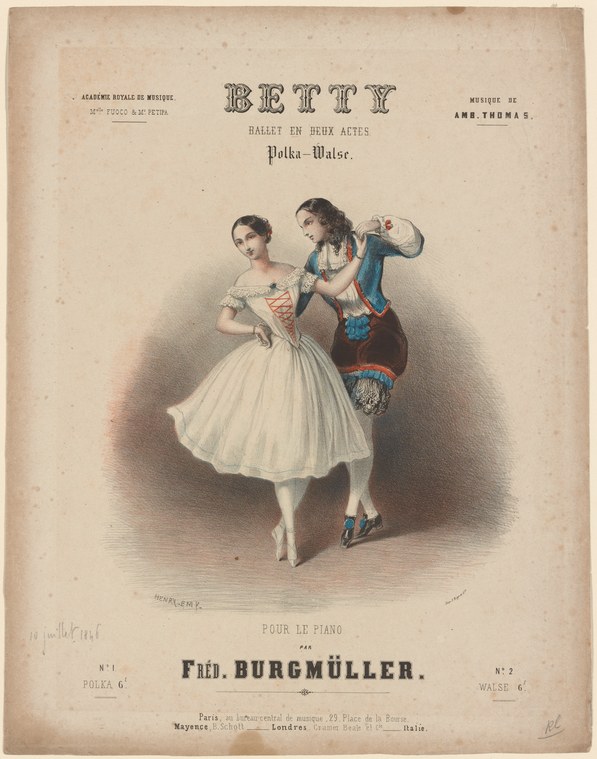
Melle. Fuoco & Mr. Petipa: Betty, ballet en deux actes, polka-walse, Académie royale de musique
Unknown artist
- Collection:
- Prints depicting dance
- Source:
- New York Public Library
- Rights:
- Public domain — free to use, share and adapt.
- Recorded as:
- Public Domain
Marius Petipa's partnership with prima ballerinas like Fuoco was foundational to Romantic ballet in Paris, and this image preserves the visual language of that partnership—the posture, frame, and costume of an era that defined classical ballet technique. The survival of the score and promotional image together reveals how ballet reached audiences beyond the theatre: through domestic music-making, print culture, and the celebrity circulation of major dancers. For historians of dance technology and partnering, this image is direct evidence of how mid-nineteenth-century male and female dancers related physically and aesthetically.
What you are looking at
A woman in a white tulle ballet skirt, corseted bodice with decorative detail, and pink pointe shoes stands en relevé in a pose of elegant stillness. A male dancer in a richly decorated blue jacket with gold embroidery, dark trousers, and a plumed hat catches her from behind in a partnered lift or support, his right arm raised to steady her shoulder. The two figures are rendered against a pale background with subtle shadow work creating depth; the woman's pose is characteristically balletic—lifted, ethereal, turned out—while the man's posture and costume mark him as a male soloist or cavalier of the Romantic era. The composition captures a moment of support and courtship typical of mid-nineteenth-century ballet partnering, where the male dancer's strength enables the female dancer's weightless appearance.
The dancing
The woman stands in a turned-out position with her weight on her left leg en relevé (raised on the ball of the foot), her right leg extended in arabesque or attitude. Her carriage is upright and graceful, with her arms held in classical port de bras. The male dancer is positioned behind and to her left, his right arm raised protectively or supportively at her shoulder, creating the characteristic frame of partnered Romantic ballet. His stance shows a bent-knee support position, knees slightly flexed to anchor the pair. The dynamic is one of male-supported female elevation and ease—the visual language of Romantic-era pas de deux where the ballerina appears weightless and the danseur is her invisible support.
The dance depicted
This is a page from a published piano score for a Romantic-era ballet, *Betty: Ballet en deux actes, polka-walse*, performed at the Académie royale de musique (Paris Opéra) by the celebrated ballerina Mademoiselle Fuoco and the premiere danseur monsieur Petipa. The work combines elements of the polka and waltz in its musical structure, genres that were fashionable in theatrical dance during the 1840s–1850s. The image shows the iconic partnered moment central to Romantic ballet: the male dancer as supporter and enabler of the female dancer's aerial lightness. Petipa and Fuoco were major figures in Romantic ballet, and this score represents the kind of balletic spectacle that dominated the Paris Opéra in this period.
How it was made
This is a hand-colored lithographic print, a reproduction of a theatre poster or promotional engraving for a ballet score published by Imprimerie Michallet (Paris). The technique allowed for wide distribution of dance imagery to opera patrons and music publishers; the color work (particularly the pink of the pointe shoes and the blue and gold of the male costume) was applied by hand after printing, a common practice for theatrical imagery. The lithograph's fine detail and clarity suggest it was produced by professional theatrical printmakers for circulation among subscribers to the Paris Opéra and music collectors. The printed text identifies it as sheet music *pour le piano* (for piano), indicating this was a domestic music publication, allowing amateur pianists to recreate moments from the ballet at home.
About this work
This is a lithographic title page for a piano arrangement of *Betty*, a two-act Romantic ballet premiered at the Paris Opéra, featuring the legendary ballerina Mademoiselle Fuoco and premier danseur Marius Petipa. The print captures the visual language of 1840s–1850s Romantic ballet: a corseted female dancer in pointe shoes supported by a richly costumed male partner, frozen in a moment of partnered grace. As a commercial theatrical print distributed through music publishers and opera subscription channels, it documents both the artistic content of a major ballet and the mechanisms by which dance imagery reached the educated urban public of Second Empire France. The work sits at the intersection of dance history, music history, and the commercial culture of mid-nineteenth-century Paris.
How to look at it
Attend to the moment chosen: the male dancer has already caught the female dancer mid-lift, so the image captures not the ascent but the suspension—the moment where her weight is fully supported and she can extend her line. Notice how the lithographer has rendered the woman's pointe shoes in pink and the tulle of her skirt with fine linear work, creating the impression of delicate elevation, while the man's feet and knees are grounded, his musculature implied through the line of his leg and the richness of his costume. The composition follows a Romantic-era convention: the ballerina is the visual focus, ethereal and weightless, while the male dancer is present but subordinate, his art consisting of invisible support. The hand-coloring of the lithograph—the blue coat, the gold embroidery, the pink shoes—was essential to the appeal of such prints; color signaled luxury and theatrical spectacle.
The artist
The print is credited to the Paris music publishing firm Michallet and the Académie royale de musique. The imagery was likely produced by a professional theatrical engraver or lithographer working for the opera house, whose name is not recorded in the inscription. Such promotional prints were standard practice at the Paris Opéra, created to advertise premieres and boost sales of published scores. The quality and finish suggest the work of an experienced printmaker familiar with theatrical costume and ballet anatomy.
The period
This work dates to the height of the Romantic ballet era in France, approximately the 1840s–1850s. The Paris Opéra was the cultural centre of European ballet; major dancers like Carlotta Grisi, Marie Taglioni, and Fanny Elssler dominated the repertoire. Marius Petipa, then a young premier danseur at the Opéra, would later become the defining choreographer of Russian Imperial ballet. The prevalence of polka and waltz in theatrical music reflects the popularity of these social dances, which were adapted for the ballet stage. Published piano scores of ballet music were a major commercial product, allowing the educated middle class to engage with operatic culture in their salons. This image is a window into how Romantic ballet—with its emphasis on female ethereality, male strength, and exotic or contemporary subject matter—was marketed and consumed.
Where it lives
This object is a page from a sheet music publication held by the New York Public Library in its collection of prints depicting dance. It is a commercial theatrical product, not a unique artwork, but one of many copies distributed through music sellers and opera subscription networks in Paris. The survival of the colored lithograph reflects its status as both an aesthetic and commercial product—beautiful enough to frame or keep in an album, but fundamentally designed for circulation and use.
Dance in this work
Questions about this work
Who were Fuoco and Petipa?
Mademoiselle Fuoco (Maria Felicita Boccherini) was an Italian-born prima ballerina who danced at the Paris Opéra in the 1830s–1840s, celebrated for her technical virtuosity and dramatic presence. Marius Petipa was a French premier danseur who later became the dominant choreographer of the Russian Imperial Ballet. Their partnership at the Paris Opéra represented the international prestige of that institution and the celebrity culture of Romantic ballet.
What is a polka-walse?
A polka-walse is a hybrid musical form combining rhythmic elements of both the polka (a lively Central European dance in duple time) and the waltz (a three-beat ballroom dance). In mid-nineteenth-century theatrical music, such hybrids were fashionable, allowing composers to blend contemporary social dance styles for popular appeal. For ballet, they provided rhythmic variety within a single act.
Why is the male dancer in such rich costume while the female dancer wears pointe shoes and a tutu?
This reflects the aesthetic priorities of Romantic ballet: the ballerina in her ethereal, weightless form was the primary visual object, often costumed as a spirit, ghost, or otherworldly being. The male dancer, though technically proficient, was dressed in character—as a nobleman, prince, or traveller—and his role was to support and frame the ballerina's line. The hierarchy is visual and conceptual: male strength enables female transcendence.
More dance artwork





