49 works in this view — arrow keys or swipe to move between them.
Dance in Art
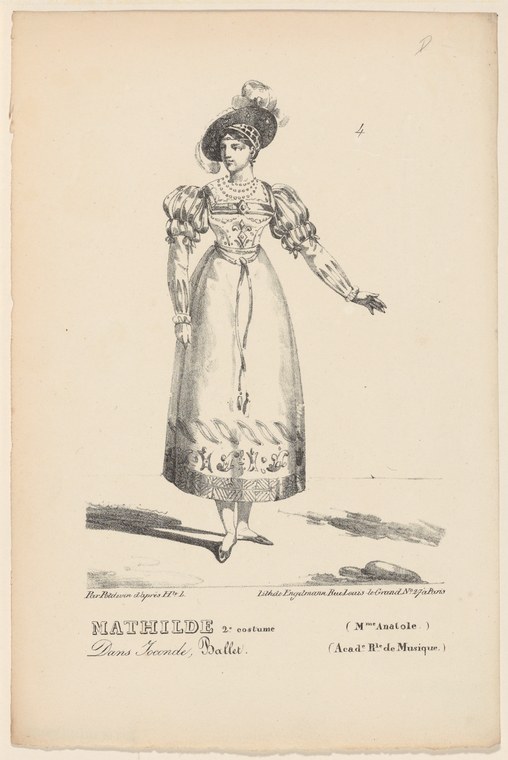
Mathilde 2e costume (Mme Anatole) dans Goconde, ballet (Acade. Rle. de musique)
Unknown artist
- Collection:
- Prints depicting dance
- Source:
- New York Public Library
- Rights:
- Public domain — free to use, share and adapt.
- Recorded as:
- Public Domain
This is authentic documentation of 19th-century ballet costuming and theatrical practice at the highest level—the Paris Opéra—rendered by professional engravers for public circulation. It shows what audiences saw and how dancers were dressed, and it preserves the visual memory of roles that would otherwise be known only through text and dance notation. For historians of costume, stage design, and the visual culture of ballet, this record is invaluable evidence of period practice and audience expectations.
What you are looking at
A single female figure stands in frontal pose against a plain background, wearing an elaborate early 19th-century costume. The dress is a high-waisted gown with puffed sleeves typical of the Regency or early Romantic period, decorated with ornamental embroidery or patterning at the hem. She wears a headdress adorned with feathers or plumes rising above her hair, which is styled up in the fashion of the period. Her right arm extends gracefully at her side with an open hand in an elegant gesture; her left arm hangs naturally. Her posture is upright and dignified. The figure is rendered in a fine engraving technique with careful cross-hatching for shading, against an unadorned background. Below the figure are scattered sketch marks suggesting study or notes. At the foot of the image, text in French identifies the figure and role.
The dancing
The single figure stands in a classic three-quarter frontal stance with weight evenly distributed. Her torso is held erect and composed; her arms are positioned with apparent ease, the raised right arm extended in an elegant open gesture characteristic of formal theatrical posture. Her stance suggests repose or a formal presentation rather than mid-movement, though the raised arm and slight asymmetry of pose suggest preparation for or between actions. There is no visible partnering or interaction with other dancers, and no clear indication of active footwork.
The dance depicted
This appears to be a costume study for a named theatrical role—Mathilde in the second act costume from the ballet Gioconda, performed at the Académie Royale de Musique (the Paris Opéra). The ballet Gioconda was choreographed to music by Ponchielli and premiered in 1883; however, the dress style depicted here suggests an earlier French Romantic ballet tradition, and the engraving technique points to documentation from the 19th-century theatrical world. The figure is presented as a costume plate—a formal documentation of theatrical dress for a named role rather than a capture of choreographic movement. Without visible pointe work, specific partnering, or mid-movement freezing, the image functions as costume documentation rather than evidence of a particular dance technique or style.
How it was made
This is an engraving executed with fine parallel hatching and cross-hatching to model form and fabric. The technique allows precise rendering of costume detail—the texture of the puffed sleeves, the patterning at the hem, the ornament of the headdress—with a clarity suited to theatrical documentation and costume reference. The engraving's refinement and the presence of text identifying the figure and work suggest publication as a theatrical souvenir or costume record, likely distributed among the opera-going public or within the theatre itself to document notable roles and performers. The format and execution place this squarely in the 19th-century tradition of theatrical ephemera and costume documentation.
About this work
This is a costume study for a named role in a 19th-century French ballet, executed as an engraving and presumably issued as part of the documentation and publicity surrounding performances at the Paris Opéra. It documents the visual presentation—dress, ornament, posture, and bearing—of a character or scene from the ballet Gioconda. It belongs in a gallery of dance in art as a primary-source record of how dance roles were visually constructed and presented to audiences, and as evidence of the theatrical infrastructure that surrounded ballet performance in the 19th century. The image testifies to the importance of costume design, the visual spectacle of the stage, and the way theatrical roles were marketed and remembered by audiences.
How to look at it
Attend to the precision of the costume rendering—the texture and structure of the puffed sleeves, the ornamental patterning at the hem, the elaborate headdress—which demonstrates the engraver's skill and the importance of visual spectacle in Romantic ballet. Note the formal, frontal presentation of the figure and the elegance of her arm gesture, which convey the dignity and composure expected of a prima ballerina and the refined aesthetic of Romantic ballet. The engraving documents a moment of formal presentation rather than choreographic action; it is a costume portrait, not a dance scene, and its value lies in its precision as a historical record of how the role was dressed and presented.
The period
This engraving dates to the height of the Romantic ballet era in France, when the Paris Opéra was the center of European dance innovation and prestige. Gioconda itself (with a libretto by Amédée Burion and choreography by Charles Nuitter and Jules Perrot or Joseph Hansen, choreographed to Amilcare Ponchielli's opera of 1883) occupied a particular position in this tradition—part of a succession of narrative ballets built on literary and dramatic sources. The costume depicted here—with its high waist, puffed sleeves, and Regency-period styling—suggests a historical setting within the ballet's narrative and reflects the Romantic era's fascination with historical costume and exotic or period settings. Theatrical engraving of this kind was a standard form of publicity and documentation, circulating among patrons and the public to preserve the memory of notable performances and roles.
Where it lives
This engraving is part of the New York Public Library's collection of prints depicting dance. The catalogue identifies it as a costume study from the Paris Opéra (Académie Royale de Musique), suggesting it was part of the printed documentation and publicity materials surrounding theatrical performances.
Dance in this work
Questions about this work
What is Mathilde's role in Gioconda?
The catalogue record does not specify Mathilde's dramatic function within the ballet. Ballet libretti from this period typically named multiple female roles; without access to the full cast list or choreographic record, her position in the narrative cannot be determined from the image alone.
Why is she dressed in Regency-style clothing?
The costume suggests a historical or exotic setting within the ballet's narrative. Romantic-era ballets frequently adopted historical or period dress to create atmosphere and narrative context, even when the ballet itself was contemporary. This reflects the era's fascination with historical spectacle.
Is this a photograph or a drawing?
This is an engraving—a print made from an etched metal plate. You can identify it by the fine parallel lines (hatching) used to create shadow and model the form of the dress and figure. Engravings were the standard medium for theatrical documentation and costume reference in the 19th century.
Can you see her dancing in this image?
No. This is a costume study documenting how the role was dressed for performance. The figure is presented in a formal, posed stance rather than captured mid-movement. Its purpose was to record and publicize the visual spectacle of the role, not to document choreographic technique.
More dance artwork





