49 works in this view — arrow keys or swipe to move between them.
Dance in Art
Arlésienne
Unknown artist
- Collection:
- Prints depicting dance
- Source:
- New York Public Library
- Rights:
- Public domain — free to use, share and adapt.
- Recorded as:
- Public Domain
This print is a primary document of how Romantic ballet was consumed and circulated outside the theater. It shows that the audience for dance extended far beyond those who could afford tickets; these prints shaped how dance was understood by the broader public and influenced the way dancers presented themselves and were marketed. The genre of the hand-colored theatrical portrait is now largely forgotten but was once the dominant visual medium for dance culture.
What you are looking at
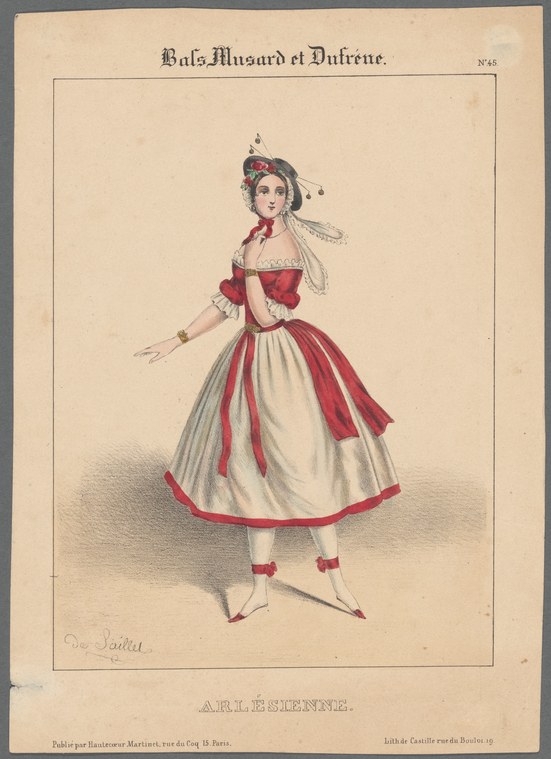
A young woman in theatrical costume stands alone against a plain background, posed in a moment of arrested motion. She wears a white muslin skirt with dramatic red trim along the hem and a red silk shawl or fichu draped across her shoulders, leaving them bare. Her dark hair is styled up and adorned with feathers or plumes. The figure stands with weight shifted to one leg, the other extended, creating a sense of suspended action; her right arm hangs relaxed while her left gestures outward with open hand. Red silk ribbons or ties adorn her legs at the ankles. The pose suggests a moment between steps—not the apex of a jump but the fluid transition of a trained dancer moving through space. The hand-colored engraving technique renders fabrics with delicate shading, the white of the skirt luminous against the pale ground.
The dancing
A single figure in a three-quarter stance with free-leg extension suggests the balletic vocabulary of the nineteenth-century stage. The dancer's torso is upright, shoulders squared but soft; her supporting leg is straight and engaged. The extended leg is neither fully pointed nor relaxed, but held in a natural line at roughly hip height. Her arms are asymmetrical—the lower arm open and presented, the upper relaxed—a compositional choice that suggests either a specific choreographic position or a moment of transition between movements. The head is turned toward the viewer with a composed, direct gaze. There is no partner and no visible floor, which emphasizes the dancer's solitary, statuesque quality.
The dance depicted
This is a theatrical solo, most likely from the Romantic ballet tradition of mid-nineteenth-century Europe. The costume—the white skirt, the red accent pieces, the feathered headdress—suggests a character role rather than a corps uniform, and the pose reflects the balletic style in which characters were presented in isolation for the print market. The title 'Arlésienne' (the woman from Arles) suggests a regional or character identity, possibly drawn from dramatic or operatic sources. Without a specific ballet attribution or date, this cannot be pinned to a single work, but the visual language belongs decisively to the era of Romantic ballet as it was mediated through popular prints and souvenirs.
How it was made
This is a hand-colored engraving or lithograph, a reproductive print that was mass-produced and sold to a broad public market. The delicate color work—the subtle shading on the fabrics, the rosy complexion, the careful articulation of the feathers—is applied by hand after the print was struck, which accounts for the luminous but somewhat flat quality of the palette. The technique was economical and efficient enough to make theatrical portraiture affordable to middle-class audiences; the print allowed viewers who could not attend the Opéra or other theaters to own an image of a fashionable dancer or a famous role. The publication mark at the bottom ('Buls, Musard et Dufrene') identifies this as a commercial theatrical print from a Parisian publisher active in the nineteenth century.
About this work
This is a theatrical character portrait from the Romantic ballet era, presented through the medium of hand-colored theatrical engraving. The figure embodies the conventions of mid-nineteenth-century ballet presentation: the idealized female body in a moment of suspended grace, the picturesque regional costume, the direct address to the viewer. It belongs to a vast corpus of similar prints that circulated through European cities, making the spectacle of the theater available in domestic and commercial spaces. The work is neither a documentation of an actual performance nor a narrative scene, but rather a type of idealized portraiture—the crystallization of a role or a dancer into a single, composable image.
How to look at it
Observe the precise moment the artist chose to arrest: not a pose of maximum extension or drama, but a quiet moment of transition, with one leg extended and the dancer's weight settled. This reflects a fundamental principle of Romantic ballet portraiture—the dancer should appear natural, graceful, and effortless rather than contorted or strained. Notice how the red accents (the hem, the shawl, the ankle ribbons) create a visual frame within the white skirt, guiding the eye to the line of the body. The blank background is not an artistic limitation but a convention: it isolates the figure as a pure object of contemplation, free from narrative or context. The directness of the gaze is crucial—this is a portrait as much as a dance image, asking the viewer to look directly at the performer.
The artist
The artist is not recorded in the catalogue. The engraving is attributed to the publisher Buls, Musard et Dufrene, a Paris-based firm that specialized in theatrical prints and character portraits. These firms employed staff engravers and hand-colorists rather than producing works by named fine artists; the prints were understood as commercial commodities rather than unique artistic statements. The style is consistent with hundreds of similar prints produced in Paris between approximately 1830 and 1870.
The period
This print emerges from the height of Romantic ballet in Europe (roughly 1830–1860), when the ballet d'action and the cult of the ballerina were at their zenith. Paris was the capital of ballet culture, and prints distributed the aesthetics of the Parisian stage across Europe and beyond. The hand-colored theatrical print was the primary visual medium for dance during this era—before photography became standard and before color lithography and chromolithography rendered hand coloring obsolete. The subject matter (a woman in picturesque national or regional dress) reflects the era's fascination with exoticism and local color, themes that appeared constantly in ballet plots and in the character roles danced between acts. The Arlésienne costume invokes the south of France, a subject that had been treated in paintings and prints since the early nineteenth century and would later inspire Bizet's operatic intermezzo.
Where it lives
This print is held in the New York Public Library's collection of prints depicting dance. It is one of thousands of similar theatrical prints that were produced commercially in the nineteenth century and have survived in archives and libraries. Many such prints are unattributed and undated; this one is identifiable only by its title and the publisher's mark.
Dance in this work
Questions about this work
Is this a famous dancer or a famous role?
Almost certainly we cannot know. The print was produced as a commercial product, and without additional documentation it is impossible to determine whether it depicts an actual performance, a famous ballerina in a famous role, or simply a stock character pose that could be titled and sold to a general market. The title 'Arlésienne' might refer to a specific ballet, a dramatic scene, or simply a type of character costume.
What does the costume tell us?
The white skirt, the feathered headdress, the red trim, and the silk shawl are all conventions of Romantic ballet's treatment of regional or 'exotic' characters. By the 1840s and 1850s, audiences expected such characters to appear in picturesque folk costume rather than in the uniform white tulle worn by supernatural beings or sylphs. The Arlésienne—a woman from Provence—would have been understood as a local, earthly, sensual character rather than an ethereal one.
Why was she posed alone?
The theatrical print served a function analogous to the modern publicity photograph or film still. Dancers and roles were marketed to the public through these images, which circulated as souvenirs, collectibles, and advertisements. A solo portrait was the standard format, as it emphasized the individual performer and made the image easier to compose, color, and distribute.
What is the difference between this and a painting?
This is an engraving (or lithograph) that was hand-colored after printing. It was therefore reproducible and affordable in a way that a unique oil painting could never be. Hundreds or thousands of impressions of this design could be printed and colored, making it possible for middle-class households to own dance imagery. The technique also meant that the 'original' was a process, not a single object—the engraved plate could produce many versions.
More dance artwork





