49 works in this view — arrow keys or swipe to move between them.
Dance in Art
Cameriste
Unknown artist
- Collection:
- Prints depicting dance
- Source:
- New York Public Library
- Rights:
- Public domain — free to use, share and adapt.
- Recorded as:
- Public Domain
This work shows how theatrical dance in the 19th century was inseparable from character comedy and pantomime: not pure movement, but embodied social type. For historians of dance in popular theatre, commedia dell'arte, and the development of vaudeville, such character portraits are primary evidence of how bodies were moved, dressed, and presented for paying audiences.
What you are looking at
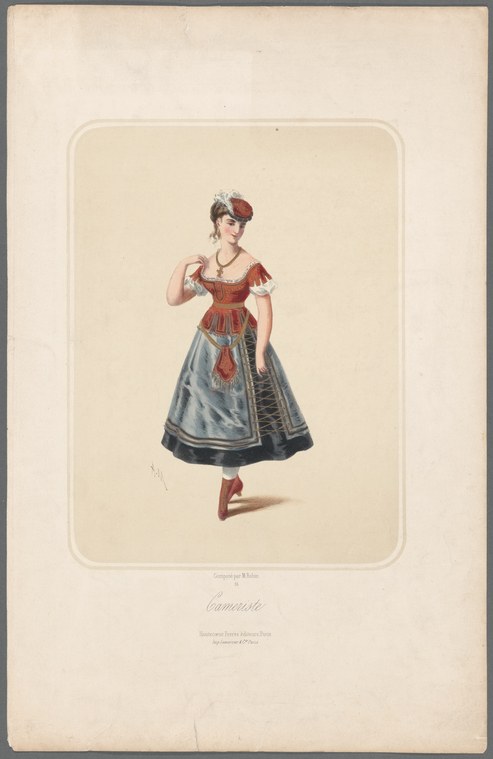
A single young woman stands in three-quarter view against a plain cream ground, posed as if caught mid-movement. She wears a red silk bodice with short off-shoulder sleeves and a deep décolletage, paired with a full skirt of blue-grey silk that reaches mid-calf, trimmed with black braid at the hem. A red fabric—possibly a shawl or decorative element—drapes from her dark hair, which is arranged in the period style. Her right arm is raised and bent, hand near her shoulder in a gesture of liveliness or flirtation; her left arm hangs at her side. She stands with her weight shifted, one leg bearing the load while the other appears ready to step. Her feet are in red shoes. The composition is a single figure against emptiness: this is a character portrait, a representation of a type or a named role rather than a scene of social dancing. The hand-coloured print is framed with a thin ruled border in cream.
The dancing
The figure's pose conveys ease and readiness rather than fixed formal position. The raised right arm, bent at the elbow with a relaxed hand, suggests a moment of conversational animation or a preparatory gesture rather than the rigid frame of courtly dance. The slight shift of weight and the forward tilt of the torso imply walking or stepping motion. The figure stands alone, isolated for presentation, which constrains what can be read about partnered hold or formation.
The dance depicted
The title and dress suggest this is a character from the commedia dell'arte or light theatrical tradition—*cameriste* refers to a chambermaid or lady's maid character. The pose and costume evoke the theatrical dances and movements of 19th-century popular comedy and pantomime rather than classical ballet. The figure is not en pointe and shows no sign of the turned-out legs or lifted frame of ballet; the gesture is colloquial and naturalistic. This is likely a representation of stage movement for a comic or domestic role, set against the broader contexts of Italian or European musical theatre.
How it was made
This is a hand-coloured engraving or lithograph from the 19th century, as indicated by the precise line work, the thin ruled border, the delicate cross-hatching used for modelling, and the subtle hand application of colour. The technique allows for careful characterization of fabric texture—the silk of the bodice is rendered with precise highlights; the striped or checked pattern of the skirt is evoked through parallel lines. The isolation of the figure against blank ground is characteristic of theatrical character prints, a format that allowed for wide distribution and collection. The hand-colouring, applied after printing, suggests this is a mid-to-upper-market print: expensive enough to be coloured but not a unique work.
About this work
This is a theatrical character portrait of a chambermaid figure from 19th-century European comedy, presented as an isolated figure study in the format of the period's theatrical print trade. The work documents not a dance as such but the gestural vocabulary and costuming of a stage character type—the animated, flirtatious servant who was a stock figure in pantomime and light musical theatre. As such, it sits at the intersection of dance history and theatre history, recording how bodies moved and were dressed in popular entertainment contexts before dance became codified as a separate discipline. The print preserves evidence of the physical types, costume conventions, and gestural repertoires that informed theatrical dance in the 19th century.
How to look at it
Notice the specificity of the gesture: the raised arm is not a dance position but a conversational or behavioral one, suggesting animated speech or flirtation. The weight shift and the forward tilt of the torso indicate that the figure is about to move or has just stepped—this is a moment in continuous action, not a held pose. The artist chose to present the figure not in a formal frame or architectural setting but isolated, allowing full attention to the costuming and bodily demeanor that signified the character. The crossed lines and hatching used to render fabric are worth attending to: they convey the texture of stage costume, the materials that would be visible under theatrical light.
The artist
The artist is not recorded in the catalogue. The inscription 'Compagni de Milan' (or similar) may refer to a publisher or printing firm rather than the artist. This is typical of theatrical character prints of the period, which were produced in quantity by workshops and publishing houses; individual artists often remain unattributed or are known only by monograms.
The period
This work dates from the era when theatrical character prints were a major popular medium—roughly 1840–1880—and when commedia dell'arte characters and types remained vivid in European theatrical imagination, particularly in Italy, France, and central Europe. The costume and pose reflect the conventions of mid-19th-century stage dress for comic or domestic roles. This was also the period when theatrical dance was separating from comedy pantomime: the same theatres and publishers that produced character prints like this were also beginning to market and define ballet as a distinct art form. The isolated figure portrait format derives from earlier tradition of actors' prints but evolved to serve the market for theatrical souvenirs and reference images.
Where it lives
This print is held in the NYPL's *Prints depicting dance* collection, a thematic assemblage of theatrical and social dance imagery rather than a single acquisition or archive. Such prints were collected as records of theatrical practice and as visual ephemera of popular entertainment.
Dance in this work
Questions about this work
What is a cameriste?
In commedia dell'arte and 19th-century European theatre, a cameriste or cameriera is a chambermaid or lady's maid—a stock comic character, typically young, witty, and flirtatious, who served as a foil to the main action. The role allowed for physical comedy, animated gesture, and audience connection. This print captures how such a character was costumed and how the actress moved within it.
Is this a ballet?
No. This is a character from popular theatre or pantomime, not classical ballet. The pose, the lack of turned-out legs or pointe work, and the naturalistic gesture all distinguish it from ballet technique. The figure represents a type of movement and deportment suited to comic domestic roles in musical theatre or pantomime.
Who made this print?
The artist is not recorded in the catalogue. The inscription suggests it may have been published in Milan, and it was likely produced by a theatrical print workshop or publishing house as part of a series. Individual artists often went uncredited in this work; what matters is the printing house's reputation for quality and circulation.
Why is she posed like that?
The pose conveys character: the raised arm and forward weight suggest liveliness, readiness, and social ease—the qualities that made the chambermaid character appealing and comedic. The artist has frozen a moment of casual movement rather than a formal position, to show the figure as audiences would see her on stage, engaged in action or speech.
More dance artwork





