49 works in this view — arrow keys or swipe to move between them.
Dance in Art
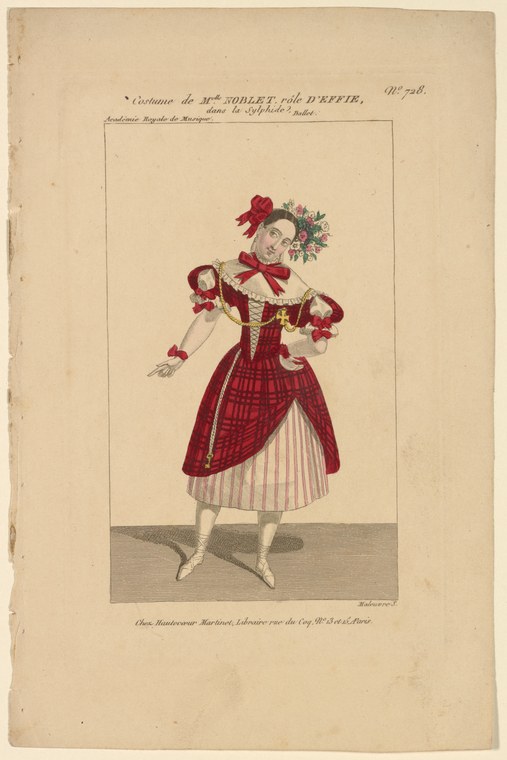
Costume de Melle Noblet, rôle d'Effie, dans La sylphide. Ballet. Academie Royale de Musique
Unknown artist
- Collection:
- Prints depicting dance
- Source:
- New York Public Library
- Rights:
- Public domain — free to use, share and adapt.
- Recorded as:
- Public Domain
La Sylphide is the oldest ballet still regularly performed in its original form, and this print documents the role and technique from its moment of creation. For historians and dancers, it is primary evidence of how the Romantic female body was shaped, dressed, and presented on stage—the visual foundation for all subsequent ballet aesthetics. Noblet was a principal dancer of the Paris Opéra during the most transformative decade in ballet history, and images like this are rare windows into the actual practice and costume of that watershed period.
What you are looking at
A young female dancer in Romantic-era theatrical costume stands in a posed attitude against a plain ground. She wears a crimson velvet bodice with white puffed sleeves tied with red ribbons, and a white pleated skirt that falls to mid-calf—the silhouette characteristic of 1830s ballet. Her hair is crowned with flowers and ribbons. She holds a small bouquet or garland in one hand while adopting a graceful, elongated pose with her weight shifted onto one leg; the other leg extends slightly behind. Her posture is upright and refined, the body composed in the balletic alignment of the period. The figure is rendered in hand-colored engraving or aquatint, with careful attention to the texture of fabrics and the pale modeling of skin against the neutral background. The inscription at top identifies her as Mlle Noblet in the role of Effie from La Sylphide.
The dancing
A single female figure stands in a classical balletic pose suggesting a moment of repose or display rather than active movement. The weight rests on one leg in a near-vertical line, while the other leg is softly pointed and held behind in what appears to be an attitude or arabesque preparation. The arms are held at mid-height with gentle curves, one presenting the flowers; the upper body is erect with shoulders drawn back. The pose emphasizes verticality and elongation—the hallmark of Romantic ballet technique—rather than the turned-out flexibility of later classical vocabulary.
The dance depicted
This is a costume study for La Sylphide, the foundational work of Romantic ballet, premiered at the Académie Royale de Musique (Paris Opéra) in 1832 with choreography by Philippe Taglioni. The work revolutionized ballet by introducing the supernatural sylph and the pointe shoe as standard technique. Noblet danced the role of Effie, the mortal bride-to-be, whose costume shown here—the fitted bodice, white skirt, and floral crown—reflects the ballet's fusion of folk-inspired earthly dress with Romantic idealization. The pose conveys the refined, weightless aesthetic that defined the era's visual language for female dancers.
How it was made
This is a hand-colored engraving or aquatint, a reproductive print technique that allowed wide circulation of costume documentation in the nineteenth-century theater world. The use of fine line engraving for the figure's outline, combined with aquatint tonal shading for the skirt and ground, creates a hybrid technique suited to theatrical publicity. Such prints were inexpensive to produce and reproduce, making them the standard medium for disseminating images of celebrated dancers and roles across Paris, London, and beyond. The coloring—applied by hand after printing—shows the care taken to render the precise crimson of the bodice and the delicate pleating of the skirt.
About this work
This is a costume study commemorating Marie Noblet's performance as Effie in La Sylphide, the 1832 Paris Opéra premiere that established Romantic ballet as a distinct theatrical form. The print documents not only the historical costume but also the body ideal of the era: elongated, weightless, posed with balletic refinement. As a theatrical souvenir and publicity image, it circulated among the dance-literate public—subscribers to the Opéra, aficionados who followed the stars, and practitioners studying the new vocabulary of Romantic technique. The image preserves a crucial moment in ballet history, when the pointe shoe, the supernatural narrative, and the ethereal female dancer became the genre's defining elements.
How to look at it
The pose is not a moment of dynamic movement but a formal presentational attitude—the dancer displaying the role for the print-buying public much as she would acknowledge applause or be presented in a curtain call. Notice the deliberate elongation: the line from hip through the extended leg, the graceful curve of the supporting side, the restrained arm positions that avoid crossing the body's centerline. The flowers and ribbons, though decorative, are part of the role's meaning—they mark Effie as a peasant bride, earthbound and innocent, distinct from the ethereal Sylphide herself. The engraving's fine line work emphasizes the delicate precision of the costume while the soft aquatint tones model the body's three-dimensionality against the flat ground.
The artist
The artist is not recorded. The print bears the mark of a professional theater print publisher working in Paris during the 1830s, when such costume studies were a standard commercial product of the Opéra publishing circuit. The composition and hand-coloring conventions are consistent with the output of Paris theaters' official publishers, who sold these prints to subscribers and tourists as souvenirs and as study materials for dancers.
The period
La Sylphide (1832) arrived at the peak of European Romanticism, when ballet was being reframed as a vehicle for the supernatural and for the idealization of the female body. The previous decade had seen the rise of pointe work and the refinement of turnout and elongation as technical ideals. Simultaneously, in visual culture and literature, the ethereal, unattainable female figure—whether sylph, spirit, or dreaming maiden—became the central Romantic icon. Theater prints like this one were not high art but mass-produced images that shaped how the public encountered and understood dance; they were displayed in print shops, purchased by opera subscribers, and used by dancers as reference materials for costume and deportment.
Where it lives
The print is held by the New York Public Library's Dance Collection, a major repository of dance documentation and imagery. It belongs to a large holdings of theatrical prints from the Paris Opéra and European theaters of the 19th century, many of them originally published and hand-colored for sale to subscribers and the opera-going public.
Dance in this work
Questions about this work
Who was Marie Noblet and why is she important?
Marie Noblet was a principal dancer of the Paris Opéra during the 1830s and participated in the premiere of La Sylphide (1832), one of the two most important ballets in the repertory. She originated the role of Effie, the mortal bride, in Taglioni's revolutionary work. While Taglioni herself danced the Sylphide, Noblet's Effie was equally important to the drama and provided the grounded human perspective to the supernatural action.
What is La Sylphide and why does it matter?
La Sylphide (1832) is the oldest ballet still regularly performed in something close to its original form and the foundational work of Romantic ballet. It introduced the supernatural narrative (a mortal man falls in love with a ghostly sylph), established pointe work as standard technique for female dancers, and created the visual and narrative template for Romantic ballet that persisted through the century. It is still performed and studied because it works—the choreography and music create a complete aesthetic world.
How were dancers documented before photography?
Theater prints like this were the primary means of documenting and publicizing dancers before photography became practical in the 1860s. These costume studies and performance scenes were made by professional engravers, hand-colored, and sold as souvenirs to opera subscribers and the general public. They circulated among dancers as reference materials and shaped how the wider public knew and imagined dance. They were affordable, reproducible, and portable—the mass media of theater in the 1830s.
What does the pose tell us about Romantic ballet technique?
The elongated vertical line, the lifted carriage, the softly pointed working leg, and the restrained arm positions all reflect the core values of Romantic-era ballet: verticality, weightlessness, turnout, and a graceful reserve that avoided abrupt or angular movement. The pose is not a dynamic step but a presentation of the ideal body—elongated, refined, and seemingly weightless despite standing on the ground. This aesthetic shaped ballet training and performance for generations.
More dance artwork





