49 works in this view — arrow keys or swipe to move between them.
Dance in Art
Papillon
Unknown artist
- Collection:
- Prints depicting dance
- Source:
- New York Public Library
- Rights:
- Public domain — free to use, share and adapt.
- Recorded as:
- Public Domain
This print preserves a moment in the pre-photographic history of theatrical dance performance, showing how fantasy characters and specialty dances were costumed and promoted in mid-19th-century Europe. The title and costume conventions offer insight into the taste for natural and fantastical subject matter in Romantic-era dance programming. As part of a genre of commercial theatrical portraiture, it documents the infrastructure by which dance performance reached audiences beyond the theater itself.
What you are looking at
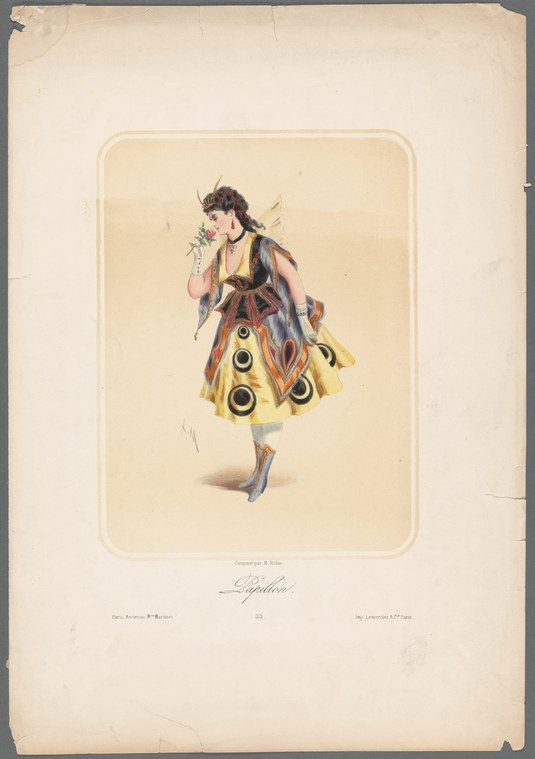
A single dancer occupies the center of this hand-colored print, posed in a moment of theatrical stillness against a plain cream background. The figure stands in three-quarter view, weight shifted slightly forward, wearing a striking costume: a dark corseted bodice with off-shoulder sleeves, and a voluminous skirt of brilliant yellow silk decorated with large circular motifs in dark red and gold. The dancer holds a delicate floral garland or wreath to her face with one hand, while the other arm hangs at her side. Her dark hair is styled elaborately upswept, and her posture suggests both grace and a certain statuesque quality. The print is framed within a simple rounded-corner border, and the inscription below reads "Papillon" (Butterfly), with publication information suggesting a mid-19th-century European origin.
The dancing
The single figure stands in an upright, nearly frontal stance with minimal weight shift, suggesting the formal presentation conventions of theatrical portraiture rather than the capture of active movement. The raised arm holding the floral crown and the position of the body create a gentle asymmetry. The costume—particularly the expansive skirt—appears designed for rotational or spinning movement, though the chosen moment freezes the dancer in a posed moment rather than mid-action. The dancer's frame is open and the posture is one of display rather than active propulsion.
The dance depicted
This is most likely a character or specialty dance from the Romantic ballet era, possibly a divertissement or solo performed during an operatic or theatrical production. The title "Papillon" (Butterfly) suggests a naturalistic or fantastical character typical of mid-19th-century ballet programming. The costume—particularly the architectural skirt with its bold circular ornaments—points to a theatrical fantasy dance rather than a classical academic ballet. Such dances were often performed by principal dancers in mixed theatrical programs, combining elements of pantomime, character interpretation, and formal dance technique. Without further documentation, the exact choreography cannot be determined, but the presentation style is consistent with the commercial dance imagery of the 1840s–1860s.
How it was made
This is a hand-colored engraving or lithograph, likely produced as a commercial theatrical souvenir or promotional print. The delicate line work, the careful modeling of the figure, and the precision of the decorative border all suggest professional engraving. The hand coloring—particularly the vivid yellows, reds, and golds of the skirt—was applied after printing, a labor-intensive but economical method for producing colored theatrical imagery in quantity. This technique was standard for mid-19th-century European dance portraiture and indicates a work intended for circulation among theater-goers, dance enthusiasts, and performers. Such prints were affordable and collectible, making them among the primary visual records of commercial dance performance from this period.
About this work
This is a hand-colored theatrical print of a dancer identified only as performing "Papillon," likely a character or specialty dance from a mid-19th-century European ballet or theatrical program. The print captures a single posed moment rather than choreographic action, following the conventions of commercial dance portraiture of the era. The figure's striking costume—particularly the voluminous yellow skirt with bold circular ornaments—and the fantastical floral crown suggest a Romantic-era fantasy character, the type regularly programmed alongside classical ballet in mixed theatrical evenings. The work belongs to a large category of promotional and commemorative prints that constitute the primary visual record of 19th-century theatrical dance before photography became the dominant medium.
How to look at it
The artist has chosen a moment of formal presentation rather than active choreography—the dancer is posed, not caught mid-movement. Note the architectural quality of the skirt and the precision of its ornament, which suggests costumes designed for visual impact and rotation. The upright, open posture and the carefully arranged arm position reflect the 19th-century ballet convention of the formal portrait, in which the dancer's beauty and refinement were demonstrated through still grace rather than dynamic action. The floral crown and delicate features emphasize the Romantic taste for femininity and lightness, even when the character represented was an insect or creature of fantasy.
The period
This print dates to the height of the Romantic ballet era in Europe, roughly 1840–1860, when productions increasingly featured solo character dances and fantastical scenarios alongside classical academic ballet. The taste for nature-inspired characters—sylphs, sprites, flowers, insects—was a defining feature of Romantic aesthetics. Such dances were often inserted into longer theatrical programs (opera-ballets, ballet-pantomimes, or ballet divertissements) to showcase individual dancers and provide variety. Hand-colored theatrical prints were a primary means of promoting performances and preserving the memory of celebrated dancers and roles; their production represents a significant commercial infrastructure around theatrical dance performance.
Where it lives
This print is held by the New York Public Library in its collection of prints depicting dance. The print carries publication information indicating mid-19th-century European production, though the specific publisher, printer, and date are not currently recorded in detail.
Dance in this work
Questions about this work
Who danced Papillon?
The dancer's identity is not recorded in the current catalogue entry. Such prints often named the character but not the performer, or vice versa. Further research in 19th-century theater records, playbills, or archives of the publishers might identify both the dancer and the original performance context.
What kind of dance is Papillon?
Papillon is most likely a character or specialty dance—a solo divertissement performed as part of a longer theatrical program during the Romantic ballet era. Such dances typically combined pantomime, character portrayal, and formal dance technique, often with music and narrative context provided by the larger production.
Why are these prints colored by hand?
Hand coloring allowed prints to be produced and sold affordably while still offering the vivid colors that made theatrical costumes visually striking and marketable. Before lithographic color printing became economical, hand coloring was the standard method for producing colored theatrical and entertainment imagery for mass audiences.
How do I interpret the costume?
The yellow skirt with bold circular ornaments was likely designed to catch light and emphasize movement during spinning or rotational choreography. The off-shoulder bodice and floral crown signal the Romantic taste for naturalism and fantasy; the costume's architecture suggests a hybrid between classical ballet technique and character-dance expressiveness.
More dance artwork





