49 works in this view — arrow keys or swipe to move between them.
Dance in Art
La Cerrito
Unknown artist
- Collection:
- Prints depicting dance
- Source:
- New York Public Library
- Rights:
- Public domain — free to use, share and adapt.
- Recorded as:
- Public Domain
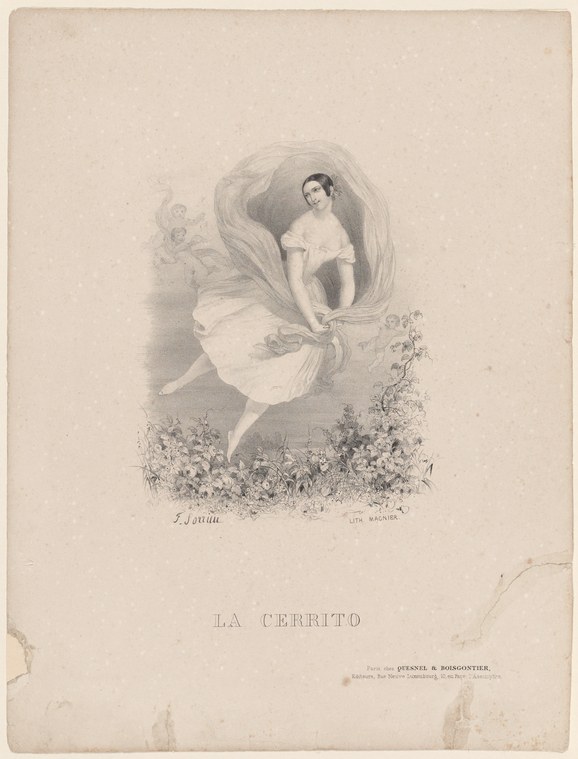
Fanny Cerrito was among the most celebrated ballerinas of her era, and this print is visual evidence of how Romantic ballet positioned the female dancer as a transcendent, nearly supernatural figure. For historians of dance iconography and for dancers, the image reveals the aesthetic values of Romantic ballet: weightlessness, emotional openness, and a dreamlike quality that contrasts sharply with the technical virtuosity we now associate with classical ballet.
What you are looking at
A young woman in a classical white draped dress is captured mid-leap or flight, her body weightless against a soft, undefined background. She is positioned within or emerging from a large spiral or shell-like form that curves protectively around her, rendered in delicate graphite shading. Her pose is ethereal: one leg extends behind, the other bent, her arms open and released. Below her floats a small cherub or putto, and at the base of the composition a profusion of flowering plants—clustered blooms rendered in fine detail—anchor the scene to earth. The entire image is suffused with the romantic sensibility of the early 19th century: the woman seems to inhabit a realm between dream and waking, between the material and the celestial.
The dancing
The primary figure is a single dancer, depicted in a moment of suspension rather than grounded movement. Her torso is arched and open, her arms extended in a gesture of freedom or abandon, with no sense of technical balletic control but rather an emotional release. The pose suggests weightlessness—a quality prized in Romantic ballet. A secondary cherub figure below adds a narrative or allegorical dimension. No partner, no closed hold, no rigid frame; instead, the woman's body reads as fluid, almost liquid in its freedom.
The dance depicted
This is almost certainly a Romantic ballet image, likely a lithographic print commemorating or celebrating a specific celebrated dancer of the 1830s–1850s era. The title *La Cerrito* most probably refers to Fanny Cerrito, one of the most celebrated ballerinas of the Romantic period. The image captures the Romantic ideal: the ethereal, weightless, semi-supernatural female dancer, often depicted in a moment of transcendence. The cherub and flowering plants suggest allegory—the dancer as a creature of nature or dream, not a technical virtuoso but an embodiment of sentiment and grace.
How it was made
This is a lithographic print, likely colored or hand-tinted in places, rendered in soft graphite and tonal washes. Lithography allowed for wide circulation of theatrical imagery in the 19th century, making this both a commercial theatrical souvenir and a fine art object. The soft modeling of the figure, the delicate rendering of botanical detail, and the subtle atmospheric background are all characteristic of Romantic-era theatrical lithography. The technique was well-suited to the gauzy, ethereal quality the period demanded of ballet imagery.
About this work
This is a Romantic-era lithographic portrait of a celebrated ballerina, almost certainly Fanny Cerrito, one of the greatest stars of the 1830s and 1840s. The image embodies the visual language of Romantic ballet: a solitary female figure in a moment of transcendent, weightless motion, surrounded by allegorical and natural imagery that situates the dancer in a realm of dream and emotion rather than technique. Cerrito was renowned for both her technical skill and her ability to embody the otherworldly grace that Romantic choreography demanded. This print is a document of how the period visualized and celebrated its dance stars—not as athletes or technicians, but as creatures of ethereal beauty and emotional depth.
How to look at it
Observe the moment the artist chose: not the apex of a jump, but a floating suspension, as if gravity has been temporarily suspended. Notice how the figure's gesture is open and released, not controlled or technical. The cherub and flowers ground the fantasy in classical allegory, a device the Romantic era borrowed from earlier periods to lend depth to images of its dancers. The soft, atmospheric background and the careful tonal modeling of the figure create an effect of reverie—you are looking not at a document of a performance, but at an idealization of what the dancer represents: beauty, transcendence, otherworldliness.
The artist
The artist is not recorded. The signature or initials visible on the print may be those of the lithographer or the engraver who translated a painted or drawn design onto stone. Theatrical lithography was a collaborative industry in the 19th century; the image may have been created after a painting by another artist, or adapted from a pose struck by the dancer herself during performance or portrait sittings. The hand-coloring and finishing suggests the work of a commercial printmaking house, likely Parisian or European, serving the theater-going public.
The period
This work dates from the height of Romantic ballet, roughly 1830–1850. The Romantic movement in ballet, as in literature and visual art, privileged the ethereal, the emotional, and the supernatural over the rational and technical. Female dancers dominated the stage in this era, and the visual iconography—the weightless pose, the gauze and tulle, the dreamlike settings—reinforced the period's fascination with women as creatures of beauty and sentiment rather than as skilled performers. Lithographic theater prints were a mass medium of the era, circulating widely among theater-goers and dance enthusiasts.
Where it lives
Held in the New York Public Library's collection of prints depicting dance. The work is a lithograph, likely a commercial theatrical souvenir from the mid-19th century, distributed through print sellers serving the opera and ballet-going public of Paris and other European cities.
Dance in this work
Questions about this work
Who was Fanny Cerrito?
Fanny Cerrito (1817–1909) was an Italian ballerina who became one of the most celebrated dancers of the Romantic era, particularly admired for her technical skill and her ability to embody the ethereal, otherworldly qualities that Romantic choreography demanded. She danced across Europe and created roles in major ballets of the period. She was a contemporary and rival of Marie Taglioni.
What is Romantic ballet?
Romantic ballet emerged in the 1830s and emphasized the emotional, supernatural, and otherworldly qualities of dance. Female dancers dominated the stage, often depicted as ethereal, weightless creatures. Pointe work became standard, and the visual and thematic language of the period drew on themes of love, loss, desire, and the impossible. Major works include *La Sylphide* and *Giselle*.
Is this a portrait of an actual performance?
Likely not a literal document of a single performance moment. Rather, it is an idealized portrait combining recognizable poses and imagery associated with the dancer and her signature roles. Theater prints of the era were commercial objects designed to celebrate and memorialize star dancers for a wide public; they drew on actual performance moments but rearranged them for aesthetic and allegorical effect.
What does the cherub signify?
The cherub is an allegorical device, borrowed from Neoclassical and Baroque art, used to elevate the ballerina and situate her in a realm of beauty, grace, and the transcendent. In the context of 19th-century ballet imagery, it signals that the dancer represents an ideal or a muse rather than a mere performer.
More dance artwork





