49 works in this view — arrow keys or swipe to move between them.
Dance in Art
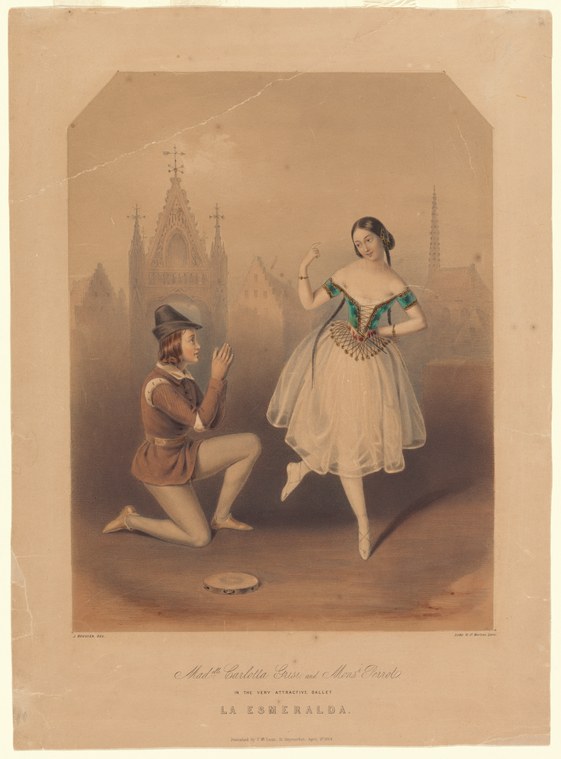
Madelle. Carlotta Grisi and Monsr. Perrot, in the very attractive ballet La Esmeralda
Unknown artist
- Collection:
- Prints depicting dance
- Source:
- New York Public Library
- Rights:
- Public domain — free to use, share and adapt.
- Recorded as:
- Public Domain
This print is evidence of how Romantic ballet was disseminated, remembered, and monetized in the 19th century. It documents a moment in a now-lost performance recorded by a working dancer (Perrot) and a celebrated prima ballerina (Grisi), and it shows the visual and gestural vocabulary of Romantic male dancing—the kneeling, the upward gaze, the devotional posture—that defined masculine identity in the ballet of this era.
What you are looking at
A young male dancer in brown tunic and cap kneels in supplication before a young female dancer in a pale tulle skirt with green ornamental bodice, set against a misty Gothic cityscape of spires and pointed arches. The kneeling figure gazes upward with one hand raised in a gesture of devotion or plea, while the standing woman regards him with a slight smile, one arm lifted gracefully. The background suggests a medieval or Romantic-era setting through its architectural vocabulary. The composition is intimate and theatrical, lit to suggest late afternoon or stage lighting, with warm tones dominating the foreground and cooler tones receding into the cityscape.
The dancing
The male dancer's body is compressed into a deep kneel, with his torso upright and one arm extended upward—a posture of supplication or romantic yearning typical of Romantic ballet's male vocabulary. The female dancer stands in an easy contrapposto, her weight on one leg, her upper body upright but relaxed, her arms positioned with the soft épaulement characteristic of early 19th-century technique. She appears en demi-pointe or in a standing position rather than on pointe. The spatial relationship—kneeling devotee and standing beloved—encodes a narrative hierarchy common to Romantic ballet.
The dance depicted
This is almost certainly a scene from *La Esmeralda*, the 1841 ballet choreographed by Jules Perrot with a libretto by Théophile Gautier, based on Victor Hugo's *Notre-Dame de Paris*. The title confirms Carlotta Grisi in the lead role and Perrot in the supporting male role. The image captures a moment of courtship or romantic crisis—likely the scene in which the male protagonist (a soldier or nobleman) declares his love or allegiance to Esmeralda (the Gypsy dancer). The kneeling posture was a convention of Romantic ballet for expressing masculine devotion, distinguishing it from the aristocratic restraint of earlier court dance or the virtuosic display that would dominate later ballet.
How it was made
This is a hand-coloured lithograph or colour-printed engraving, as indicated by the soft gradations in the background, the careful registration of flesh tones and fabric colours, and the characteristic line work defining the figures. The printing technique—likely lithography given the date and the fluid handling of the architectural background—allowed for broad circulation as a theatrical souvenir and record of the performance. The hand-colouring (visible in the precise rendering of the woman's bodice and the man's tunic) suggests this was a premium or deluxe edition. Such prints were standard merchandise in the mid-19th century, sold in theatre lobbies and by print dealers to document celebrated dancers and roles.
About this work
This is a record of a specific moment in a celebrated Romantic ballet, captured through the mass medium of hand-coloured lithography. *La Esmeralda* premiered in 1841 and became one of the defining vehicles for Carlotta Grisi, one of the great ballerinas of the era. The print documents not only the choreography and costume but also the dramatic intensity and narrative clarity that Perrot and Gautier brought to Romantic ballet—a shift toward emotional storytelling and character psychology that distinguished Romantic from Classical ballet. The image preserves the moment, the dancers, the roles, and the visual grammar of a theatrical tradition that depended on such prints for its afterlife in memory and circulation.
How to look at it
Attend to the contrast between the two bodies: the male's compressed, kneeling posture and upward gaze express dependence and emotional intensity, while the female's standing ease and slight smile suggest power, distance, and authority. This reversal of conventional gender dynamics in narrative—the woman holding the power, the man in the posture of vulnerability—was one of the innovations of Romantic ballet and was encoded in gesture and position. The architectural setting is not incidental: the Gothic city is the world of the narrative (Hugo's medieval Paris), and it frames the dancers as characters in a story rather than as abstract bodies. Notice also the precision of the costume: the woman's tulle skirt (the 'tutu' in its early form) and pointe work are essential to her identity as a ballerina, while the man's tunic and boots mark him as a character within the narrative rather than as a virtuoso display.
The period
This print dates to the height of Romantic ballet in the 1840s, when ballet had shifted from the courtly formality and virtuosic display of the Classical tradition toward narrative and character-driven works inspired by Romantic literature, medievalism, and the exotic. Jules Perrot was both a dancer and a choreographer of the first rank—trained in the Classical tradition but innovative in his use of narrative, gesture, and dramatic tension. Carlotta Grisi was one of the four great Italian ballerinas of the Romantic era (alongside Marie Taglioni, Fanny Cerrito, and Lucile Grahn). The popularity of *La Esmeralda* across Europe and America made it a vehicle for international touring and for the circulation of printed images—each theatre, each city, each dancer's interpretation spawned new prints and lithographs. The print medium was central to this economy: it allowed dancers to be recognized beyond the theatre, created a market for theatrical souvenirs, and preserved images of celebrated performances for dancers and fans across Europe and the Americas.
Where it lives
Held in the New York Public Library's collection of prints depicting dance. This is a theatrical souvenir and record, one of thousands printed to document celebrated performances and to serve as both advertisement and memento for theatre-goers.
Dance in this work
Questions about this work
Is this a real performance or an artist's invention?
This documents a real moment from a real ballet that premiered in 1841 and was performed hundreds of times across Europe and America. However, the print is not a photograph—it is a hand-coloured lithograph made by a commercial print publisher, likely based on a sketch or a programme design. It aims at fidelity to the actual performance and the dancers, but like all such prints, it is an interpretation and an idealization rather than a direct record.
What is Romantic ballet and why does this image matter to its history?
Romantic ballet (c. 1830–1890) was a movement away from the pure virtuosity and formal court vocabulary of Classical ballet toward narrative, character, emotion, and the exotic. *La Esmeralda* is one of the four or five canonical works of the Romantic era. This print preserves the moment and the dancers, and it shows the visual language—the kneeling, the devotion, the narrative clarity—that made Romantic ballet distinct and influential.
Who were Carlotta Grisi and Jules Perrot?
Carlotta Grisi (1819–1899) was an Italian ballerina who became one of the greatest stars of the Romantic era. Jules Perrot (1810–1894) was an Italian-born dancer and choreographer based in France and Russia, known for his dramatically sophisticated and emotionally intense choreography. *La Esmeralda* was one of his masterpieces and a vehicle that showcased Grisi's dramatic and technical gifts. Both were central figures in mid-19th-century ballet and toured internationally.
What is the scene showing?
The image shows a scene of romantic or devotional crisis—almost certainly a moment when the male character declares his love or allegiance to Esmeralda, the Gypsy dancer at the centre of the ballet. The kneeling posture was a convention of Romantic ballet for expressing masculine emotion and dependence. The setting (the Gothic city) and the costumes (her tulle skirt, his tunic) identify them as characters within the narrative of Hugo's novel.
More dance artwork





