49 works in this view — arrow keys or swipe to move between them.
Dance in Art
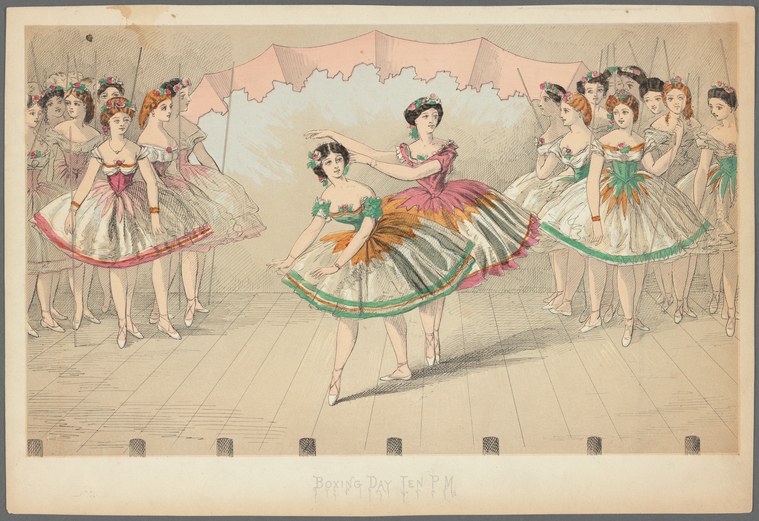
Boxing Day ten p.m.
Unknown artist
- Collection:
- Prints depicting dance
- Source:
- New York Public Library
- Rights:
- Public domain — free to use, share and adapt.
- Recorded as:
- Public Domain
This print provides rare evidence of how classical ballet was performed and staged in Victorian England, including details of costume design, ensemble choreography, and the social context of holiday performances. For dance historians, it documents the persistence of Romantic ballet vocabulary and aesthetics well into the 19th century, while the theatrical print format itself reveals how dance was commodified and circulated as popular visual culture.
What you are looking at
A theatrical stage scene depicts a line of young women in classical tutus arranged in a semi-circle around a central dancer who commands the composition. The central figure wears a tutu with notably elaborate wings or draped fabric extensions in striped patterns of pink, orange, green, and black—an ornamental detail that dominates the visual center. She stands in a lifted, weightless pose characteristic of ballet vocabulary. The surrounding dancers, dressed in simpler tutus with colored trim, form a symmetrical frame, their bodies aligned and attentive. The stage floor is rendered in perspective lines that recede toward the background, establishing theatrical depth. The entire scene is rendered in a soft, hand-colored medium with delicate pen work, and the title "Boxing Day ten p.m." is inscribed below—a domestic English reference that contrasts oddly with the classical ballet setting. The work captures an ensemble moment, likely from a theatrical performance, with careful attention to the formal arrangement and the spectacle of the central dancer's costume.
The dancing
All dancers are on pointe, their bodies held in the vertical alignment fundamental to classical ballet. The central figure presents an extended arabesque or similar lifted pose with one leg extended, arms raised in a classical frame. The surrounding dancers stand in parallel positions, their arms held uniformly in port de bras. The central dancer's torso shows the upright carriage required of ballet technique, and the surrounding figures mirror this postural discipline. There is no partnering or contact between dancers—this is a formal, symmetrical corps arrangement emphasizing visual harmony rather than dynamic interaction.
The dance depicted
This is almost certainly a scene from a classical or Romantic-era ballet, evidenced by the pointe work, tutus, and formal ensemble choreography arranged in geometric precision around a featured soloist. The central dancer's costume—with its exaggerated, wing-like striped extensions—suggests either a character role (a bird, a fairy, or a similar fantastical creature) or a stylized rendering of Romantic ballet spectacle. The date inscription 'Boxing Day' places this as an English theatrical tradition, suggesting a Christmas or holiday season performance. The artist has captured the moment of stillness or pose rather than movement, a convention common in theatrical prints meant to advertise or commemorate performances.
How it was made
This is a hand-colored engraving or etching, evidenced by the fine pen line work defining all forms, the cross-hatching used for shadow, and the subtle watercolor or gouache tinting applied over the printed line. The technique suggests a work intended for commercial circulation—theatrical prints of this kind were sold to audiences as souvenirs and mementos of performances. The refinement of the line work and the careful attention to costume detail indicates skilled printmaking, likely produced for an educated urban audience. The pastel color palette and delicate handling suggest mid-to-late 19th-century theatrical print practice.
About this work
This is a theatrical print commemorating a ballet performance, likely from the Victorian era, staged on Boxing Day evening. It documents not only the formal choreography of classical ballet—the pointe work, the tutus, the corps de ballet arrangement—but also the spectacular costume design and theatrical staging conventions of the period. The work sits at the intersection of dance history and visual culture, capturing how ballet was presented, advertised, and remembered in 19th-century England. The inscription and hand-coloring mark it as a souvenir object, something audiences could take home to preserve memory of an evening's entertainment.
How to look at it
Attend to the formal symmetry the artist has chosen: the corps dancers create a frame that isolates and elevates the central figure, a compositional choice that reflects the hierarchies of classical ballet choreography. The central dancer's pose is caught in stillness—a moment of sustained extension rather than a fleeting transition—which is typical of how theatrical prints immortalized ballet, emphasizing the line and shape of the body over the dynamics of movement. Notice the costume detail: the artist has taken pains to render the striped extensions on the central dancer's tutu, suggesting either its dramatic importance or the artist's delight in baroque ornament. The perspective lines of the stage floor draw the viewer's eye inward, reinforcing the theatrical illusion.
The period
This work dates to the era when classical ballet, descended from the Romantic ballets of the 1830s–1840s, remained the dominant form of theatrical dance in Britain and Europe. By the mid-to-late 19th century, ballet had become a staple of pantomime and theatrical entertainment, particularly during the Christmas season. Theatrical prints and lithographs were a significant medium for promoting performances and allowing audiences to extend their experience beyond the theater. The emphasis on elaborate costume, symmetrical corps de ballet arrangement, and the spectacular 'character' costume of the central dancer reflects the period's investment in visual spectacle and narrative fantasy on stage.
Where it lives
This work is held in the NYPL's Prints collection under the category 'Prints depicting dance.' The catalogue record provides minimal information—no artist attribution, date, or medium documentation—suggesting it may be one of many theatrical prints catalogued as a category rather than as individual named works. Its hand-colored nature and theatrical subject matter are consistent with 19th-century print practice.
Dance in this work
Questions about this work
What is the significance of the title 'Boxing Day ten p.m.'?
Boxing Day is the day after Christmas (December 26th) in Britain. The inscription suggests this ballet was performed as part of the Christmas theatrical season, likely as an evening entertainment. The specific time notation may reference either the performance time or simply mark the work's theatrical context. This detail anchors the work to a specific English cultural tradition.
Why is the central dancer's costume so different from the others?
In classical ballet, the central or featured dancer typically wears a more elaborate or character-specific costume that distinguishes them as the soloist. The striped, wing-like extensions on this dancer's tutu suggest she may be performing a character role—perhaps a fairy, a bird, or a supernatural creature—consistent with Romantic and classical ballet narratives. The elaborate costume signals her importance in the choreography.
Is this a specific ballet, or a generic scene?
The catalogue record does not identify a specific ballet, and the image alone does not provide enough narrative or iconographic detail to confirm which work is depicted. The formal arrangement and costume design are consistent with many Victorian-era ballets. Without additional documentation, we cannot determine whether this commemorates a particular production or is a more general representation of ballet spectacle.
What does this tell us about 19th-century ballet training and technique?
All dancers are depicted en pointe with the vertical posture, arm placement, and leg extension characteristic of classical ballet technique. The artist has rendered pointe work accurately, suggesting firsthand knowledge of or careful study from ballet performance. The formal, symmetrical arrangement reflects the period's emphasis on precision, line, and visual harmony rather than dramatic character interaction.
More dance artwork





