49 works in this view — arrow keys or swipe to move between them.
Dance in Art
The pantomime quadrille
Unknown artist
- Collection:
- Prints depicting dance
- Source:
- New York Public Library
- Rights:
- Public domain — free to use, share and adapt.
- Recorded as:
- Public Domain
The Pantomime Quadrille reveals how nineteenth-century dancers and entrepreneurs mixed genres to create commercial entertainment: theatrical drama, social dance, and comic performance were not separate categories but ingredients in a single fashionable product. For dance historians, the image documents a now-lost performance tradition and shows how movement was packaged, advertised, and taught to the Victorian public. The work is also a valuable artifact of music publishing and visual marketing in an era when sheet music was a primary vector for dance knowledge and entertainment.
What you are looking at
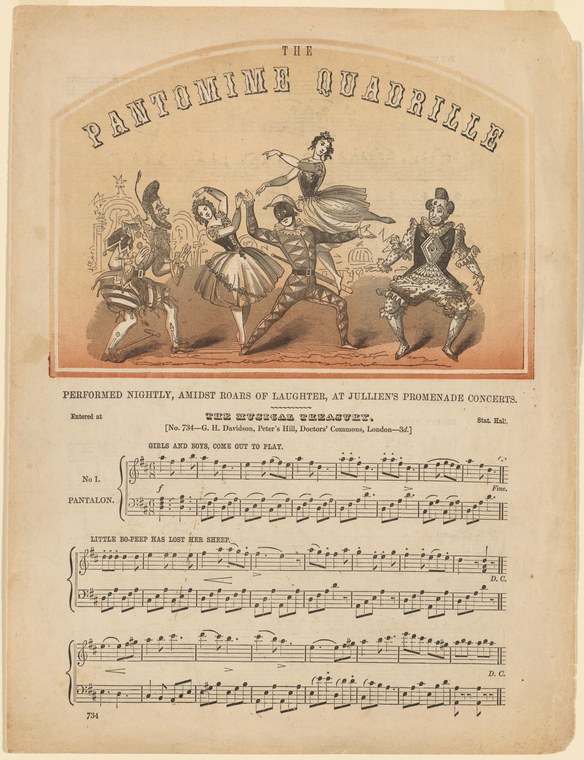
This is a printed score and advertisement for a fashionable social dance called the Pantomime Quadrille, performed at Jullien's Promenade Concerts in London. The title cartouche features five figures in mid-performance: at center, a woman in a full-skirted dress executes a high kick or extension, her body angled dynamically; she is flanked by four other dancers in theatrical costume—three women in bell-skirted gowns and one man in period dress—arranged in an informal but balanced composition. All figures are rendered in line engraving with light tonal shading. Below the theatrical vignette sits musical notation for piano: the opening sections labeled "PANTALAON" and "LITTLE DOEUP HAS LOST HER DRESS" with full bass and treble staves, indicating this was a published music folio for domestic or concert use. The paper is aged cream-colored stock, typical of mid-nineteenth-century English music publishing.
The dancing
The central female dancer dominates the composition with an extended leg raised high, her torso upright and arm lifted, suggesting vigorous, acrobatic movement far removed from classical ballet's turnout and control. The surrounding dancers adopt casual, varied positions—one partially crouching, others with arms gesturing—creating an impression of playfulness rather than formal technique. All five are dressed in contemporary 1840s–1850s theatrical costume with full skirts, fitted bodices, and period details. The poses suggest sequential action within a suite rather than a unified geometric formation, and the informality of spacing and alignment is characteristic of a pantomime or character-dance entertainment rather than ballroom discipline.
The dance depicted
The Pantomime Quadrille was a Victorian entertainment dance that grafted theatrical pantomime and comic character work onto the quadrille, the period's most popular social dance form. Quadrilles were danced in sets of four couples and consisted of five distinct figures; this work appears to be a medley or 'pantomime version' in which narrative or character business—suggested by the title "Little Doeup Has Lost Her Dress"—was interwoven with the standard figures. The style sat between ballroom and stage, occupying the space of drawing-room or concert entertainment. The image shows dancers in full theatrical dress rather than formal ball attire, and the dynamic, varied poses suggest that the pantomime element involved exaggerated gesture and burlesque comedy. This was a commercial product: Jullien's Promenade Concerts were London's premier public dance and music venue, and publishing the music and imagery together served both concert audiences and amateur musicians wanting to recreate the fashionable entertainment at home.
How it was made
This is a wood engraving or steel engraving—a fine-line process that allowed detailed, precise reproduction—combined with letterpress printing. The title and descriptive text are set in metal type; the illustration and musical notation are engraved. The technique's economy and sharpness made it ideal for sheet music covers and advertisements, allowing hundreds of copies to circulate at low cost. The skill of the engraver is evident in the subtle modeling of the figures' drapery and the precision of the musical staves. This is a primary source for how these dances were marketed and consumed: as portable, reproducible commodities aimed at the middle-class amateur.
About this work
This is a printed music folio cover for a Victorian social dance entertainment, the Pantomime Quadrille, performed and published in London around the mid-nineteenth century. It combines theatrical imagery with dance instruction in a format designed for both concert-going audiences and domestic use. The five dancers depicted in the engraving are rendered in exaggerated, playful poses that signal the comic and acrobatic character of the piece—a marked departure from the restraint of classical ballet or the geometric precision of ballroom quadrilles. As a published object, it testifies to the professionalization and commodification of dance in the Victorian era and to the blurred boundaries between stage performance and social dancing during this period.
How to look at it
Observe the central dancer's extended leg and lifted arm: the pose is momentary and unstable, caught mid-movement rather than in a formal position. This captures the burlesque or pantomime aesthetic of exaggeration and comic energy. Notice too how the five figures are not arranged in the geometric pattern of a formal ballroom quadrille—no squares, no couples in symmetry—but scattered in a theatrical tableau. The title "Little Doeup Has Lost Her Dress" suggests narrative content; the raised leg of the central figure may mime this comedic situation. The mix of formal dress (for some) and theatrical costume (for others) signals the blurred boundary between ballroom and stage. The presence of full musical notation below shows that this was a reproducible, teachable object: the image sold the entertainment, but the music made it actionable for amateurs.
The artist
The engraver is not named in the catalogue record. The work was published by Cramer & Co., a London music house active in the mid-nineteenth century, whose address is given as No. 734, G. H. Hardoon, Peel's Hill, Doctors' Commons. The engraving appears to be a standard commercial product of a London music-publishing workshop, competently executed but not signed or attributed to a named artist—typical of much reproductive and commercial graphic work of the period.
The period
The Pantomime Quadrille emerged during the golden age of the quadrille in European ballroom culture, roughly 1830s–1860s. The quadrille had been codified into a formal social dance with specific figures (Pantaloon, Été, Poule, Trenis, Finale), but it was also subject to endless variation and theatrical adaptation. Jullien's Promenade Concerts (active 1840–1859) were part of a broader Victorian phenomenon of public, ticketed entertainment that democratized access to music and dance previously confined to aristocratic balls. At the same time, the rise of the music folio—a purchasable score with an illustrated cover—created a mass market for dance instruction and fashionable entertainment at home. This work sits at the intersection of theatrical innovation, commercial publishing, and the social aspirations of an expanding middle class.
Where it lives
This work is part of the New York Public Library's collection of prints depicting dance. It is a published sheet music cover, a mass-produced commercial object rather than a unique artwork, and should be understood as one instance of a printed edition. The library's holding reflects the importance of such ephemera as primary sources for the history of vernacular and commercial dance.
Dance in this work
Questions about this work
What is a Pantomime Quadrille?
A Pantomime Quadrille was a Victorian social dance entertainment that combined the formal structure of the quadrille—a popular ballroom dance for four couples—with theatrical comic acting, exaggerated gesture, and burlesque movement. Performers wore stage costume and acted out comic narratives (like the one suggested by the title here) while executing the traditional figures of the quadrille. It sat between ballroom and theater, occupying the space of drawing-room entertainment or commercial concert performance.
Who performed the Pantomime Quadrille?
This particular version was performed nightly at Jullien's Promenade Concerts, a prestigious public entertainment venue in London run by the conductor and impresario Louis-Antoine Jullien. These were commercial, ticketed events that mixed orchestral music with dance and spectacle, attracting fashionable London audiences. The concerts were influential in bringing theatrical and ballroom entertainment to a paying public and helping to define Victorian popular culture.
How do I read the musical notation?
The engraved score shows the piano arrangement of the opening sections of the piece. The treble and bass staves are printed in full, allowing an amateur pianist to play and teach the dance at home. The sections are labeled with the names of the traditional quadrille figures ('Pantaloon') and the pantomime narrative elements ('Little Doeup Has Lost Her Dress'). This was a common format for dance music in the nineteenth century, making it possible for sheet music to serve as both a souvenir of a concert performance and a practical teaching tool.
Why is this image important for dance history?
It documents a now-lost performance tradition and shows how dance, theater, and music were mixed in Victorian commercial entertainment. It also reveals how dance knowledge was packaged and sold as a printed commodity—the image advertised the spectacle, while the music made it reproducible in domestic or amateur settings. For art historians, it shows how wood or steel engraving was used to create mass-market illustrated goods. For social historians, it testifies to the aspirations and leisure practices of the Victorian middle class.
More dance artwork





