49 works in this view — arrow keys or swipe to move between them.
Dance in Art
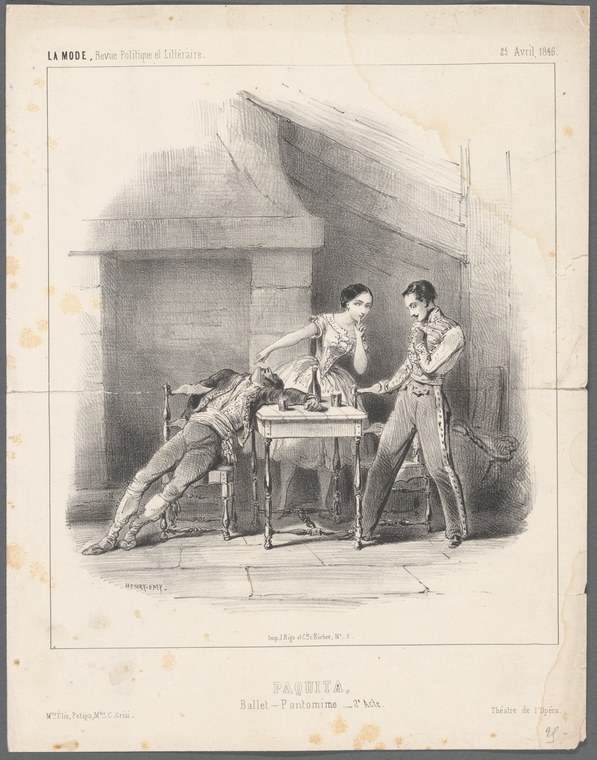
Paquita: ballet, pantomime, 2e acte
Unknown artist
- Collection:
- Prints depicting dance
- Source:
- New York Public Library
- Rights:
- Public domain — free to use, share and adapt.
- Recorded as:
- Public Domain
Theatrical prints like this document the pantomime conventions that structured Romantic ballet—essential context for understanding how 19th-century choreography integrated storytelling with dance technique. For historians, it reveals what physical vocabulary was considered legible and moving to contemporary audiences, and how male dancers were presented in heroic or emotionally charged roles.
What you are looking at
A theatrical scene depicting three male figures in early 19th-century dress within a sparse interior. The setting appears to be a simple room with a fireplace or architectural backdrop rendered in soft gray tones. The central figure reclines dramatically backward across a small table, his body in an exaggerated arc of distress or passion, while two standing figures flank him—one to the left gesturing with raised arm, the other to the right in a more restrained pose. The reclining figure's legs extend beyond the table's edge, emphasizing the theatrical extremity of his posture. All three wear fitted breeches, vests, and jackets typical of Romantic-era male costume. The composition uses dramatic light and shadow to model the forms and create theatrical depth.
The dancing
The three figures form a narrative group rather than a unified dance formation. The reclining man's body is hyperextended in a pantomimic gesture of emotional extremity—his back arched, limbs loose—while the two standing men adopt expressive poses of reaction or intervention. The figure on the left gestures upward with one arm in a classical theatrical convention of appeal or distress. None of the three appear to be in a closed or ballroom hold; their spatial relationship is organized by dramatic narrative rather than dance partnership. The pose suggests pantomime—wordless storytelling through body position—rather than balletic movement.
The dance depicted
This image illustrates a pantomime scene from the second act of Paquita, a ballet-pantomime created in the 1840s. The extreme, emotionally charged postures and the narrative grouping identify this as pantomime rather than dance proper—the codified silent acting style that formed a core component of 19th-century Romantic ballet. The recumbent figure's posture does not depict a step or movement but rather an attitude of theatrical distress or passion, rendered in the exaggerated vocabulary of melodramatic gesture. The print documents the dramatic narrative content of a ballet, showing how Romantic-era audiences consumed both pure dance and elaborate pantomimic storytelling within a single theatrical work.
How it was made
This is a lithograph or engraving printed in black ink on cream paper, rendered in a linear hatching technique typical of mid-19th-century theatrical prints. The artist used fine parallel lines to model form and create tonal gradation, particularly visible in the shadows of the interior setting and the musculature of the figures. The technique allowed rapid reproduction and distribution of theatrical imagery to the broader public; prints like this circulated as souvenirs and publicity for popular ballets, making them central to how dance was consumed outside the theater. The signature at lower left remains partially legible, and the publication information suggests this was part of a commercial series documenting stage action.
About this work
This is a lithographic print from a series documenting Paquita, one of the major works of the Romantic ballet repertoire. It captures a moment of dramatic pantomime—the non-dance storytelling that alternated with pure choreography in 19th-century ballet productions. The image shows three male dancers enacting an emotional scene through exaggerated gestural language, demonstrating that Romantic ballet audiences expected elaborate theatrical narrative alongside technical virtuosity. As a mass-produced print, it represents how ballet imagery circulated and shaped public understanding of what happened on stage, particularly for those who could not attend performances.
How to look at it
Attend to the extreme, almost contorted quality of the central figure's posture: this is not a moment of actual dancing movement, but a frozen gesture of emotional intensity frozen for legibility and dramatic effect. Notice how the composition uses the reclining body as the focal point and the two standing figures as witnesses or participants in the narrative. The soft, atmospheric rendering of the background and careful attention to fabric and musculature show that the artist understood theatrical spectacle as a complete visual experience, not merely a display of technique.
The period
Paquita was created in 1846 in Paris and became a celebrated work of the Romantic ballet era, a period when narrative spectacle and technical display were equally valued. The 1840s saw intense competition among Paris, London, and other European capitals for ballet supremacy, and successful works were documented and marketed through widely distributed prints. This print, labeled as depicting Act II, was likely produced shortly after the premiere or during subsequent revivals. The publication information suggests it was part of a commercial series—possibly from the journal La Mode or a similar illustrated periodical—aimed at theater-goers and the fashionable public.
Where it lives
This print belongs to the collection of prints depicting dance held by the New York Public Library. The publication information indicates it is from La Mode, a 19th-century journal of public opinion and letters published in French, and is dated 28 April 1846, placing it in the year of or shortly after Paquita's Paris premiere.
Dance in this work
Questions about this work
Is this a ballet or a dance picture?
It is a ballet picture—specifically, a documentation of a scene from the theatrical work Paquita. The scene shown is pantomime (dramatic acting) rather than pure dance, but pantomime was an essential component of Romantic-era ballet productions, alternating with and interrupting passages of choreographed movement. This print captures the narrative and emotional content that made 19th-century ballet appealing to audiences.
What does the reclining figure represent?
Without additional context from the full libretto or choreographic record, the precise narrative meaning cannot be stated with certainty. The extreme posture—the arched back and extended limbs—is a pantomimic gesture of distress, passion, or emotional extremity. The two standing figures appear to react or respond to this central figure, suggesting a moment of crisis or high emotional stakes in the plot.
Why does this look like acting rather than dancing?
Because this image documents the pantomime sections of the ballet, not the choreographed dance sequences. Romantic ballets integrated long passages of silent, gestural storytelling with the purely danced scenes. This lithograph captures one of those narrative moments, showing how Romantic dancers were expected to master dramatic expression and bodily eloquence, not merely technique.
More dance artwork





