49 works in this view — arrow keys or swipe to move between them.
Dance in Art
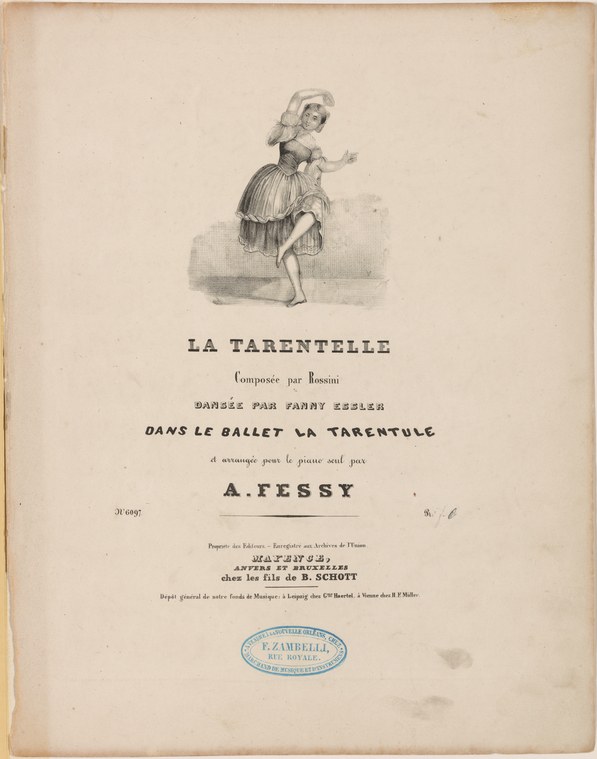
La tarentelle,: composée par Rossini dansée par Fanny Essler [sic] dans le ballet La tarentule et arrangée pour le piano seul par A. Fessy
Unknown artist
- Collection:
- Prints depicting dance
- Source:
- New York Public Library
- Rights:
- Public domain — free to use, share and adapt.
- Recorded as:
- Public Domain
Fanny Elssler was a central figure in Romantic ballet and a rival to Marie Taglioni; her signature roles included character dances like this tarantella that showcased dramatic intensity and technical brilliance rather than ethereal weightlessness. The image is a rare direct record of how a canonical dancer of the 1840s-50s moved and presented herself, freezing a moment of a celebrated role that left no film record.
What you are looking at
This is a printed score cover for a piano arrangement of a tarantella composed by Rossini and danced by the renowned ballerina Fanny Elssler in the ballet *La Tarantule*. The image shows a single female dancer in mid-performance, captured in a moment of vivid movement against a plain background. She wears the costume of a southern Italian peasant woman: a white blouse with puffy sleeves, a full skirt gathered at the waist and caught mid-swirl, and what appears to be a decorative headdress or bonnet. Her body is twisted in a characteristic tarantella pose—weight on one leg, the other extended or about to strike, arms raised and gesturing with the expressive animation typical of the dance. The engraving is delicately executed with fine cross-hatching to suggest volume and the fabric of her costume, while the background remains neutral, throwing all attention onto the dancer's form and the energy of her movement.
The dancing
A single female dancer is shown in an asymmetrical, dynamic pose with her weight shifted onto one leg and her torso twisted. One arm is raised expressively while the other gestures outward, capturing the characteristic arm movements of the tarantella. Her head is turned upward, and her expression suggests intensity and engagement. The full skirt is rendered in mid-swirl, suggesting rapid rotation or the momentum of the dance. The posture demonstrates understanding of balletic training—the dancer maintains an upright carriage despite the folk-dance vocabulary, a hallmark of how European concert dancers of the 1840s-50s performed regional dances.
The dance depicted
This is a tarantella, a rapid, lively folk dance from southern Italy characterized by whirling turns and striking footwork, performed here as a concert piece by Fanny Elssler, one of the most celebrated ballet dancers of the Romantic era. The tarantella was adopted into the ballet repertory and performed across European stages as an exotic character dance, often framed as a colourful diversion within a larger narrative ballet. The image captures the essential character of the tarantella: the rapid, energetic movement, the peasant costume transformed through theatrical presentation, and the solo virtuosity expected of the ballerina. Elssler's interpretation would have emphasized technical precision and dramatic intensity rather than the vernacular informality of the original folk practice.
How it was made
This is an engraving, a print medium that allowed for fine detail and wide distribution of musical and theatrical imagery in the nineteenth century. The title page is printed with both image and letterpress text, typical of published sheet music of the period. The engraved figure is rendered with delicate parallel lines and cross-hatching to create volume and texture, particularly evident in the rendering of the skirt's folds and the shading of the face. Such prints served multiple audiences simultaneously: musicians purchasing the score, theatre-goers seeking a souvenir or record of a celebrated performance, and dance enthusiasts documenting the leading artists and roles of the day.
About this work
This is a printed title page for a piano reduction of Rossini's tarantella music, arranged by A. Fessy and published following Fanny Elssler's performance in the ballet *La Tarantule*. It documents a moment in the history of Romantic ballet when European concert dancers regularly performed character dances drawn from folk traditions, reimagining them for the theatre stage. The engraving captures Elssler mid-performance, preserving both the choreographic vocabulary of the tarantella and the visual identity of one of the era's dominant ballerinas. Sheet-music covers of this kind were primary documents of theatrical dance in the nineteenth century, circulating among music teachers, amateurs, and dance audiences and serving as one of the chief ways that theatrical dance was visualized and remembered before photography.
How to look at it
The viewer should attend to the moment chosen: the dancer is captured not in a static pose but in a moment of rapid motion, with the skirt still swinging and the limbs in an asymmetrical, expressive arrangement. Notice how the artist has conveyed the sense of spinning and striking that characterises the tarantella, not through blur but through the twisted torso, the raised arms, and the swirl of drapery. The upturned face and energetic gesture suggest the intensity and joy of the performance. The costume—the peasant dress transformed into a stage garment through its careful tailoring and the dancer's refined posture—embodies the Romantic fascination with folk authenticity filtered through theatrical sophistication.
The artist
The engraver and arranger are not identified in the record, but the publisher's information—Chez les fils de B. Schott in Mayence (Mainz)—places this within the major German music publishing houses of the nineteenth century. The arrangement itself reflects the standard practice of transcribing successful theatrical music for amateur pianists and home performance, a crucial means of extending the reach and profitability of theatrical compositions.
The period
This dates to the height of the Romantic ballet era, when Fanny Elssler and her rival Marie Taglioni dominated European stages. The 1830s-1850s saw intense interest in folk and national character dances; these were incorporated into full-length ballets as colourful interludes or as vehicles for ballerina virtuosity. The tarantella in particular was a favourite of the period, performed across Europe as an emblem of Italian exoticism and peasant vitality. Publishing theatrical music and distributing engraved images of celebrated dancers were booming commercial enterprises that made dance visible to audiences far beyond the theatre.
Where it lives
This is a printed title page to sheet music held in the New York Public Library's Prints depicting dance collection. It is a mass-produced object, likely one of many copies distributed to music sellers and performers across Europe.
Dance in this work
Questions about this work
Who was Fanny Elssler?
Fanny Elssler (1810–1884) was an Austrian ballet dancer and one of the most celebrated performers of the Romantic era. She rivalled Marie Taglioni for dominance of European stages and was known particularly for dramatic character roles and national dances, including the tarantella shown here. She performed across Europe and the Americas and was a major star of the 1830s-1850s.
What is a tarantella?
The tarantella is a rapid, whirling folk dance from southern Italy, traditionally performed with striking footwork and energetic arm movements. It entered the ballet repertory in the nineteenth century as a character dance, where it was performed as a virtuosic solo or ensemble piece, often within larger narrative ballets. The theatrical version emphasized technical precision and dramatic intensity.
What was the ballet *La Tarantule*?
The ballet *La Tarantule* (The Tarantula) was a vehicle for ballerina virtuosity, likely a one-act or divertissement-length piece centered on the tarantella dance. It belongs to the tradition of character ballets and national dances that were popular during the Romantic period. Fanny Elssler's performance of this role became famous, and this engraving preserves her interpretation of the leading role.
Why would a sheet-music publisher include a dance engraving?
Publishing theatrical music as sheet music for amateur performance was a major business in the nineteenth century. The engraved image of the celebrated dancer who performed the role advertised the music, made the purchase more appealing to amateurs who wanted to own a piece of theatrical culture, and helped circulate knowledge of celebrated performers and roles to audiences who could not attend the theatre.
More dance artwork





