49 works in this view — arrow keys or swipe to move between them.
Dance in Art
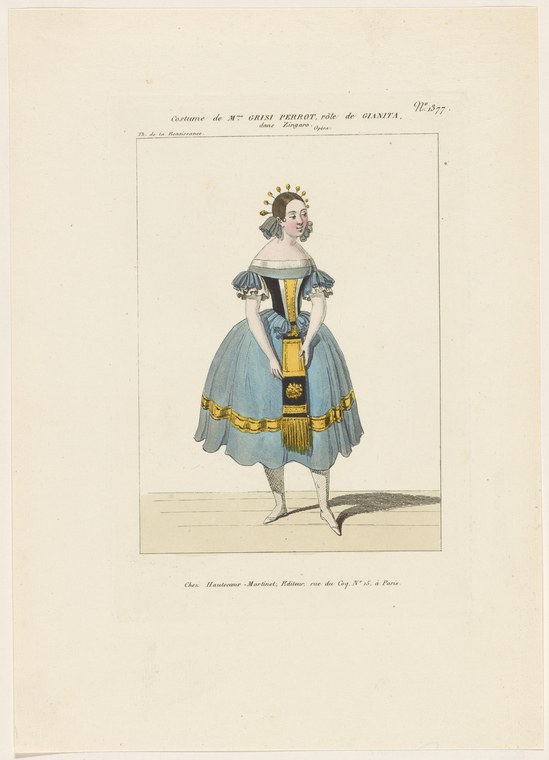
Costume de Mme. Grisi Perrot, rôle de Gianita, dans Zingaro.: Opéra, Th. de la Renaissance
Unknown artist
- Collection:
- Prints depicting dance
- Source:
- New York Public Library
- Rights:
- Public domain — free to use, share and adapt.
- Recorded as:
- Public Domain
Grisi and Perrot were foundational figures in Romantic ballet, and this image preserves a rare window into what their actual stage practice looked like—not through memory or description, but through the clothes themselves. The print demonstrates how engraving and lithography made the ephemeral art of dance partially permanent, allowing later dancers, costume designers, and historians to study the material reality of how the role was performed and dressed.
What you are looking at
A single female dancer stands in a composed, frontal pose against a plain background, wearing an elaborate mid-nineteenth-century theatrical costume. Her dress consists of a pale blue silk skirt with graduated tiers trimmed in gold braid, worn over a white underskirt with puffed sleeves that sit low on her shoulders. A gold-trimmed bodice cinches her waist, and a gold sash drapes across her torso. She wears a small crown or tiara and her dark hair is arranged in the fashionable center-parted style of the period, partially covered by a gossamer veil or headpiece. Her weight rests lightly on one leg in a pose suggesting readiness or a moment of repose between movement. The figure is rendered with pale wash and careful linear detail, positioned centrally within a ruled rectangular frame that suggests this is a costume study or design document rather than a scene of active performance.
The dancing
The dancer presents herself in a balletic stance with upright posture and graceful arm carriage, one leg bearing weight while the other appears ready to move. Her frame is elongated and refined, consistent with the trained virtuosity expected of opera-ballet performers of the era. The pose is neither fully static nor captured mid-movement, but rather displays the figure in a formal presentation mode typical of costume documentation. No other dancers appear; the image isolates the single performer for close study of her dress and bearing.
The dance depicted
This is a costume document for a 'Zingaro' (Gypsy) opera-ballet role performed by the celebrated ballerina Giulia Grisi in collaboration with Jules Perrot at the Théâtre de la Renaissance in Paris during the 1830s–1840s. The character name 'Gianita' and the Gypsy theme are consistent with Romantic-era opera-ballet, a genre that blended sung dramatic narrative with elaborate choreography. The costume—with its exotic color scheme, ornamental sash, and folk-inspired trimming—signals the Romantic obsession with picturesque foreign and peasant subjects. Grisi was one of the most technically accomplished ballerinas of her time, and Perrot one of the finest choreographers; such collaborations generated new ballet vocabulary and theatrical spectacle.
How it was made
This is a hand-colored engraving or lithograph, rendered with delicate linear work and watercolor or gouache wash. The technique allowed for precise reproduction of costume detail—the gold braid, the ruching, the layered skirt construction are all clearly articulated—making such prints valuable for documenting theatrical practice and for circulation to patrons and other theaters. The ruled frame and the notation at the foot (identifying the work, performers, and likely publisher) confirm this as a commercial print, part of the standard production documentation of major Paris opera productions and accessible to a broad audience of opera-goers and fashion-conscious readers.
About this work
This is a costume study for Gianita, a Gypsy character in the opera-ballet 'Zingaro' performed by the legendary ballerina Giulia Grisi under the choreography of Jules Perrot in 1830s Paris. It documents not a moment of dance in action but the theatrical dress itself—the palette, construction, and ornament—photographing the precise costume worn on stage. Such images were essential records of ephemeral live performance and were widely circulated as prints, making them artifacts both of theater history and of the printing and publishing industry that served it. The work sits at the intersection of fashion documentation, theatrical record, and the emerging visual culture of celebrity performance.
How to look at it
Look at the precision of the costume detail: the graduated tiers of the skirt, the exact placement and width of each gold-trimmed band, the construction of the bodice, the texture of the veil. This is not a loose artistic rendering but a technical document, reproduced so that other theaters could recreate the costume, other dancers could study the role, and patrons could remember the image of the performer they had seen. Notice also the dancer's formal presentation pose—neither in the middle of an action nor at rest, but in a kind of readiness that allows the full costume to be displayed without distraction. This was a standard convention for costume prints: the figure shown in a pose that makes the dress legible.
The period
This image dates to the era of Romantic ballet, roughly 1830–1850, when ballet underwent radical transformation. The Romantic movement prioritized the supernatural, the exotic, and the emotionally intense; operas and ballet-operas became showcases for elaborate spectacle, novel technical vocabulary, and the celebrity of individual female dancers. Paris was the undisputed center of this world. Grisi and Perrot represented the cutting edge: Perrot as a choreographer who pushed the technical and expressive boundaries of the art, and Grisi as one of the most powerful and versatile ballerinas of the age, comfortable in classical technique and in the dramatic narrative roles that Romantic theater demanded. Such costume prints circulated widely, functioning as both theatrical documentation and fashion illustration, and they remain invaluable records of what was actually worn and how performers looked in live performance.
Where it lives
This is a hand-colored engraving or lithograph from the New York Public Library's collection of prints depicting dance. The notation at the foot indicates publication information typical of Paris theatrical print production of the period, confirming it as a commercial print intended for distribution to opera patrons and the general public interested in theatrical fashion and celebrity performance.
Dance in this work
Questions about this work
Who was Giulia Grisi?
Giulia Grisi (1811–1869) was one of the most celebrated lyric sopranos and ballerinas of the Romantic era. She performed across Europe, commanding enormous fees and critical acclaim. She was equally at home singing operatic roles and dancing ballet, a versatility that made her invaluable to choreographers like Jules Perrot. She created roles in many of the most important ballets and operas of the 1830s–1850s.
What is 'Zingaro'?
'Zingaro' (Italian for Gypsy) was an opera-ballet, a theatrical form that combined sung arias and dramatic narrative with dance interludes and set pieces. The Romantic era loved exotic and marginalized subjects, and Gypsy characters featured frequently in both opera and ballet. The costume here—with its folk-inspired ornament and exotic color—signals that aesthetic.
Why are there so many costume prints from this period?
Prints served multiple functions: they documented what had actually been performed on stage (valuable in an era before photography); they circulated the celebrity of the performer; they functioned as fashion illustration; and they allowed other theaters to reproduce celebrated roles. A print like this would have been sold at the theater or through music publishers, making it a accessible souvenir of a live performance.
What does the pose tell us about how the role was danced?
The pose—upright, graceful, with balletic arm carriage and leg placement—shows that even in a character role with an exotic costume, the technique and deportment expected was high classical ballet. There is no suggestion of naturalism or folk movement; the body is refined and trained, the posture aristocratic. This reflects how Romantic ballet incorporated exotic subjects within the vocabulary of high technique.
More dance artwork





