49 works in this view — arrow keys or swipe to move between them.
Dance in Art
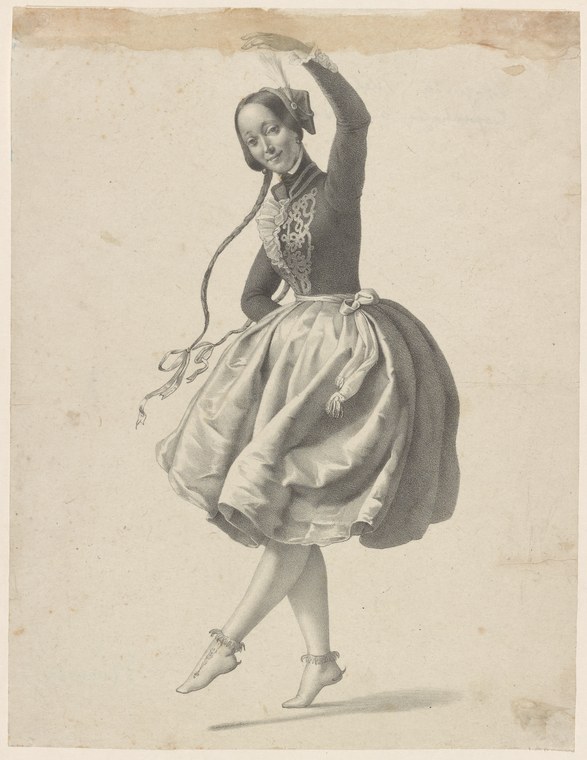
La Lituana
Unknown artist
- Collection:
- Prints depicting dance
- Source:
- New York Public Library
- Rights:
- Public domain — free to use, share and adapt.
- Recorded as:
- Public Domain
Character dances and national dances—performed by named soloists and incorporated into longer ballet narratives—were a central feature of Romantic ballet, yet they are often overshadowed by focus on classical technique. This image documents both the choreographic and sartorial vocabulary of such dances and preserves the memory of a specific performance tradition. As a mass-produced print, it reveals how theatrical dance was marketed, consumed, and remembered by the 19th-century public.
What you are looking at
A single female dancer in a three-quarter view stance, captured mid-performance against a plain background. She wears a fitted dark jacket or bodice with ornate lace or patterned detail at the front, paired with a dramatically voluminous skirt that balloons outward from the waist, suggesting rapid movement or a twirl. The skirt's fabric catches light and shadow to show its full, gathered volume. She wears heeled shoes and her hair is drawn back smoothly, topped with a small dark bow or ribbon. Her left arm is raised to her head in an elegant, graceful curve; her right arm extends outward. Her posture is upright and her gaze is directed toward the viewer with a composed expression. The figure occupies the center of the composition, isolated against neutral ground with a suggestion of shadow beneath her feet.
The dancing
The dancer stands in a single-figure pose suggesting rotation or elevation—her weight appears to be on one leg while the opposite foot lifts, and the extremity of her skirt's volume implies active, rapid motion. Her arm positions are characteristic of European theatrical dance of the 19th century: the raised arm forms a graceful line from elbow to fingertips, while the other extends for balance and line. Her frame is erect with a lifted carriage through the torso; the dancer appears to have technical training in the academic tradition. No partner is present, and the pose is frozen mid-gesture rather than a static position.
The dance depicted
This appears to be a Romantic-era ballet or theatrical dance study, most likely depicting a variation or solo from mid-to-late 19th-century European ballet repertory. The title 'La Lituana' (The Lithuanian Woman) suggests a national or character dance—a genre that was popular in Romantic ballet as exotic or regional interludes, featuring dancers in recognizable national costume and movement vocabulary distinct from classical ballet. The voluminous skirt, fitted bodice, and hairstyle are consistent with 1840s–1860s ballet costume. The pose captures a moment of elevation or turning, suggesting the technical vocabulary of classical ballet.
How it was made
This is a black-and-white engraving or lithograph, rendered with fine line work to establish form, volume, and shadow through cross-hatching and tonal gradation. The technique allows precise capture of anatomical detail and costume construction. The medium and its high finish suggest a print made for circulation as a souvenir or illustration of a celebrated dance performance or dancer—common practices in 19th-century Europe for documenting stage personalities and choreography. The work's clarity and finish imply it was intended for a broad theatrical public rather than private study.
About this work
This engraved or lithographed image documents a Romantic-era theatrical dance, likely from the 1840s–1860s, depicting a solo female dancer performing what the title identifies as a national or character dance of Lithuanian origin. The work belongs to a substantial body of 19th-century dance prints that recorded celebrated performers and choreographic moments, serving as both artistic documentation and theatrical publicity. The figure's technical pose, elegant costume, and composed presentation reflect the values of mid-19th-century ballet aesthetics: a fusion of classical technique with picturesque national costume and exoticism. Such prints were collected and circulated widely, making them key evidence of which dances, dancers, and styles captured public imagination in the Romantic period.
How to look at it
Note the precise moment the artist has chosen: the dancer is captured mid-lift or mid-turn, with the skirt at maximum volume and the body in active motion rather than a static pose. This captures the essence of Romantic ballet aesthetics—the illusion of weightlessness and the marriage of technical virtuosity with picturesque costume. Observe how the raised arm and extended line of the body convey control and elegance within apparent motion; this was the hallmark of the Romantic ballerina's style. The neutral background and frontal presentation emphasize the dancer's isolation as a subject of admiration—a convention of dance portraiture that made the print function as both art and celebrity image.
The period
This work dates to the height of Romantic ballet in Europe (approximately 1830–1870), when the ballet d'action—a narrative ballet featuring multiple genres of dance including classical variations, character dances, and corps de ballet spectacle—dominated the repertory. National and character dances performed in recognizable costume were a standard feature of these ballets, offering both comic and exotic flavor. Dancers such as Marie Taglioni, Fanny Essler, and Carlotta Grisi popularized both classical roles and character variations, and prints of their most celebrated roles were eagerly purchased. The lithograph or engraving was the primary medium for documenting and disseminating images of dancers during this period, before photography became standard.
Where it lives
The work is held in the New York Public Library's collection of prints depicting dance. It is a reproductive print intended for public circulation and sale, typical of 19th-century theatrical documentation.
Dance in this work
Questions about this work
What is a character dance or national dance in Romantic ballet?
Character dances were theatrical solos or group numbers performed in recognizable national or regional costume, featuring movement vocabulary that distinguished them from classical ballet vocabulary. They were popular in narrative ballets of the 1840s–1860s, offering picturesqueness and exoticism alongside classical technique. Celebrated dancers often had signature character roles—Fanny Essler's cachucha is a famous example.
Why were there so many prints of dancers in the 19th century?
Dancers were celebrities, and prints were affordable souvenirs sold to the public after performances. They served as both artistic records of celebrated roles and marketing tools, allowing dancers' images to circulate beyond the theater. Lithography and engraving made mass production possible, making dance imagery accessible to a broad audience.
How can you tell this is from the Romantic era of ballet?
The voluminous skirt, fitted bodice, hairstyle with ribbon or bow, and the pose itself—suggesting weightlessness and elevation—are all hallmarks of 1840s–1860s ballet costume and aesthetic. The emphasis on the picturesque and the isolated, admiring portrayal of the dancer also reflect Romantic values.
More dance artwork





