49 works in this view — arrow keys or swipe to move between them.
Dance in Art
Dance on music covers
Unknown artist
- Collection:
- Prints depicting dance
- Source:
- New York Public Library
- Rights:
- Public domain — free to use, share and adapt.
- Recorded as:
- Public Domain
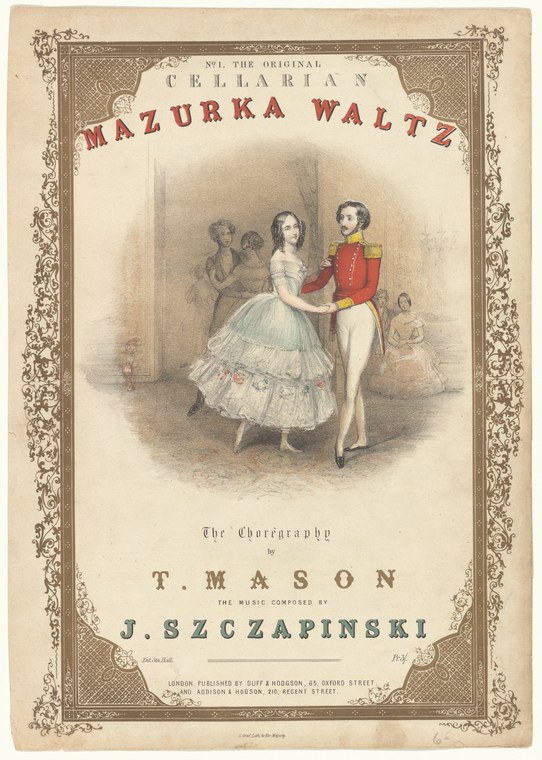
This print captures the moment when the mazurka became a staple of European ballroom culture, crossing from folk dance to fashionable salon practice. It is also a rare record of how dancers and their audiences imagined the movement: the still image on a music cover is itself a kind of choreographic notation, showing the hold, dress, and moment of the dance that the musical score will accompany. For historians of dance and design, it is evidence of how dances circulated through print, music, and commercial culture in the nineteenth century.
What you are looking at
A couple dances in an elegant interior, the woman in a pale tulle gown with a fitted bodice and voluminous skirt caught mid-swirl, her partner in a scarlet military coat with white trousers. The composition is intimate and formal: the pair occupy the center of the frame in a three-quarter view, with shadowy figures of observers visible in the background, suggesting a ballroom or salon setting. The woman's skirt, rendered in soft gray wash with delicate detail, dominates the lower half of the image; the man's bright uniform and the woman's pale dress create a strong color contrast typical of hand-colored theatrical prints. The lighting is warm and diffuse, focused on the dancing couple while the setting recedes into shadow. This is the cover of a music score, with decorative typography and an ornamental border framing the scene—a commercial print designed to advertise the dance and composer to a nineteenth-century audience.
The dancing
The couple holds a closed ballroom position: his right arm around her waist, her left hand resting on his shoulder, their right and left hands clasped at the side. Both bodies incline slightly toward each other, a frame typical of the waltz or mazurka. The woman's weight appears to be on her right leg as her skirt swings, suggesting mid-rotation or sway; her posture is upright and composed. The man stands firm, his military bearing evident in his straight back and the set of his shoulders. Their faces are serene and focused downward or toward each other, following the convention of ballroom etiquette. No footwork is visible, but the attitude of the bodies suggests smooth, flowing movement.
The dance depicted
This is a mazurka, as stated in the title. The mazurka was a Polish peasant dance that became fashionable in European ballrooms during the nineteenth century, particularly among the aristocracy. The print is the cover of the sheet music for Józef Moniuszko's 'Mazurka Waltz,' choreographed by T. M. Mason, and was published in London. The costume—military dress for the man, formal ball gown for the woman—and the closed ballroom hold confirm its identity as a ballroom dance of the Romantic era. The image shows the mazurka as it was danced in the salon: stately, partnered, and closely allied to the waltz in its formal mechanics, though the mazurka retained more of the characteristic accent and rhythmic variety of its Polish origins.
How it was made
This is a hand-colored lithograph or engraving, characteristic of the commercial music-cover prints that proliferated in London during the 1840s–1860s. The title and credits are letterpress or lithographic; the image itself appears to be a stone-drawn lithograph, tinted by hand with watercolor or gouache. This technique allowed for rapid, economical production of multiple copies while preserving fine detail in the figures and ornamental borders. The soft tonalities and the careful rendering of the woman's dress—especially the layered tulle—are typical of the hand-coloring process. Such prints were sold at music publishers and concert halls, making them affordable to middle-class audiences and serving as both advertisement and souvenir.
About this work
This is a commercial music cover from mid-nineteenth-century London, illustrating the mazurka—a Polish dance that captivated European ballrooms during the Romantic era. The print shows the dance in its ballroom form: a formal, partnered waltz-like movement performed by the aristocracy and upper middle class in drawing rooms and concert halls. The couple's dress, posture, and setting all confirm this as a document of how the mazurka was understood and consumed in Britain: exotic in origin, refined in execution, and tied to the world of sheet music, concert culture, and fashionable dancing masters. The image is both artwork and advertisement, designed to sell both the music and the idea of the dance to consumers who wanted to learn it themselves.
How to look at it
Attend to the woman's skirt: the artist has frozen the moment when it swings outward in the rotation of the dance, a moment of visual drama that best displays the volume and construction of the gown. The ornamental border and typography signal that this is a commercial object, not a fine-art print; the composition is designed to catch the eye in a shop window or on a music shelf. The couple's closed hold and their downward gaze follow the ballroom convention that dancers should appear absorbed in the movement and in each other, not in the spectator. The scarlet coat stands out against the pale dress deliberately—this is a print made to sell, and color harmony was key to that aim.
The artist
The choreography is credited to T. M. Mason; the music is by J. Szczapinski. Nothing is recorded of either figure in the catalogue. The print itself is unsigned. It was published by Chappell & Co. or Addison & Beale, major London music publishers of the era. The engraver or lithographer is not named, which is typical of commercial work of the period.
The period
The mazurka reached London and Paris in the 1820s–1830s, carried by Polish émigrés and taken up by the Romantic intelligentsia as a symbol of nationalist fervor and exotic authenticity. By the 1840s–1850s, when this print was made, it had become a staple of ballroom dancing, competing with the waltz for dominance. Unlike the waltz's continuous circular motion, the mazurka retained a more syncopated rhythm, characteristic accents, and an element of display. It was taught by dancing masters, published as sheet music and instruction books, and performed at public concerts and private balls. The Romantic era privileged folk forms and national character, and the mazurka fit this aesthetic perfectly—it was 'authentically' Polish yet refined enough for the drawing room.
Where it lives
This is a hand-colored lithographic or engraved music cover published by Chappell & Co. or Addison & Beale in London, held in the New York Public Library collection of prints depicting dance. It is one of thousands of such covers produced during the nineteenth century, a category of commercial print that has rarely been studied as a source for dance history.
Dance in this work
Questions about this work
Is this a waltz or a mazurka?
The title and the credit to Józef Moniuszko confirm it is a mazurka. Though the closed hold and frame resemble the waltz, the mazurka was a distinct dance with its own character, originating in Poland. By the mid-nineteenth century, the two dances were often confused or blended in the ballroom, and a 'mazurka waltz' like this one reflects that fusion.
Who was Józef Moniuszko?
Józef Moniuszko (or Joseph Szczapinski, as the credit on the print reads) was a composer of dance music and popular songs in the nineteenth century. He worked in London, where there was a thriving market for mazurkas and other fashionable dances. Beyond this credit, little is recorded of him in standard reference works.
How do we know this is the ballroom form of the mazurka?
The costume, the closed hold, the formal interior setting, and the publication as salon music all confirm this is the ballroom version of the mazurka, not the folk dance or a theatrical staging. The dress and deportment of the dancers follow the conventions of mid-nineteenth-century ballroom etiquette.
What was the mazurka's appeal in Europe?
The mazurka symbolized Romantic ideals of authenticity, national character, and exotic glamour. It came to London through Polish émigrés and appealed to the same audiences who embraced folk music, folk poetry, and folk costume as expressions of authentic feeling. It was also simply a beautiful dance to watch and to perform.
More dance artwork





