49 works in this view — arrow keys or swipe to move between them.
Dance in Art
Bal du May donné à Versailles
Unknown artist
- Collection:
- Prints depicting dance
- Source:
- New York Public Library
- Rights:
- Public domain — free to use, share and adapt.
- Recorded as:
- Public Domain
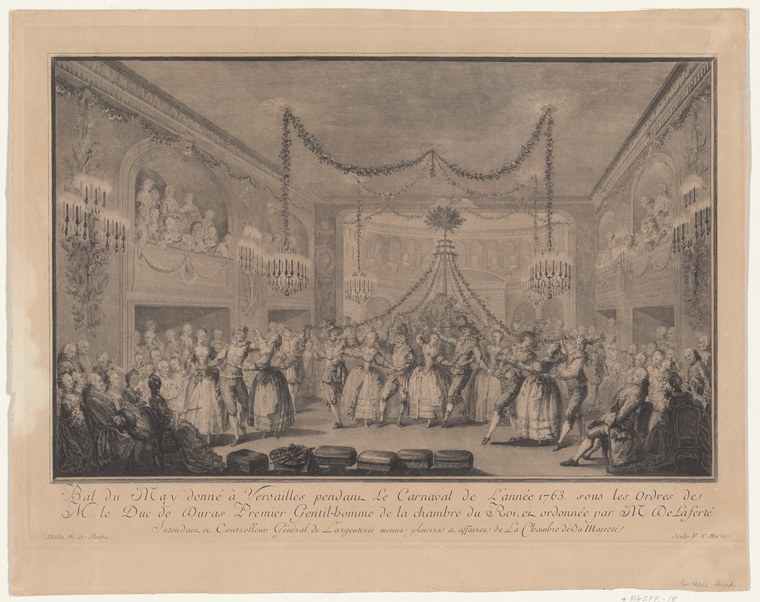
This is a dated, inscribed record of a specific historical dancing event at the French court, showing the minuet and quadrille embedded in their actual social context. For dancers and historians, it provides visual evidence of how 18th-century court dances were structured spatially, how participants dressed, and how these dances functioned as social ritual rather than solo performance.
What you are looking at
A grand ballroom filled with aristocratic dancers dressed in 18th-century formal attire. The space is ornate with crystal chandeliers, wall sconces, and garland swags draped across the ceiling. Couples are dispersed throughout the room in various formations—some in the center of the floor, others clustered near the walls or seated on benches. The dancers wear long gowns with full skirts (the women) and formal coats with breeches (the men). The setting suggests a royal palace or grand château, with classical architectural details visible in the background. A string of evergreen or flowering garland dominates the center of the ceiling, suspended from two tall pyramidal structures, creating a festive atmosphere. The engraving captures a moment of social gathering rather than active vigorous movement—people are promenading, conversing, and preparing to dance rather than in the midst of energetic figures.
The dancing
The figures are arranged in small groups and couples scattered across the floor, with many standing rather than actively dancing. Where couples are engaged, they maintain the upright, formal posture characteristic of 18th-century court dance, with arms extended in proper frame and bodies held at a distance. Several figures are seated on benches around the periphery, watching. The women's full skirts are prominent in the composition, and the men's formal dress includes justaucorps coats. The overall impression is of restrained, dignified movement and social positioning rather than virtuosic footwork or dramatic spatial claims.
The dance depicted
This depicts a ball—likely a minuet or contredanse occasion—at a French royal court or aristocratic venue, consistent with mid-18th-century dancing masters' documented practice. The inscription references Versailles and the Carnival of 1763, suggesting this is a specific historical event. The dance style visible is the formal court minuet or quadrille, danced by couples in a restrained, processional manner with emphasis on proper deportment and spatial arrangement rather than speed or height. The presence of musicians (implied by the formal setting) and the architectural framing suggest this is theatrical court dance in its most official, documented form.
How it was made
This is an engraving, recognizable from the fine linear work, the use of hatching for shadow and texture, and the tonal range achieved through varying line density. The technique allowed for detailed architectural rendering and the capture of multiple figures and their spatial relationships across the large ballroom. Engravings of this quality and subject matter were costly to produce, indicating circulation among educated, aristocratic audiences interested in documenting court life and social practice. The inscription in French suggests a French or cosmopolitan European market.
About this work
This engraving documents a masquerade ball held at Versailles during Carnival in 1763, under the auspices of the Duc de Boufflers and the chamber of the King. It is a valuable historical record of aristocratic dance practice in the late 18th century—not a depiction of any single choreography, but rather a social panorama showing how formal court dances were situated within broader ceremonial life. The image captures the minuet and quadrille as they were actually danced: as occasions for social positioning and conversation as much as for movement, with strict protocols of dress and deportment. It belongs in dance history as evidence of how court dance functioned as social performance, and in art history as an example of how engraving was used to document and circulate images of royal and aristocratic ceremony.
How to look at it
Attend to the spatial arrangement: dancers are neither packed densely nor scattered, but grouped in couples and small sets with clear geometric spacing. Notice the near-total absence of women's legs—their full skirts completely conceal the footwork, which was in any case constrained by fashion and the small, precise movements of the minuet. Look at the frame and posture of the dancers: arms are held out in the formal frame of the period, bodies are upright, and there is no sense of athletic exertion. The moment captured is one of presentation and social positioning; this is dance as ceremonial propriety.
The period
The mid-18th century saw the minuet and quadrille at the height of their formal prestige in European courts. These dances were taught by professional dancing masters according to strict codes of deportment and step. Versailles remained the model for court ceremony and courtly behavior across Europe, and the documentation of court balls through prints served to circulate images of proper aristocratic conduct. The Carnival season (Lent preceding) was a traditional occasion for masquerades and formal balls, and such events were frequently recorded in engravings for circulation among the nobility and educated classes. This period also saw the beginning of a shift away from the minuet toward faster, more social contredanses, making this 1763 record historically significant.
Where it lives
The work is held in the New York Public Library's collection of prints depicting dance. It is an engraving made after a drawing or painting documenting a specific historical event, suggesting it was a commemorative or celebratory work produced for court distribution or for sale to the aristocratic market.
Dance in this work
Questions about this work
What dance is being performed?
The primary dances would have been the minuet and the quadrille (contredanse). Both are visible in the arrangement of couples and sets across the floor. The minuet was a solo-couple dance in 3/4 time with formal, geometric movements, while the quadrille involved groups of four couples in set formations. Both required strict adherence to step and deportment.
How can you tell the date and place?
The inscription at the bottom of the engraving states in French that it depicts a ball given at Versailles during the Carnival of 1763 under the orders of the Duc de Boufflers, Gentleman of the Chamber to the King. This is a specific historical event, not a generic ball.
Why can't we see the dancers' feet?
Women's skirts in the 1760s were extremely full and reached to the floor, completely concealing the feet and legs. This was a standard feature of elite women's dress and made footwork invisible to observers—the focus of the minuet was on upper-body carriage, arm position, and spatial geometry rather than feet.
Why are so many people seated?
Not everyone danced at once. In a formal ball, dancing occurred in organized sets, and those awaiting their turn, those not invited to dance, or those preferring to observe would sit on benches around the room. This was normal social practice and a significant part of the ball's function as social display and courtship occasion.
More dance artwork





