49 works in this view — arrow keys or swipe to move between them.
Dance in Art
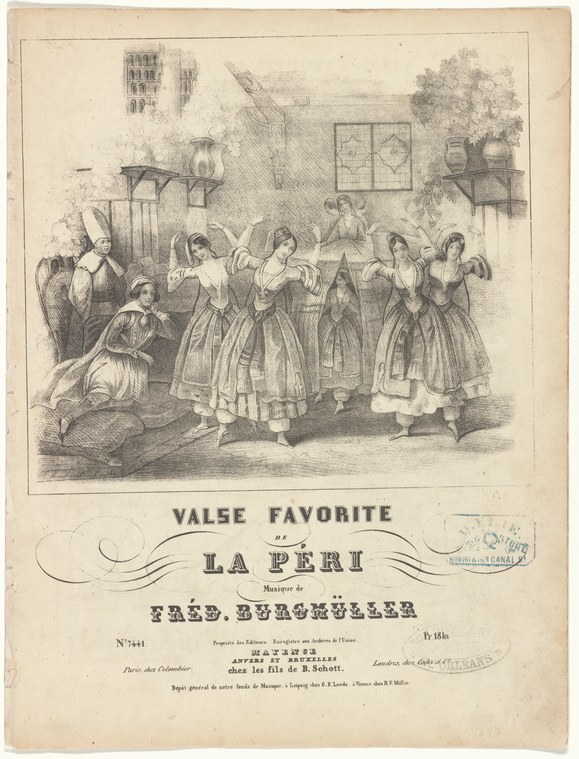
Valse favorite de La péri
Unknown artist
- Collection:
- Prints depicting dance
- Source:
- New York Public Library
- Rights:
- Public domain — free to use, share and adapt.
- Recorded as:
- Public Domain
This work documents the waltz during its transition from scandalous novelty to respectable social dance and theatrical spectacle. It is an example of how Romantic ballet and popular music intersected in 19th-century visual and material culture, and shows how dance imagery was packaged for middle-class consumption through music-cover prints.
What you are looking at
A crowded interior scene depicting a group of young women in early 19th-century dress gathered in what appears to be a modest room or dance hall. The women wear high-waisted muslin gowns with puffed sleeves and bonnets typical of the Regency era. They are arranged in a loose formation, some standing, some with arms raised or extended as if in the midst of movement. The setting includes simple furnishings—a table or chair visible on the left, a window with panes in the background, and architectural details suggesting a domestic or semi-public space. The lighting is even and atmospheric, created through the engraver's hatching technique. The composition suggests a moment of social gathering or informal performance, with the women's postures suggesting music, movement, or animated conversation. The mood is one of youthful energy and social pleasure.
The dancing
The women stand and move without rigid formation or obvious partnering. Several have raised arms in gestures that suggest lightness and abandon rather than ballroom discipline—some with arms extended sideways, others with hands raised. The skirts, rendered in fine parallel lines by the engraver, are caught in movement, suggesting the swirl of a twirl or the ripple of active motion. There is no visible closed hold or the structured frame of partnered ballroom dance. The bodies tilt and lean; the overall impression is of freedom of movement and an emphasis on the upward, floating quality of the bodies rather than grounded, weighted steps.
The dance depicted
This image illustrates a valse—a waltz—titled as the 'favorite waltz of La Péri,' likely a choreographed piece or popular musical piece associated with the Romantic ballet *La Péri* (first performed 1843 by Jean Coralli). The waltz was danced socially in early 19th-century ballrooms but also appeared as a theatrical spectacle in Romantic ballet, where it was performed by corps de ballet and soloists in costume. This engraving appears to depict a theatrical or semi-theatrical waltz performance, possibly a group waltz scene such as would appear in a ballet or stage production, rather than a formal ballroom waltz between couples. The emphasis on the collective movement of young women in matching dress suggests a corps de ballet interpretation.
How it was made
This is a wood engraving or steel engraving, identified by the fine parallel hatching, careful gradation of tone, and the crisp black lines characteristic of the medium. The technique allowed for fine detail in fabric texture and facial features. The print carries a Parisian imprint (Chez Ies fils de Noblet), indicating it was a commercial publication, likely a music cover or theatrical souvenir. Engravings of this type had wide circulation among the middle-class audience for music and dance, and the presence of printed music notation at the bottom confirms this was a published score cover.
About this work
This is a commercial music-cover engraving from mid-19th-century Paris, illustrating a theatrical waltz titled after the Romantic ballet *La Péri*. It shows a group of young women in Regency dress performing a buoyant, free-moving waltz in a domestic or theatrical interior. The image captures the Romantic-era fascination with the waltz as both a social and theatrical form, and the emphasis on lightness, youth, and feminine grace characteristic of Romantic ballet aesthetics. The engraving served a dual function: to advertise the music to piano-playing households and to commemorate or promote a stage performance or fashion associated with the dance.
How to look at it
Attend to the postures of the women: their raised arms and tilted bodies convey a sense of upward momentum and spiral motion characteristic of the waltz turn. The engraver has captured not a single fixed moment but a sense of continuous rotation and flight. Notice how the figures are distributed across the space in no strict geometric order, unlike a formal quadrille or contredanse, emphasizing the freedom and expressiveness the Romantic era associated with the waltz. The fine rendering of fabric suggests the importance of the visual spectacle of movement—the swirl of skirts was as much a part of the waltz's aesthetic appeal as the steps themselves.
The artist
The engraver is not credited in the catalogue record. The print bears the imprint of Chez les fils de Noblet, a Parisian music publisher, and was engraved and printed in Paris. The work is unsigned and was likely created by a commercial workshop engraver working for the publisher, a common practice for music-cover illustrations in this period.
The period
The waltz emerged in Vienna in the late 18th century and spread across Europe in the early 19th century, initially controversial for its close partnering and rotational movement. By the 1830s–1840s, it had become fashionable in ballrooms and was incorporated into theatrical works, including Romantic ballets. The Romantic ballet period (roughly 1830–1850) embraced the waltz as an expressive, lyrical form that suited the ethereal, weightless aesthetic favored in works like *Giselle* and *La Péri*. This engraving belongs to the moment when the waltz was being consolidated as both a ballroom standard and a theatrical form.
Where it lives
This engraving is held in the New York Public Library's collection of dance-related prints. It is a published music cover, likely dating to the 1840s–1850s, printed in Paris and intended for the domestic market as both a musical score and a souvenir or advertisement of a theatrical piece.
Dance in this work
Questions about this work
What is La Péri?
*La Péri* is a Romantic ballet first choreographed by Jean Coralli in 1843, with music by Frédéric Burgmüller. A peri is a beautiful fairy in Persian mythology. The ballet tells the story of a mortal lover's quest for an ethereal fairy, and it exemplifies the themes of longing, grace, and otherworldliness central to Romantic ballet. The waltz was a key movement in the ballet.
Is this a ballroom scene or a theater scene?
The image is ambiguous by design. The setting—a modest interior—could be either. However, the grouping of multiple women in identical dress, the formal arrangement, and the association with a named theatrical work suggest this is a theater or stage scene, likely depicting a corps de ballet performance of the waltz from the ballet or a theatrical adaptation of it.
Why were waltzes engraved and printed on music covers?
The waltz was hugely popular in the 19th century, and piano arrangements of famous waltzes (especially those from ballet and opera) were sold to amateur musicians for domestic performance. The engraved cover served both as advertisement and as a souvenir or memento of a famous dance or theatrical piece. Such prints reached a broad middle-class audience.
How can you tell this is an engraving?
The fine parallel lines (hatching), the crisp black lines, the even tone, and the careful gradation of shading are all hallmarks of wood or steel engraving. The texture and fineness of detail are characteristic of this medium, which allowed for wide-scale reproduction by press.
More dance artwork





