49 works in this view — arrow keys or swipe to move between them.
Dance in Art
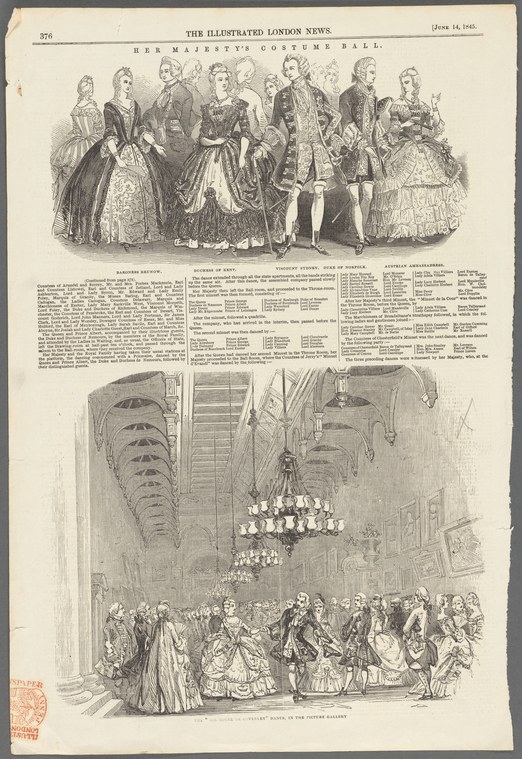
Her Majesty's costume ball; The "Sir Roger de Coverley" dance in the picture gallery
Unknown artist
- Collection:
- Prints depicting dance
- Source:
- New York Public Library
- Rights:
- Public domain — free to use, share and adapt.
- Recorded as:
- Public Domain
The image is valuable evidence that the Sir Roger de Coverley remained a prestige dance in Victorian high society even as new waltz and ballroom forms emerged, and it shows in considerable detail how a large formal country dance was organized and executed in a grand institutional space. For anyone studying the persistence of folk and early modern dance forms in later eras, or the role of dance in 19th-century court ritual, this is primary visual testimony.
What you are looking at
This is a wood engraving from The Illustrated London News depicting two distinct moments of a formal court ball held at Her Majesty's residence. The upper half shows nine figures in elaborate Victorian formal dress arranged in a line, presenting the attendees in their costumes of rich fabrics, jewels, and ornamental detail. The lower half captures the "Sir Roger de Coverley" dance in progress within a grand gallery: a substantial crowd of dancers and spectators fills a columned hall hung with chandeliers, the space rendered in atmospheric perspective that emphasizes the scale and grandeur of the occasion. The dancers are arranged in the characteristic line formations of a country dance, with couples positioned along the length of the gallery, their bodies engaged in the figure patterns of the Sir Roger de Coverley. The engraver has captured both the formal presentation of court society and the animated social dance that follows, using the two halves of the page to document the event's ceremonial and recreational aspects.
The dancing
In the dance scene below, couples are arranged in long lines facing one another across the gallery floor, a disposition fundamental to the Sir Roger de Coverley and English country dances. The bodies show the characteristic upright carriage and controlled arm positions of Victorian ballroom deportment, with dancers in closed or semi-closed holds appropriate to the period. The women's voluminous skirts, visible in silhouette, dominate the visual rhythm; the men appear in evening dress. The engraver has rendered sufficient detail to show dancers mid-figure—some in processional movement down the lines, others in the turning and casting movements the dance requires—though the distance and density of the crowd prevents precise analysis of footwork or arm placement.
The dance depicted
The "Sir Roger de Coverley" is an English country dance of long standing, named after a character in *The Spectator* and descended from earlier longways set traditions. By the Victorian era it was a standard feature of formal balls and public assemblies, danced in the formation visible here: two long lines of couples facing each other, executing a sequence of figures including processional movements, allemandes, and casts. The image documents its persistence as a fashionable court entertainment in the 19th century, the scale of the gathering suggesting this was a significant state occasion. The precise year is not stated in the catalogue record, but the style of the women's dress and the engraving technique place it in the mid-Victorian period, when such formal balls were regular features of London society.
How it was made
This is a wood engraving, a relief printing process that produced crisp, fine lines suitable for reproduction in newspapers and periodicals. The technique allowed the artist to capture considerable architectural and dress detail while rendering crowd scenes through suggestive rather than literal portrayal—faces in the gallery are indicated by stipple and line rather than individually rendered. Wood engraving was the dominant medium for news illustration in the mid-19th century and would have allowed this image to reach thousands of readers of *The Illustrated London News*, making it both a documentary record and a piece of popular visual journalism circulated to the educated middle and upper classes who would have been interested in court proceedings.
About this work
This is a page from *The Illustrated London News* documenting a formal ball at court, presenting both the society attendees in their official dress and the Sir Roger de Coverley dance in progress in the state gallery. The work captures a specific moment in Victorian court life and offers evidence of the continued use of an old English country dance in the most formal social settings of the era. It serves simultaneously as fashion plate, architectural record, and dance documentation, aimed at readers who were not present but wished to know how the evening unfolded.
How to look at it
Notice the two distinct registers: the formal presentation portrait of the attendees above, and the social dance below. The architectural setting—the columns and chandeliers—is rendered with the artist's careful attention to the geometry of the gallery, emphasizing that this is a documented place and event. Look at the density and arrangement of the dancers: they are not posed, but caught in the midst of the figure patterns that make up the Sir Roger de Coverley, with some couples advancing while others turn or retreat. The crowded spectators at the margins of the dance floor and in galleries above indicate that watching was as much part of the occasion as participating.
The artist
The artist is not recorded in the catalogue. The work is a product of the *Illustrated London News* workshop, which employed a large staff of engravers and artists in the mid-19th century. Such pages were typically collaborative: a journalist or society correspondent would report on the event, an artist would sketch it or work from verbal description, and specialized wood engravers would execute the final blocks for printing.
The period
The Victorian era saw a stylistic division in ballroom dancing: the waltz and newer couple dances dominated fashionable ballrooms, yet formal court balls and public assemblies retained older set dances and country dances as markers of tradition and decorum. The Sir Roger de Coverley in particular was considered a respectable, nostalgic form suitable for mixed company at official functions. Meanwhile, the growth of the popular press, and *The Illustrated London News* in particular (founded 1842), created an enormous appetite for images of court life and fashionable society. This engraving reflects both the dance culture of the period and the visual media ecosystem that documented it for a mass readership.
Where it lives
The work is held as part of the New York Public Library's collection of prints depicting dance. It is a page from *The Illustrated London News*, a weekly periodical, and represents the documentary and entertainment function of the illustrated press in Victorian Britain.
Dance in this work
Questions about this work
What is the Sir Roger de Coverley?
It is an English country dance performed in two long lines of couples facing each other. Named after a character in the 18th-century periodical *The Spectator*, it combines processional figures, reels, and casts. By the Victorian era, it was considered a respectable, traditional dance suitable for formal balls and public assemblies, often closing the evening or serving as a moment of decorum between newer waltz and quadrille dances.
How would this dance have been learned and performed?
Dancers would have learned the figures from a dance master or through repetition at social events. A caller or musician would lead the dance, and participants would follow the established pattern. The image shows that even in a large formal setting, the dance could accommodate many couples simultaneously in its linear formation, making it practical for court occasions where large numbers of people needed to participate.
Why publish this image in a newspaper?
*The Illustrated London News* was aimed at educated middle- and upper-class readers who were interested in court life, fashion, and social events. Publishing images of the ball allowed those not present to know how the evening unfolded, what people wore, and which dances were performed. It served as both documentary evidence and aspirational social content.
What does the architecture tell us?
The grand gallery with columns and multiple chandeliers indicates this is a state occasion in a significant institutional space—likely a royal palace or ministerial residence. The scale and formality of the setting reflect the importance of the event and the status of those invited. Country dances required long, clear floor space, and the gallery's proportions made it ideal for hosting the Sir Roger de Coverley.
More dance artwork





