49 works in this view — arrow keys or swipe to move between them.
Dance in Art
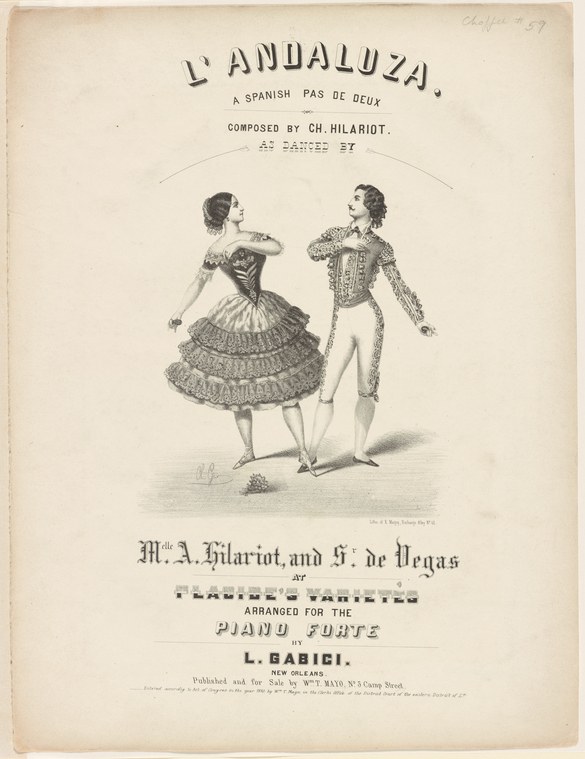
L'andaluza: A Spanish pas de deux composed by Ch. Hilariot. As danced by Melle. A. Hilariot, and Sr. de Vegas at Placide's Varietès, arranged for the piano forte by L. Gabici
Unknown artist
- Collection:
- Prints depicting dance
- Source:
- New York Public Library
- Rights:
- Public domain — free to use, share and adapt.
- Recorded as:
- Public Domain
For dance historians, this print is evidence of the repertory, casting, and visual presentation of mid-19th-century theatrical dance, and of the commercial systems that turned stage pieces into domestic drawing-room music. For scholars of theatrical costume and fashion, it documents the clash between contemporary women's dress and consciously Spanish male costume as a source of visual erotic interest. For anyone tracking European responses to Spanish culture in the 19th century, it shows how Spanish identity was performed, packaged, and circulated as a commodity.
What you are looking at
This is a lithographic cover page for a piano arrangement of a Spanish dance. Two figures are depicted in profile against a plain background, rendered in the sharp black-and-white contrasts typical of mid-19th-century theatrical prints. On the left, a woman wears a voluminous dark skirt with pronounced horizontal pleating or flouncing that extends from her waist to her ankles—the silhouette of fashionable 1840s dress. Her bodice is fitted and off-the-shoulder, her posture upright and alert. On the right, a man stands in a contrapposto pose wearing the tight breeches, short jacket, and embroidered waistcoat of Spanish theatrical costume. His legs are splayed in a wide stance, one arm extended toward his partner in a gesture of invitation or engagement. The woman leans slightly back, her arm raised as if responding to his movement. The composition is symmetrical and theatrical, designed to convey the dramatic courtship at the heart of the Spanish pas de deux.
The dancing
The woman and man are separated by a small distance, neither in closed hold nor in a formal ballroom frame. The man's weight appears to be distributed across a wide base; his extended arm and forward lean suggest the gallant address of Spanish courtship dances. The woman's raised arm and backward lean suggest a coquettish response or a moment of theatrical tension between the partners. Both figures are shown in profile, which was the conventional way to display costume and bodily extension in theatrical prints of this era. The artist has chosen a moment of encounter rather than active partnered movement—a pause in which attraction and social negotiation are readable in posture and gesture.
The dance depicted
The title identifies this as *L'Andaluza*, a Spanish pas de deux composed by Ch. Hilariot and performed by Mlle. A. Hilariot and Sr. de Vegas at the Placide's Variétés theatre. The dance belongs to the theatrical ballet tradition of the mid-19th century, when Spanish-themed dances were fashionable as character pieces or divertissements within longer ballets. The print is a cover for a piano arrangement, indicating this was a piece of music for social or pedagogical use as well as professional performance. Nothing in the image contradicts a Spanish regional or character dance context: the woman's fashionable dress, the man's Spanish costume, and the courtship tableau are all consistent with the theatrical conventions of the 1840s-1850s.
How it was made
This is a lithograph, identifiable from the characteristic black-line drawing, tonal graduation, and compositional layout typical of mid-19th-century French theatrical music covers. Lithography allowed rapid, inexpensive production of sheet music covers and theatrical prints; the fine detail visible in the costume embroidery and the woman's pleating suggests a skilled transfer to stone. The credit to L. Babici (Babicci?), a New Orleans publisher, indicates this was a commercial product aimed at both professional dancers and amateur musicians—people who wanted to own and perform a fashionable piece. Such prints had wide circulation and served as both promotion for the original stage work and a durable record of how the dance was costumed and presented.
About this work
This is a lithographic cover for a piano reduction of a theatrical Spanish dance composed and performed in mid-19th-century Paris. The image freezes a moment of social interaction between two dancers—a woman in contemporary fashionable dress and a man in Spanish costume—in a pose that emphasizes courtship, tension, and theatrical presentation rather than technical movement. As a published music cover, it represents the dance as a commodity for drawing-room performance and as a memory of professional stage work; the print circulated through sheet music distribution and theatrical publicity, making it a window onto both professional dance practice and the domestic consumption of dance-derived music in the 19th century.
The work sits at the intersection of several 19th-century obsessions: the European fascination with Spanish exoticism and regional character, the dominance of ballet and character dances in theatrical spectacle, and the rise of printed musical and visual ephemera as a mass medium. It documents not primarily how the dance was actually executed, but how it was marketed and imagined—the image is a sales tool and a souvenir, calculated to evoke the glamour and drama of the stage.
How to look at it
Attend to the postures and gestures rather than any suggestion of footwork or technical vocabulary. The artist has chosen to show the dancers in a moment of social negotiation—the man's bold, splayed stance contrasts with the woman's more reserved, leaning-back response. The woman's contemporary dress is key; she is not in a ballet dress or Spanish costume, which makes the Spanish-costumed man's approach to her a cross-cultural encounter. The theatrical profile view, the careful rendering of costume detail, and the balanced composition are all devices to catch the eye and sell the image as a record of a glamorous stage event. The print was meant to be looked at in a music shop or a drawing room, not studied for technical information about the actual choreography.
The artist
The composer Ch. Hilariot and dancer Mlle. A. Hilariot appear to have been working in Parisian theaters (likely related by family). Hilariot's arrangement for piano was published by L. Babici in New Orleans, indicating either that the piece was successful enough to be exported for American distribution or that Babici obtained publication rights independently. No broader biographical information about Hilariot the composer is given in the record, and no visual signature or identifying information can be extracted from the print itself.
The period
The 1840s-1850s were the height of Romantic ballet in Paris and a peak period for character dances and national divertissements within full-length ballets. Spanish theme dances were particularly fashionable in this era, reflecting a broader European Romanticist obsession with the exotic, the Southern, and the passionate. The théâtres de variétés (variety theaters) where this piece was performed occupied a tier below the Opéra in prestige but competed vigorously for audiences and innovation; they specialized in shorter character pieces, acrobatic divertissements, and music-hall spectacle. The publication of dance music for home performance—usually arranged for piano—was a major commercial enterprise, allowing middle-class households to own and replay the sensations of the stage. This print is a product of that system.
Where it lives
This print is held by the New York Public Library as part of their collection of prints depicting dance. It was published in New Orleans by L. Babici (printer and music publisher), which suggests either an American edition of a French piece or a reissue of rights. The object is a music cover and theatrical advertisement combined—a commodity that circulated through sheet music sales and theatrical publicity networks.
Dance in this work
Questions about this work
Was this a real ballet or just a ballroom dance?
It was a theatrical piece—a *pas de deux* (a dance for two) composed for the stage and performed by professional dancers at the Placide's Variétés theatre in Paris. However, the fact that it was arranged for piano and published as sheet music means it was also adapted for drawing-room performance by amateurs. The distinction between 'stage' and 'social' was porous in this era; successful theatrical pieces regularly became domestic music.
Who were Hilariot and de Vegas?
They were professional dancers working in Parisian variety theaters in the mid-19th century. Mlle. A. Hilariot and Sr. de Vegas are credited as the performers of the original stage version. Beyond their names and this association, little is recorded here. They were not major stars of the Paris Opéra ballet, but rather performers in the slightly less prestigious but often more innovative variety theater circuit.
What is the dress supposed to tell us?
The woman wears fashionable contemporary (1840s) European dress—the off-shoulder bodice and voluminous pleated skirt were current haute couture. The man wears consciously Spanish costume: the tight breeches, embroidered jacket, and theatrical bearing. The visual contrast between the two suggests a fantasy encounter—the 'Spanish man' approaching the 'European woman.' This cross-cultural flirtation was a stock scenario in Romantic-era theater and dance.
How do we know this is a lithograph and not something else?
The characteristic technique is visible: the fine black line, the bold contrasts between black and white (no gray wash or shading), and the layout and typography typical of mid-19th-century French theatrical music covers. Lithography was the dominant process for theatrical prints and music covers in this period because it was fast, cheap, and allowed for detailed illustration combined with text.
More dance artwork





