49 works in this view — arrow keys or swipe to move between them.
Dance in Art
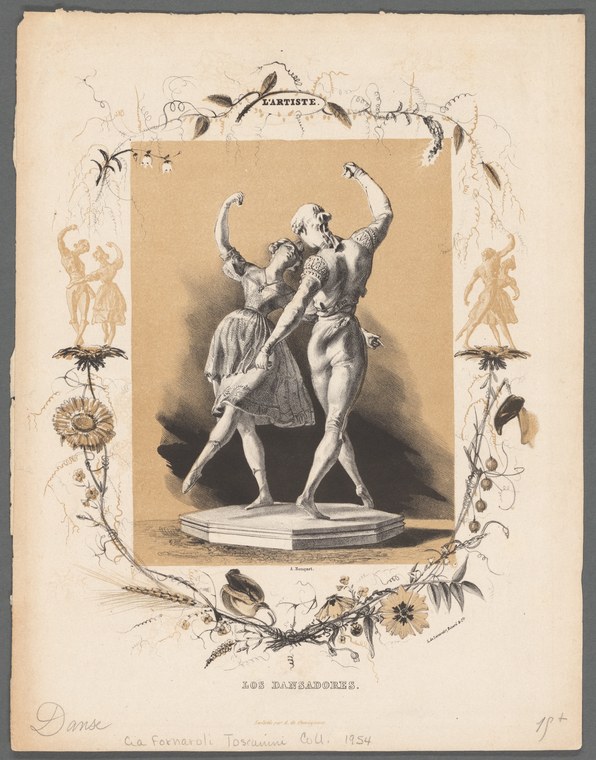
Los dansadores
Unknown artist
- Collection:
- Prints depicting dance
- Source:
- New York Public Library
- Rights:
- Public domain — free to use, share and adapt.
- Recorded as:
- Public Domain
This image documents the aesthetic and physical grammar of Romantic ballet partnership — the lifted figure, the supporting male dancer, the idealization of the female form in motion — that remains foundational to classical ballet today. For historians of nineteenth-century dance, it provides evidence of how the balletic body was understood, represented, and circulated to audiences beyond the theatre.
What you are looking at
Two dancers perform on a circular platform against a dark background, their bodies captured in a moment of balletic lift and support. The dancer on the left, wearing a draped skirt, is held aloft by the dancer on the right, who stands in a powerful supporting pose with one leg extended. Both figures are rendered in neoclassical style with idealized musculature and graceful lines. The composition is framed by an ornamental border of botanical elements — flowering vines, leaves, and sunflowers on the left and right margins — with a decorative cartouche at the top bearing the word "L'ARTISTE" and the title "LES DANSADORES" at the base. The technique creates strong modeling through shadow, with the dancers' bodies highlighted against the darker surround.
The dancing
The supporting dancer stands in a classical pose with upright carriage and one leg extended, demonstrating the strength required for partnered work. The lifted dancer is cradled horizontally, with arms raised and head tipped back in an attitude of abandon or ecstasy. The relationship between the figures is one of intimate trust and physical mastery — the male figure bears the female's full weight with apparent ease, a dynamic central to academic ballet of the nineteenth century. The musculature of both dancers is emphasized, suggesting trained, professional performers.
The dance depicted
This is a romantic-era ballet scene, most likely representing either an adagio sequence or a moment of theatrical apotheosis in which the ballerina is lifted and displayed by her cavalier. The pose — horizontal lift with the dancer's body fully extended and supported — was a signature of grand Romantic ballet and would remain foundational to classical ballet technique. The image presents idealized rather than naturalistic movement, consistent with the aesthetic conventions of nineteenth-century theatrical dance. The scene may reference a specific celebrated work, but without additional documentation it cannot be identified more precisely.
How it was made
This is an engraving or lithograph, executed in the academic realist style. The work demonstrates skilled draftsmanship in the rendering of the human form and sensitive gradation of tone to create volume and drama. The ornamental border — a common feature in commercial dance prints of the period — indicates this was intended for circulation as a standalone sheet, likely sold to audiences as a souvenir or to collectors of dance imagery. The combination of naturalistic figure drawing with neoclassical composition suggests production in mid-to-late nineteenth century Europe.
About this work
Les Dansadores is an academic theatrical image celebrating the technical and aesthetic ideal of Romantic-era partnered ballet. The work captures a moment of lift — a display of virtuosity and trust between dancers — rendered in the neoclassical style that dominated high art representation of dance in the nineteenth century. The ornamental border frames the dancers as subjects worthy of serious aesthetic attention, positioning the image as both a souvenir for theatre-goers and a work of printmaking craft. The piece belongs to a tradition of ballet imagery produced for a growing middle-class audience eager to commemorate celebrated performances and perpetuate the ideal of the graceful, supported ballerina.
How to look at it
Attend to the moment of suspension: the artist has frozen the lift at its moment of maximum extension and vulnerability, with the lifted dancer's body fully displayed and the supporting dancer's strength implicit in his stable stance. The ornamental surround of natural forms — flowers and vines — suggests the ballet's connection to Romantic idealization of nature and the feminine. The composition asks you to admire the geometry of the partnered form: the way the male dancer's vertical line contrasts with the female dancer's horizontal extension, creating a balanced, almost architectural image of support and display.
The period
This work dates to the height of Romantic ballet, the era of Marie Taglioni, Fanny Elssler, and the full flowering of pointe-work and ethereal aesthetic in European theatre. The mid-nineteenth century saw an explosion of dance-related commercial prints and lithographs, as ballet became a major entertainment for urban audiences and a subject for visual artists. The neoclassical style and ornamental framing reflect the period's conviction that ballet was an art form worthy of the highest aesthetic consideration — a reconciliation of ancient ideals with contemporary performance.
Where it lives
The work is held in the New York Public Library's collection of prints depicting dance, a substantial archive of commercial and artistic dance imagery accumulated over several centuries. The annotation visible at lower left ("C. Forneaux, Toronto, O.U. 1954") indicates a prior owner or cataloguer, suggesting this sheet circulated as a collectible object.
Dance in this work
Questions about this work
What dance move is being shown?
This is a lift or supported arabesque, a fundamental movement in partnered ballet where the male dancer supports the female dancer in a horizontal or semi-horizontal position. The moment shown — with the female dancer's body fully extended and the male dancer standing solidly to support her — is the climax of the movement, displaying both dancers' technical skill and the trust required for partnered work.
Is this a real dance scene or an imaginary one?
It is both: the lift was and is a real technical movement, but the idealized treatment of the bodies, the perfect geometries, and the theatrical framing indicate this is not a documentary image of an actual performance. Rather, it is an artistic representation of the Romantic ballet aesthetic — a vision of what ballet aspired to be.
Why is the border decorated with flowers?
The ornamental surround reflects the Romantic era's fascination with nature and the feminine. Flowers and natural forms were thought to align ballet with ideals of beauty, lightness, and grace. For commercial prints, the decorative border also served a practical purpose: it framed the image as a finished, gallery-like object suitable for display or collection.
More dance artwork





