49 works in this view — arrow keys or swipe to move between them.
Dance in Art
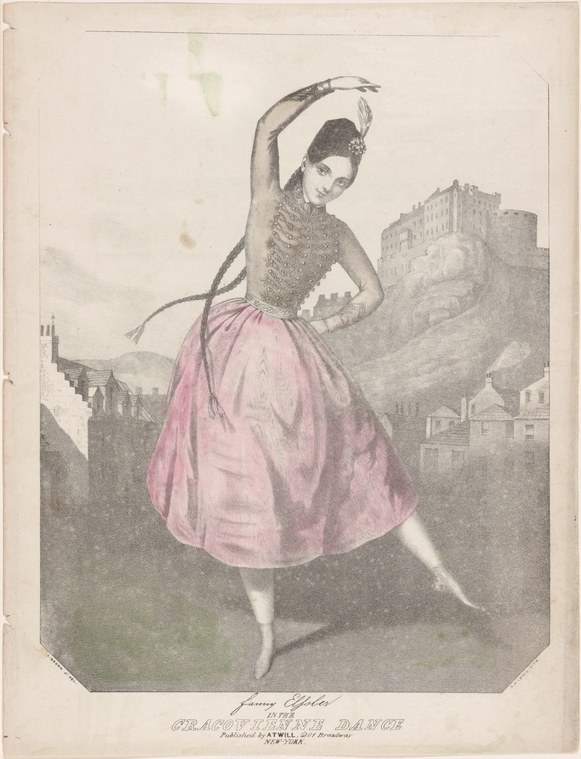
Fanny Elssler [facsim. sig.] in the Cracovienne dance
Unknown artist
- Collection:
- Prints depicting dance
- Source:
- New York Public Library
- Rights:
- Public domain — free to use, share and adapt.
- Recorded as:
- Public Domain
Fanny Elssler was one of the defining ballerinas of the Romantic era, rivaling even Marie Taglioni in fame and technical achievement. Prints like this are among the only visual records of how she was actually posed and costumed on stage—a direct link to her performance practice. The work also shows how Polish and other national dances entered the Western theatrical canon in this period, a cultural exchange that shaped the subsequent development of ballet.
What you are looking at
A woman in a pink silk skirt and fitted bodice stands in a dynamic, curved pose against a European architectural backdrop. She wears a patterned or scaled upper garment with short sleeves, and her dark hair is swept up. Her right arm arcs overhead in an elegant curve while her left arm extends outward; her body twists in a pronounced S-shape. She stands on what appears to be one supporting leg, the other lifted. Behind her, a fortified castle or fortress dominates the upper right, with a church spire visible to the left, and steep-roofed buildings at ground level suggesting a Central European town. The engraving is hand-colored with pink highlighting her skirt. The composition is framed with rounded corners. Text at the base identifies the subject and work.
The dancing
A single female figure, posed in a balletic contrapposto with significant spine extension and lateral flexion. The raised right arm creates an arc overhead; the extended left arm remains at approximately shoulder height. The supporting leg appears nearly straight with subtle turnout, while the non-supporting leg is lifted or drawn up, suggesting a balletic position—possibly an arabesque or attitude. The overall line emphasizes elongation and grace rather than weight-bearing or grounded steps. This is the classical vocabulary of early 19th-century theatrical dance, not folk idiom.
The dance depicted
The title identifies this as Fanny Elssler performing the Cracovienne, a Polish regional dance that became a celebrated theatrical showpiece in the Romantic era. Elssler was one of the most famous ballerinas of the 1830s-1840s, known for her technical brilliance and interpretation of character dances. The Cracovienne (from Kraków) was part of the ballet vocabulary by this period, a stylized theatrical adaptation of Polish folk dance rather than an authentic traditional form. The pose here emphasizes the balletic treatment: the lifted leg, the arched torso, and the refined arm geometry show how the dance was theatricalized for the stage. The architectural setting (Polish fortress) grounds the performance in its supposed geographic origin, a common Romantic-era practice of using exotic or regional settings to lend authenticity.
How it was made
This is a hand-colored engraving, likely a commercial print made for circulation among theater-goers and collectors in the mid-19th century. The technique allowed fine detail in the costume patterning and architectural rendering; the hand-coloring (pink for the skirt) adds immediacy and appeal. Such prints were produced in multiple impressions and distributed widely—this was the era before photography monopolized dance documentation, so theatrical prints like this one were the primary visual record available to a public that might never see the dancer live. The holding collection (NYPL's prints on dance) preserves it as a document of theatrical practice and star culture.
About this work
This is a commercial theatrical print from the Romantic ballet era, likely 1835–1845, capturing the celebrated Polish-born ballerina Fanny Elssler in one of her signature roles. The engraving was mass-produced to sell to theater audiences and to serve as a memento of her performances. The print records not just a dance but a moment in the professionalization of ballet and the international celebrity system: Elssler toured Europe extensively, and prints of her in famous roles were as much merchandise as art. The Cracovienne itself exemplifies how Romantic ballet absorbed, stylized, and elevated folk idioms into the classical vocabulary. This work belongs in a dance gallery because it documents a specific performance tradition (the character dance within ballet), shows how a historical dancer was visually marketed to her public, and captures the moment when theatrical dance printing became a commercial and cultural industry.
How to look at it
Attend to the moment the artist chose: Elssler is caught mid-movement, with her body in a pronounced curve that displays both the control and the elongation prized in Romantic ballet. The lifted leg and arched back show the baletic grammar of the period—the body is extended upward and outward, defying gravity even in a static pose. Notice how the Polish setting (the fortress) is rendered distinctly but secondarily, as backdrop rather than integrated environment; this framing is typical of theatrical prints, which center the star and use setting mainly to indicate character or nation. The hand-coloring of the skirt in pink draws the eye to the lower body and suggests the movement of fabric—the engraver and colorist collaborated to evoke motion within stillness.
The artist
The engraver is not recorded in the catalogue. Hand-colored theatrical prints of this period were typically produced by publishing houses—often Parisian, the center of ballet culture—and sometimes credited to the engraver or publisher rather than to an original designer. The print likely derives from a portrait or sketch made from life or from another theatrical representation. Many such prints were issued by firms like Charivari or other theatrical publishers who worked rapidly to capitalize on a dancer's current fame.
The period
The 1830s–1840s were the height of the Romantic ballet era, when dancers like Taglioni, Elssler, and Cerrito dominated European stages. This was also the period when ballet absorbed and theatricalized folk and national dances—Polish, Spanish, Hungarian forms entered the classical vocabulary as character pieces or divertissements. The rise of the ballerina as international celebrity paralleled the rise of lithographic and engraved portraiture as a mass medium. Theater prints were a booming market, sold in lobbies, in shops, and through subscription series. At the same time, this was before photography; the engraving was the fastest, most reproducible way to distribute an image of a famous performer to a paying public.
Where it lives
This work is held in the New York Public Library's Prints collection on dance, a major repository of theatrical ephemera. It is catalogued as a facsimile or reproduction, likely from the 19th-century original print, which suggests the NYPL holds a later printing or copy rather than the first edition. Such works entered library collections both as historical documents of performance and as examples of printmaking technique.
Dance in this work
Questions about this work
Who was Fanny Elssler?
Fanny Elssler (1810–1884) was an Austrian ballerina and one of the two dominant theatrical dancers of the Romantic era, the other being Marie Taglioni. She was celebrated for her technical precision, her beauty, and her success in character dances—lively, nationally-inflected pieces that allowed her to display personality and virtuosity. She toured Europe and the Americas extensively, and became an international celebrity.
What is the Cracovienne?
The Cracovienne is a stylized theatrical dance based on Polish folk traditions, named after Kraków. In the 19th century, it became a standard piece in the ballet repertory—a character dance performed as a solo or divertissement within a longer ballet. It typically featured rapid footwork, high spirits, and a sense of national character. Elssler's version became famous and was much imitated.
How were dancers documented before photography?
Before photography became practical for action shots, dancers were documented through engravings, lithographs, and hand-colored prints made from sketches or live observation. These prints were created quickly and distributed as commercial merchandise—sold in theater lobbies, through publishers, and via subscription. They served as mementos for fans and as advertising for future performances. Many prints showed the dancer in a single, graceful pose rather than in dynamic action, as that was easiest to render.
What does this print tell us about the dance itself?
The balletic pose—the lifted leg, the arched torso, the refined arm geometry—shows that by Elssler's era, even folk-derived dances were executed within the classical ballet vocabulary. This is not a reconstruction of authentic Polish folk dance, but rather a theatricalized version that used folk elements (the title, the setting, possibly some footwork or music) within a framework of Western balletic technique. It exemplifies how Romantic ballet absorbed and elevated national forms.
More dance artwork





