49 works in this view — arrow keys or swipe to move between them.
Dance in Art
Dance on music covers
Unknown artist
- Collection:
- Prints depicting dance
- Source:
- New York Public Library
- Rights:
- Public domain — free to use, share and adapt.
- Recorded as:
- Public Domain
For dance historians, this image documents the visual codes and costume conventions of Romantic ballet at its commercial peak, showing how the genre was visually marketed to audiences outside the theater. For those studying 19th-century visual culture more broadly, it exemplifies how lithography democratized access to theatrical imagery and allowed multiple copies of idealized performance scenes to circulate as affordable decorative objects in middle-class homes.
What you are looking at
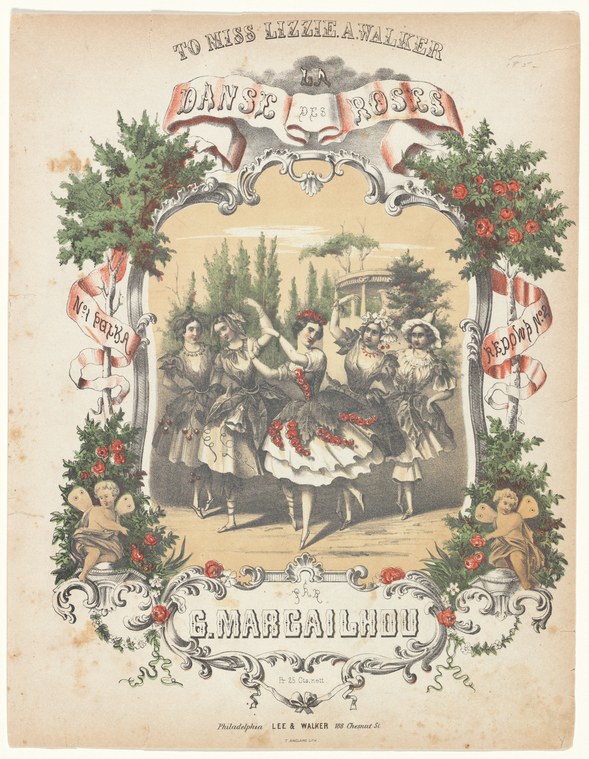
This is a chromolithographic music cover from the 19th century, addressed to Miss Lizzie A. Walker. The composition centers on a theatrical dance scene framed by an ornate rococo border of scrollwork, flowering vines bearing red blossoms, and cherub figures at the base. Within the frame, a group of women in full mid-Victorian costume—corseted bodies, full skirts with white underskirts, and their hair arranged in period style—are arranged in a lively ensemble. The dancers occupy a stage-like space defined by architectural elements including columns and what appears to be a pavilion or garden structure in the background. The scene is bathed in soft light typical of mid-century lithography, with careful color separation creating depth between the figures, the elaborate frame, and the cream background. The title "Danse de Roses" appears in decorative lettering at the top, with what appears to be a publisher or printer's mark at the base.
The dancing
The dancers occupy various positions suggesting movement and rhythm across the shallow stage space. Several figures appear to be in classical ballet posture with erect spines and lifted bearing; the skirts and their deployment suggest active turning and extension. The women's arms are raised and positioned in what could be port de bras, and the composition suggests a coordinated ensemble movement rather than isolated soloists. The full, layered skirts—reaching to the ankle and clearly constructed to show the line of the leg beneath—are characteristic of ballet costume that would allow the display of footwork and line. No male dancers are visible; this is an all-female ensemble, which was typical for commercial dance spectacle of this period.
The dance depicted
This is almost certainly a Romantic-era ballet scene, likely from a specific production or a generalized illustration of contemporary ballet practice. The title "Danse de Roses" (Dance of Roses) and the garden setting with flowering vines suggest a pastoralist or floral theme typical of Romantic ballet's taste for natural and ethereal subjects. The dress—mid-Victorian silhouette with full skirts and the particular cut suggesting 1840s–1860s—places this in the height of the Romantic ballet period. The choreography appears to involve ensemble work rather than virtuosic solo dancing; the poses suggest a coordinated spatial composition designed for visual harmony rather than technical display. The work documents how ballet was packaged and marketed as domestic entertainment through published sheet music and theatrical illustrations.
How it was made
This is a chromolithograph, a color printing technique that allowed multiple stones or plates to be inked with different colors and printed in sequence onto a single sheet. The technique was perfected in the mid-19th century and became the dominant method for producing affordable, colorful commercial imagery including theatrical and music covers. The fine gradation of tone, the subtle blending of colors (particularly visible in the flesh tones and the delicate rendering of the flowers), and the precise registration of the black outlines are all characteristic of skilled chromolithographic work. This means the image was created for mass circulation—not a one-off commission but a published product intended for sheet music distribution and domestic display, suggesting this was a commercially successful work or artist.
About this work
This chromolithographic music cover represents the visual language of mid-19th-century theatrical dance as it entered the commercial domestic sphere. The "Danse de Roses" illustrates Romantic ballet at the height of its popularity—ethereal, feminine, nature-inspired, and presented as an ensemble spectacle rather than a vehicle for individual virtuosity. The image is not a documentary record of a specific production but rather a representative image of how ballet was understood and packaged for middle-class audiences who purchased sheet music and theatrical souvenirs. The work sits at the intersection of several histories: of lithographic printing technology, of Romantic ballet aesthetics, of 19th-century music publishing, and of how dance was domesticated through print.
How to look at it
Examine the arrangement of the dancers' bodies and the implied direction of their movement; the symmetry and the placement of figures suggest a composed stage picture designed for beauty rather than action. Notice the careful rendering of the skirts and how they are deployed—the artist has taken pains to show the volume and weight of the fabric as well as the lines of the legs beneath, which would have been a selling point for contemporary viewers. The ornate frame does not simply contain the scene but visually elevates it, treating the dancers as precious subjects worthy of fine presentation, much as ballet itself was being positioned as a precious art form during this period.
The artist
The image is credited to Lee & Walker, a Philadelphia publishing firm active in the mid-19th century. Lee & Walker were significant publishers of sheet music and theatrical prints, suggesting this work was part of their professional output rather than a fine-art endeavor. The unsigned choreography or performance information on the cover may mean this was either a published work whose details are not legible in this reproduction, or a generic "Danse de Roses" package-designed image not tied to a specific production.
The period
The mid-19th century saw Romantic ballet at its zenith—the period of Giselle (1841), La Sylphide, and the rise of the ballerina as the dominant figure in European dance. This was also the era in which chromolithography became the dominant color printing technology, making theatrical imagery newly affordable and collectable. The music cover format itself represents the tight connection between ballet and the domestic music room; purchasing and performing music from favorite ballets at home was a common practice among middle-class women. The visual conventions here—the full skirt, the ethereal garden setting, the all-female ensemble, the graceful poses—are direct expressions of Romantic ballet ideology as it was being disseminated through every available medium.
Where it lives
This work is part of the New York Public Library's collection of prints depicting dance, a genre-based grouping that draws together representations of dance from many sources and periods. The object is a published chromolithograph; Lee & Walker information at the base identifies it as a commercial music cover product.
Dance in this work
Questions about this work
Is this a real ballet or a made-up cover design?
It is likely a generic illustration representing Romantic ballet rather than a specific production. The title "Danse de Roses" suggests a theme rather than a named ballet with a recorded premiere. Publishers often created idealized ensemble scenes to represent ballet generically, using recognizable costume and pose conventions to signal "this is ballet" to buyers.
Why are all the dancers women?
By the mid-19th century, the ballerina had become the dominant image of ballet, and male dancers had largely disappeared from starring roles in Western European ballet. Commercial images reinforced this: prints, lithographs, and photographs predominantly featured women, especially in ensemble scenes. This reflects actual practice on stage, where the Romantic ballet repertoire centered on the ballerina.
What would you have heard if you played this sheet music?
The music is not visible in this image, but "Danse de Roses" would have been a light balletic piece in dance tempo—likely a waltz, polka, or quadrille arranged for piano. Publishing music from ballets, or music in the style of ballet choreography, was a major commercial practice; middle-class households used these pieces to re-enact or imaginatively participate in the spectacles they had seen or read about.
Why is the frame so elaborate?
The ornate rococo border was a stylistic choice of the period, borrowed from earlier decorative traditions. It served a practical purpose too: these printed covers needed visual impact on display, and the elaborate frame made the modest central image feel precious and special—elevating sheet music to the status of fine art or jeweled object.
More dance artwork





