49 works in this view — arrow keys or swipe to move between them.
Dance in Art
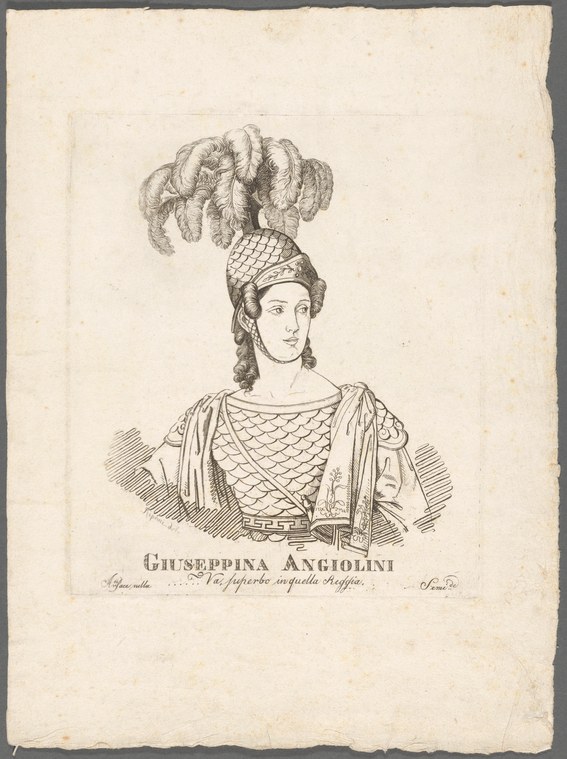
Giuseppina Angiolini [Giuseppa Angelini; in the role of] Arsace nella Semi[rami]de
Unknown artist
- Collection:
- Prints depicting dance
- Source:
- New York Public Library
- Rights:
- Public domain — free to use, share and adapt.
- Recorded as:
- Public Domain
This engraving is evidence of the fame and marketability of named dancers in the 18th-century theatre, and of the role of printed portraiture in creating and sustaining a performer's public identity. It also documents the visual conventions of serious ballet in the era of Gluck and Angiolini, when narrative pantomime and classical costume were central to the art form's prestige and claim to be a legitimate dramatic medium.
What you are looking at
A portrait bust of a woman in theatrical costume, shown from the shoulders up against a plain background. She wears an elaborately scaled breastplate or corselet in a fish-scale or chainmail pattern, rendered in fine hatching that catches light across the chest and shoulders. Over this sits a draped garment of classical cut, one end thrown across her left shoulder in the manner of a cloak or himation. Most striking is her headdress: a tall, intricately pleated and gathered structure rises from her head in multiple curved tiers, resembling a turban or elaborate coiffure of the 18th-century stage. The face is finely drawn in profile-turned-frontal view, with refined features and an expression of calm dignity. The inscription below reads "GIUSEPPINA ANGIOLINI" and "in the role of Arsace nella Semi[ramide]"—identifying her as the dancer Giuseppina Angiolini performing the role of Arsace in *Semiramide*.
The dancing
The figure is a head-and-shoulders composition, static and portrait-like rather than caught mid-movement. The body is upright and frontal, with one shoulder slightly dropped beneath the draped garment, suggesting a natural standing ease. The arms are not visible, cropped by the frame. The overall posture is ceremonial and presentational rather than kinetic—this is a portrait of a performer in character, not a depiction of a dance action or step. The face looks directly outward, engaging the viewer as a character would address an audience.
The dance depicted
*Semiramide* was one of the most celebrated heroic ballet-pantomimes of the 18th century, first choreographed by Gasparo Angiolini (likely a relative of this performer) in 1765 with music by Gluck. The role of Arsace—a general and love interest in the story—was a major male role in serious ballet, but here is identified with Giuseppina Angiolini, suggesting she may have danced a female variant or that the terminology of the period allowed for role crossing. The costume is theatrical and historical: the scaled breastplate and classical drapery mark this as heroic or "action" ballet in the style of the era, which blended courtly movement with dramatic pantomime and narrative spectacle. The headdress is a stage fantasy rather than an archaeologically accurate reconstruction of Assyrian dress—it follows the conventions of 18th-century theatrical exoticism.
How it was made
This is an engraving, executed in fine line work with cross-hatching for shadow and texture. The technique allows precise rendering of the costume's intricate details—the scaled breastplate, the pleats of the headdress, the fall of drapery—and suggests a print made for circulation among theatre-goers and collectors of dance imagery. The delicate handling of the face and the care lavished on costume detail are typical of theatrical portraiture prints of the mid-to-late 18th century, designed to commemorate celebrated performers and to circulate images of successful productions. The style and finish suggest this is a professional print, likely published in Italy or by an Italian printer, as part of a series of opera and ballet personalities.
About this work
This is a theatrical portrait of the dancer Giuseppina Angiolini in the heroic role of Arsace from the celebrated ballet-pantomime *Semiramide*, one of the defining works of serious ballet in the second half of the 18th century. The engraving captures her in full costume—scaled armor, classical drapery, and an ornate stage headdress—rendered with the fine detail and formal presentation that characterized dance portraiture of the period. Rather than depicting movement, it serves as a record of costume and role, and as a commemoration of a notable performer in a prestigious production. The work belongs in a dance gallery because it documents the visual language of heroic ballet, the star system of 18th-century theatre, and the importance of costume and character in ballets that blended dance, pantomime, and narrative spectacle.
How to look at it
Look closely at the costume details: the engraver has rendered the scaled breastplate with fine parallel lines that create the illusion of metallic texture and light reflection, and has taken equal care with the pleats and folds of the headdress and draped mantle. These details tell us what the audience saw on stage, and how the designer and costumier created the illusion of heroic antiquity. The face and the formal, frontal composition tell us that this is a celebrity portrait as much as a dance document—it presents the performer as a public figure worthy of commemoration, not merely as a body in motion. The calm, dignified expression and the stable, upright posture reflect the heroic, serious tone that *Semiramide* demanded.
The artist
The artist is not recorded in the catalogue. The style and technique are consistent with mid-to-late 18th-century Italian or Franco-Italian theatrical portraiture, a genre that flourished as a commercial enterprise in the decades following mid-century. Such prints were typically engraved after drawings by theatre designers or portraitists and published by printers in theatrical centres such as Venice, Rome, Naples, and eventually Milan.
The period
This work dates to the era of the great heroic ballets of the 1760s–1780s, when choreographers including Gasparo Angiolini and Jean-Georges Noverre were reforming ballet away from pure court technique toward a more dramatic, pantomimic form rooted in classical antiquity. *Semiramide*, first performed in 1765, was a landmark: Angiolini's choreography combined newly expressive movement vocabulary with elaborate scenic spectacle and historical (or pseudo-historical) costume. The 1760s and 1770s were also the period when named dancers first became celebrities in their own right, with prints, portraits, and written accounts circulating widely. Theatrical portraiture—both painted and engraved—became a significant commercial and artistic category, documenting the stars of the stage for audiences across Europe.
Where it lives
The work is part of the New York Public Library's collection of prints depicting dance. It is an engraving, likely produced in the third quarter of the 18th century and distributed as a popular theatrical souvenir and collector's print.
Dance in this work
Questions about this work
Who was Giuseppina Angiolini?
The catalogue record provides only her name and her role in *Semiramide*. She may have been related to Gasparo Angiolini, the celebrated choreographer and reformer of ballet, but this cannot be confirmed from the print alone. She was evidently a notable performer of heroic roles in the serious ballets of the period.
What was the role of Arsace in *Semiramide*?
*Semiramide* tells the story of an Assyrian queen and the general Arsace, who loves her. Arsace was conventionally a male role, but dancers of the era sometimes performed across gender lines in terms of costuming and character type. The heroic or 'action' ballet of this period featured leading dancers in classical military and noble dress.
How do we know this is an engraving and not a painting?
The technique is characteristic of line engraving: fine parallel lines (hatching and cross-hatching) create tone and shadow, and the composition is bounded by a clear frame. The precision and uniformity of the line work, and the absence of color, are typical of engraved theatrical portraiture of the period.
What is the tall headdress called?
The exact term is unclear from the image alone. It resembles 18th-century stage interpretations of Eastern or classical headwear—a fantastical, ornate construction of pleated and gathered fabric that conveyed 'exotic' or 'ancient' rather than archaeological accuracy. The style was standard in serious ballet and opera of the era.
More dance artwork





