49 works in this view — arrow keys or swipe to move between them.
Dance in Art
Giuseppina Morlacchi
Unknown artist
- Collection:
- Prints depicting dance
- Source:
- New York Public Library
- Rights:
- Public domain — free to use, share and adapt.
- Recorded as:
- Public Domain
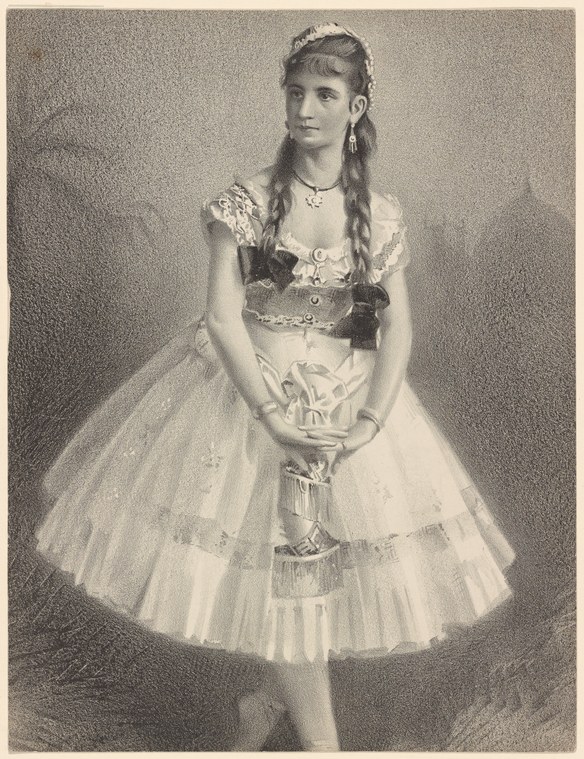
Morlacchi was a significant international star of the Romantic ballet period, yet she is now less remembered than her contemporaries Taglioni and Elssler. This portrait is one of the few widely circulated documents of her appearance and costume, making it valuable evidence of how an important traveling dancer was marketed and remembered. The print type itself—the theatrical celebrity portrait—is a crucial index of how dance was consumed as visual culture in this period.
What you are looking at
A young woman stands alone against a neutral background in a three-quarter pose, facing slightly toward the viewer's left. She wears a romantic-era ballet costume: a fitted white bodice with puffed sleeves and a full skirt of pale tulle that falls to mid-calf, creating the characteristic silhouette of 1830s–1840s ballet. Her dark hair is parted in the center and drawn back, crowned with a decorative headpiece or circlet, with long ringlets falling down her back. She wears drop earrings and holds what appears to be a small bouquet or prop in her hands, positioned at her center. Her legs are bare and her feet are in soft ballet slippers. The pose is frontal and contemplative rather than action-based—her weight appears evenly distributed, and her bearing is graceful but stationary. The image has the even, neutral tonality of a mid-19th-century print or engraving, with soft modeling that suggests the three-dimensionality of the figure and fabric.
The dancing
The dancer stands in a simple, upright posture with no visible turn-out or elevated position—both feet appear flat on the ground. The arms are held at the front of the body in a gentle, natural frame rather than in the classical positions of ballet technique. The pose reads as a portrait presentation rather than a captured moment of choreography. The full tulle skirt, characteristic of the Romantic ballet era, dominates the composition visually and takes precedence over demonstrating any specific footwork or technique.
The dance depicted
This is a portrait of a Romantic ballet dancer, most likely from the 1830s–1840s based on the costume, hairstyle, and printing style. The full white tulle skirt, puffed sleeves, and circlet were standard costume elements for the genre of Romantic ballet that flourished during this period. The dancer's name is recorded as Giuseppina Morlacchi, an Italian-born dancer who performed across Europe during the Romantic era. However, the image itself does not show her in active performance—it is a costume portrait, the type printed and sold to the public as a memento of the dancer and her most celebrated roles. The stance and presentation suggest this may document her appearance in a specific role, possibly the title role of a Romantic ballet or a famous variation.
How it was made
This is a lithograph or engraving, likely hand-colored or printed in toned ink, dating to the mid-19th century. The technique is typical of theatrical portraiture of the period: a single figure shown at half-length or full-length against a plain background, with careful attention to the rendering of fabric texture and the effects of light on the dancer's form and costume. Such prints were produced commercially in large numbers and sold in theaters, print shops, and through the mail to admirers, making them a primary form of celebrity portraiture before photography became standard. The relatively soft, even toning suggests either a lithograph or a finely executed engraving.
About this work
This is a mid-19th-century theatrical portrait of Giuseppina Morlacchi in the costume of Romantic ballet. It documents not a choreographed moment but the visual identity of a celebrated performer of the Romantic era—the dancer as public figure, presented in the costume style that defined the genre. Morlacchi was one of the virtuoso traveling dancers who brought Romantic ballet across Europe and to the Americas in the 1830s–1850s, performing in works like La Sylphide and roles created for her. The image is a record of how Romantic ballet presented itself visually to its audience: the ethereal, often otherworldly femininity embodied in the pale tulle skirt, the simplified arm positions, and the costume's emphasis on grace and lightness rather than technical display.
How to look at it
Attend to the costume as the primary subject: the cut and volume of the skirt, the transparency of the tulle, the placement of the puffed sleeves, and the ornamental headpiece are all carefully rendered and are what made this dancer recognizable to her public. Note the lack of dramatic pose or technical display—this is not a print capturing a leap or pirouette, but rather a dignified presentational image. The even stance and calm bearing read as a portrait convention for theatrical celebrities of the period, designed to present the dancer as a person of refinement and elegance rather than as an athlete or acrobat. The hand-held bouquet or ornament, the jewelry, and the careful attention to her hair all signal that this is a portrait meant to celebrate the dancer as a star, not merely to document a dance technique.
The artist
The artist is not recorded in the catalogue. The style and technique suggest a professional theatrical print maker, likely working in Paris, London, or another major European theater city where such portraits were produced for commercial sale. The quality of execution indicates a competent hand, though without signature or attribution marks visible in the image, the specific maker cannot be identified.
The period
This portrait was created during the height of Romantic ballet, roughly 1830–1850, when the genre dominated European and American stages. This was the era of La Sylphide (1832), Giselle (1841), and La Péri (1843)—ballets that centered on otherworldly female characters and showcased the new techniques of pointe work (though the dancer in this portrait appears to be standing flat). Giuseppina Morlacchi was part of the generation of traveling star dancers who brought these works and this new aesthetic across continents. In visual art, theatrical portraiture was booming: lithography made it cheap to produce and distribute such images, and dancers were among the most popular celebrity subjects of the era, alongside singers and actors. The Romantic movement in art and literature valorized grace, beauty, melancholy, and the supernatural—all qualities that the costume and presentation of this portrait emphasize.
Where it lives
This print is held in the New York Public Library's collection of prints depicting dance. It is part of a large body of Romantic-era theatrical portraiture that documents dancers, singers, and actors of the period through commercial lithographs and engravings.
Dance in this work
Questions about this work
Was Giuseppina Morlacchi a famous dancer?
Yes. Morlacchi was one of the leading traveling ballet dancers of the Romantic era, performing across Europe and the Americas from the 1830s into the 1850s. She was a contemporary of Marie Taglioni and Fanny Elssler, and performed in major Romantic ballets of the day. However, she has been largely overshadowed in dance history by those two dancers, and historical records of her career are less extensive.
What is she wearing?
The costume is a Romantic ballet dress typical of the 1830s–1840s: a fitted bodice with short, puffed sleeves, a full skirt of pale tulle that falls to the mid-calf, soft ballet slippers, and a decorative headpiece or circlet. This costume style was standard for Romantic ballet roles and is strongly associated with ballets like La Sylphide.
Is she dancing in this picture?
No. This is a portrait, not a performance image. The dancer is standing in a simple, upright pose without visible turn-out or elevation. Prints of this type were made to be sold to the public as souvenirs and mementos of celebrated performers, and they typically show the dancer in costume but in a dignified, posed manner rather than in action.
What is the print made from?
Based on its appearance, this is likely a lithograph or hand-colored engraving from the mid-19th century. Such theatrical portraits were produced commercially in large quantities and sold in theaters and print shops, making them one of the primary ways the public encountered images of their favorite dancers before the era of photography.
More dance artwork





