49 works in this view — arrow keys or swipe to move between them.
Dance in Art
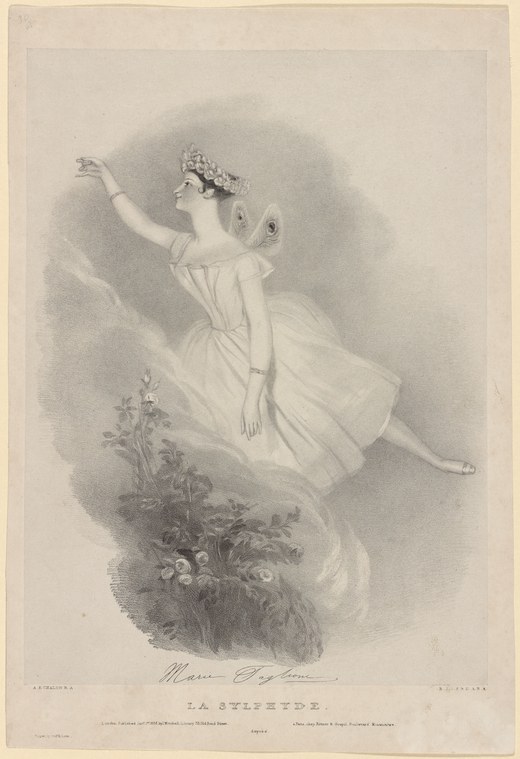
Marie Taglioni [facsimile signature] La sylphyde
Unknown artist
- Collection:
- Prints depicting dance
- Source:
- New York Public Library
- Rights:
- Public domain — free to use, share and adapt.
- Recorded as:
- Public Domain
Marie Taglioni was the first true superstar of ballet and *La Sylphide* its foundational Romantic work. This print is direct evidence of how 19th-century audiences experienced her fame and understood the new aesthetic she embodied. It shows the crucial role lithography played in making dance accessible and desirable as a commodity for the middle class.
What you are looking at
A woman in a white Romantic-era ballet dress floats upward in a pose of ethereal lightness, her body angled as though ascending or suspended in air. She wears a fitted bodice and a bell-shaped skirt—the silhouette of early 19th-century ballet—along with a delicate headdress. Her right arm extends gracefully upward while her left arm is positioned at her side, and her head is tilted back in an attitude of rapture or dreaming. Below her, a lush arrangement of flowers and foliage grounds the composition, rendered in softer focus. The entire figure is suspended against a luminous, atmospheric background that creates a sense of weightlessness and the supernatural. The print's soft edges and gentle tonal gradations suggest a dream or vision rather than a theatrical moment captured from life.
The dancing
The dancer's body is shown in a lifted, buoyant attitude with elongated lines and an upward trajectory characteristic of Romantic ballet. Her weight appears suspended rather than grounded; her legs are extended or crossed beneath her, and her torso rises from the lower half with an arched, expressive quality. The arm position—one raised, one lowered—creates an open, expansive frame. There is no visible contact with the ground or any other dancer; she inhabits a solitary space defined by vertical ascent and emotional rather than physical momentum. The pose conveys weightlessness and otherworldly grace rather than technical display.
The dance depicted
This is Romantic ballet, almost certainly depicting the title role from *La Sylphide* (choreography attributed to Filippo Taglioni, first performed in Paris in 1832). The sylph—a supernatural sylph or fairy—was the quintessential Romantic ballet heroine: ethereal, unattainable, and defined by her airborne quality. The facsimile signature of Marie Taglioni, the role's originator and greatest interpreter, identifies her as the subject. The image captures the essence of Romantic ballet technique: the illusion of weightlessness achieved through pointe work, the emphasis on vertical extension, the pale ethereal costuming, and the narrative of longing for an impossible supernatural being. No male dancer is visible; the work centers on the female figure's isolation and transcendence.
How it was made
This is a lithographic print, identifiable by its soft tonal gradations, the characteristic grainy texture, and the subtle blending of light and shade that lithography allowed. The technique was ideal for reproducing the atmospheric, dreamlike quality Romantic ballet sought. Lithography's relative affordability and accessibility made it the dominant medium for disseminating images of famous dancers to a growing middle-class public in the 1830s–1840s. The facsimile signature of Taglioni printed in the margin marks this as a souvenir or promotional print, part of a widespread commercial practice of circulating iconic images of celebrated performers. The print's soft finish and ephemeral quality—the paper is aged to cream—suggests it was handled and treasured as a keepsake of a legendary dancer.
About this work
This lithographic print documents one of the most iconic moments in dance history: Marie Taglioni as the Sylph in *La Sylphide*, the ballet that defined Romantic ballet aesthetics. The image is not a literal stage scene but an idealized vision of Taglioni's ethereal presence and the role's supernatural logic. It captures what audiences of the 1830s valued: the illusion of weightlessness, the pale poetic beauty of the new ballet vocabulary, and the star performer's transcendent quality. The print circulated widely and became a canonical image—reproduced, copied, and referenced—helping to establish the visual language of Romantic ballet for subsequent generations.
For dance historians, this image is essential documentation of how the Romantic ballet body was understood and sold to the public. It shows us what the era admired: verticality, elongation, isolation, and the feminine figure suspended between the earthly and the supernatural. Taglioni's dominance of this role and her influence on technique are visible in the idealized proportions and effortless-seeming height of the pose.
How to look at it
Observe the impossibility of the pose: the dancer appears to float without apparent effort, her feet not quite touching the floral base below. This is the central illusion of Romantic ballet—achieved on stage through pointe work, controlled descent, and the dancer's ability to move with minimal visible strain. The soft edges and luminous background reinforce the sense that we are seeing a vision or memory rather than a moment of literal stage action. Notice how the artist has idealized the body: the elongation, the small head, the weightless limbs. Compare this to how male dancers or courtship scenes were rendered in the same period; the Sylph is rendered as almost abstract, more spirit than human.
The artist
The artist is not recorded. The print was produced in Paris, the dance capital of the era, most likely by a theatrical print publisher capitalizing on Taglioni's fame. Such prints were typically created rapidly by skilled lithographers working from sketches, photographs, or descriptions of stage performance, without attribution to a named artist. The facsimile signature of Taglioni was a marketing device, not evidence of her hand in the image's creation.
The period
This print dates to the height of Romantic ballet, roughly 1832–1850. *La Sylphide* premiered in Paris in 1832 and became an immediate sensation; Taglioni danced the role for decades, and it remained the defining vehicle for her career. The 1830s–1840s were the era when ballet shifted from classicism toward Romanticism—when the supernatural, the fantastic, and the feminine became central to ballet narratives, and when the ballerina replaced the male dancer as the focus of theatrical spectacle. Lithography had recently become commercially viable and was being used aggressively by theaters and publishers to promote stars and feed public appetite for images of famous performers. The soft, atmospheric aesthetic of Romantic painting and poetry found a perfect medium in lithography's tonal subtlety.
Where it lives
The print comes from the New York Public Library's collection of prints depicting dance. It is a mass-produced theatrical souvenir from the 1830s–1840s, one of thousands issued to capitalize on Taglioni's fame. Such prints were sold at the theater, in print shops, and through subscription; they served as mementos of a performance and tokens of fandom.
Dance in this work
Questions about this work
Was this print based on a real performance?
Likely not directly. Theatrical prints of this period were usually created from sketches, memory, or imagination rather than from on-stage observation. The artist's goal was to capture the essence of the role and the dancer's fame, not to document a specific evening. The ethereal, impossible quality of the pose suggests this is an idealized vision.
Why is the sylph shown alone and floating?
*La Sylphide* is fundamentally about the male hero's impossible longing for an unattainable supernatural being. The sylph is always slightly out of reach, ethereal, not fully of the human world. Showing her alone and suspended captures that otherworldliness and was central to how Romantic ballet understood the female dancer—as a being of beauty and mystery rather than a partner or equal.
What is the flower arrangement at the bottom?
The flowers ground the composition and may reference the forest setting of *La Sylphide*, but they also carry symbolic weight. Flowers in Romantic art often signified transience, beauty, and nature. Their soft focus beneath the ethereal figure emphasizes the sylph's supernatural quality by contrast with the earthly realm below.
Why was this image so widely reproduced?
Taglioni was a global celebrity, and *La Sylphide* was performed across Europe and North America. Prints like this were cheap, portable, and highly desirable as souvenirs. They also served as advertising, promoting the dancer and the role to audiences who might not have seen her live. Lithography made mass production possible; the public's hunger for images of famous performers made it profitable.
More dance artwork





