49 works in this view — arrow keys or swipe to move between them.
Dance in Art
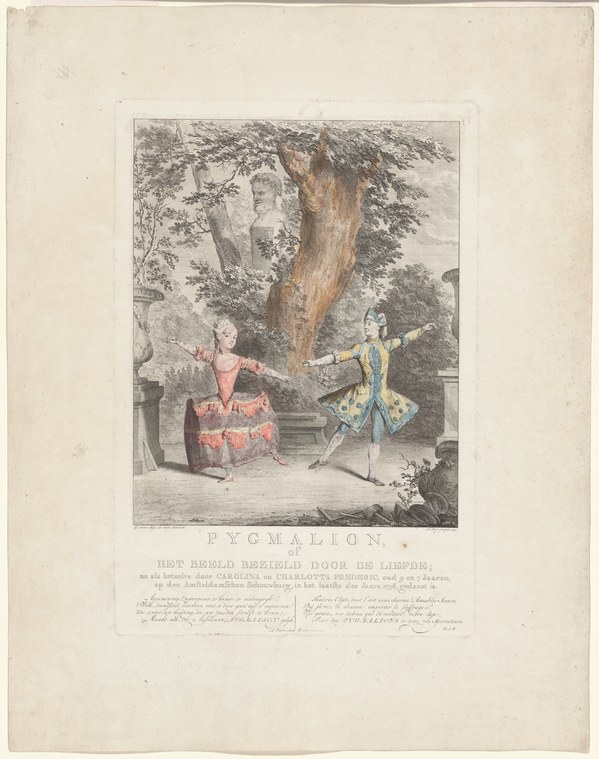
Pygmalion; of Het beeld bezield door de liefde: zo als hetzelve door Carolina en Charlotta Frederic, oud 9 en 7 Jaaren, op den Amsteldamschen Schouwburg, in het laatste des Jaars 1758, gedanst is
Unknown artist
- Collection:
- Prints depicting dance
- Source:
- New York Public Library
- Rights:
- Public domain — free to use, share and adapt.
- Recorded as:
- Public Domain
This print is one of very few images that name and document the performance of identified child dancers in the 18th century, making it valuable evidence of how youth performance was organized and celebrated in theater. It also preserves a specific moment in the long European tradition of Pygmalion ballet, showing how the myth was staged, what movement vocabulary was used to convey transformation, and how the narrative was adapted for young performers and mixed-age casts.
What you are looking at
A theatrical scene depicting the myth of Pygmalion, shown as an engraving with hand-coloring. In a garden setting with a large tree dominating the background, two child performers face each other in a moment of animated interaction. On the left, a girl in a coral-pink dress with decorative embroidery and white apron sits on a low bench or seat, her body angled toward her companion with one arm extended in greeting or gesture. On the right, a boy in a blue coat with yellow or gold trim stands in a dynamic pose, his legs bent in a lunge or deep step, one arm raised expressively toward the girl. The ground is depicted with simple parallel lines suggesting a stage floor. The garden backdrop—trees, foliage, and architectural elements—is rendered in gray tones with touches of brown wash on the central tree trunk, creating depth and a sense of outdoor festivity. The moment captures the narrative instant when the statue comes to life: the boy's energized posture and the girl's receptive gesture embody the meeting of inanimate and animate, performed here by very young dancers.
The dancing
Two child performers occupy the composition with striking asymmetry. The boy on the right exhibits an open, exuberant frame: his weight is low and forward, knees deeply bent, with one leg appearing to step or lunge diagonally across the stage space. His upper body is upright and his arm extended, suggesting both welcome and the wonder of animation—a body newly come to life. The girl sits in a more contained but engaged posture, her torso twisted slightly toward him, her arm reaching out in a reciprocal gesture. Both children are dressed in formal court or theatrical costume, suggesting trained performers rather than amateurs. The spatial relationship between them—close but not touching—captures a moment of recognition or address rather than partnered contact.
The dance depicted
This engraving documents a performance of Pygmalion at the Amsterdam Theatre (Schouwburg) in late 1758, danced by two precociously young performers: Carolina and Charlotta Frederic, aged 9 and 7. The myth of Pygmalion, in which a sculptor's statue is brought to life by divine intervention, was a popular subject for theatrical dance throughout the 18th century, especially in the context of comic ballet and children's performance. The pose and energy here suggest a moment of first contact or awakening, the boy's dynamism contrasting with the girl's more static seated position to show the boundary between animation and the human world. The formal dress and theatrical setting indicate this was a work of court or commercial theatre, likely performed as an interlude or comic ballet within a larger production. The choice to cast children may have emphasized the innocence and wonder of the narrative, a common practice in 18th-century theatre.
How it was made
This is a hand-colored engraving, a print medium that allowed wide circulation of theatrical imagery. The line work is fine and detailed, showing the engraver's skill in rendering fabric textures, facial features, and the spatial depth of the garden set. The coloring—applied by hand after printing—is selective and decorative rather than naturalistic: the girl's dress receives vivid coral pink, the boy's coat is a clear blue, and the tree trunk is warmed with brown. This technique was standard for documenting theater and dance in the mid-18th century, especially for works that toured or that the theater wished to publicize. The engraving's quality and the fact that it bears a descriptive text below suggest it was sold as a commemorative print, making it a record of both the choreography and the performance tradition.
About this work
This engraving is a rare document of 18th-century children's theatrical dance and of a specific celebrated performance. It records not only the moment depicted—the awakening of Pygmalion's statue—but also the casting of two named child performers in a prominent role, and the setting and costume conventions of Dutch theater in 1758. The work belongs to the tradition of Pygmalion ballets that flourished across Europe in the 1700s, in which the myth provided a framework for exploring animation, transformation, and the boundary between art and life. As a hand-colored engraving, it served as both theatrical souvenir and record, circulating the choreography and the performers' fame beyond those who witnessed the live performance.
How to look at it
Attend to the boy's posture: the deep bend of the knees and forward lean show a body released into motion, still learning gravity and its possibilities. The girl's seated position and reaching gesture suggest the opposite—stillness becoming aware of the world. The engraver has frozen the instant of mutual recognition, not a sustained arabesque or formal pose. Notice how the garden setting frames the action as festive and mythological rather than domestic. The formality of the dress and the careful staging of the two bodies in an open space tells you this is a theatrical moment, rehearsed and composed for an audience, not a snapshot of unmediated dance.
The artist
The artist of the engraving is not recorded in the catalogue. The print was likely made by a commercial workshop attached to or associated with the Amsterdam Theatre, as was common practice in the 18th century. Such workshops produced engravings rapidly to capitalize on successful performances, often without attributing individual artists. The quality of the work suggests a trained hand, but the anonymity was typical of theatrical ephemera of the period.
The period
The Pygmalion ballet flourished in the mid-18th century across Europe, particularly in France, Italy, and the Netherlands. The myth offered choreographers and librettists a framework for exploring the power of dance and gesture to convey emotion and transformation—themes central to the development of dramatic ballet. The casting of children in leading roles was not unusual in 18th-century theater, especially in comedic or lighter pieces; child performers were trained and celebrated, sometimes as virtuosos. The Amsterdam Theatre's production in 1758 took place during a period of increased experimentation with ballet d'action (narrative ballet) and the growing separation of dance from the court into commercial public theaters. Hand-colored engravings like this one were a primary means of advertising and documenting such productions.
Where it lives
The print is held in the New York Public Library's collection of prints depicting dance. It is catalogued as theatrical ephemera from the 18th century, likely produced in Amsterdam or a nearby printing center shortly after the 1758 performance.
Dance in this work
Questions about this work
Who were Carolina and Charlotta Frederic?
They are named in the engraving's text as the performers of this Pygmalion ballet at the Amsterdam Theatre in late 1758, at ages 9 and 7 respectively. Beyond what this print records, their identities and subsequent careers are not documented in widely available sources. They represent the tradition of trained child performers in 18th-century European theater.
Why was Pygmalion a popular ballet subject?
The myth provided choreographers with a narrative centered on transformation and the power of art (or dance) to create life. It allowed exploration of mime, gesture, and movement to convey wonder and awakening. The story also permitted flexibility in casting and scale, making it suitable for commercial theaters and diverse casts, including children.
What does the boy's deep knee bend tell us about 18th-century technique?
The pronounced plié shown here suggests a vocabulary that valued earth-bound, flexible, and expressive movement rather than the lifted, ethereal aesthetic that would dominate ballet later in the century. The posture conveys emotion and dynamism rather than control or extension.
How was this image used after it was made?
Hand-colored engravings like this served multiple purposes: as souvenirs for patrons who attended the performance, as advertisements for the theater and its star performers, and as documentary records of the staging and costume. They were sold individually or in sets, making them an important form of theatrical publicity in the pre-photographic era.
More dance artwork





