49 works in this view — arrow keys or swipe to move between them.
Dance in Art
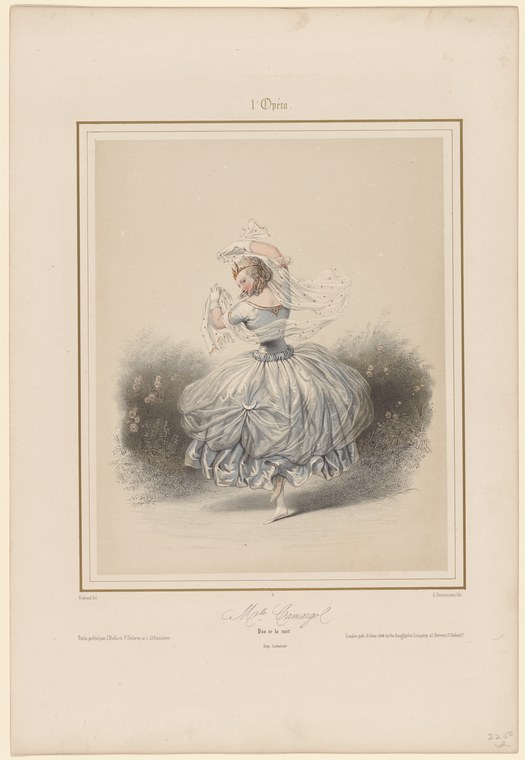
Mlle. Camargo. Pas de la nuit
Unknown artist
- Collection:
- Prints depicting dance
- Source:
- New York Public Library
- Rights:
- Public domain — free to use, share and adapt.
- Recorded as:
- Public Domain
The work documents how 19th-century audiences and print culture imagined and memorialized Romantic ballet performance, translating ephemeral stage moments into portable imagery. The attribution to the historical Camargo also reveals how the era's dance imagination drew on earlier legends, reframing older names through contemporary aesthetics and technique.
What you are looking at
A woman in mid-pirouette occupies the center of a lightly shaded stage, her body captured in a moment of sustained rotation. She wears a full, pale tulle skirt gathered high at the waist—a silhouette characteristic of Romantic ballet—and her arms are raised in a soft, rounded frame. Her head tilts slightly, and the pencil shading around her creates a gauzy, atmospheric space that suggests stage lighting and the ethereal quality of mid-19th-century theatrical dance. The background is deliberately vague, rendered in grey wash that keeps focus on the dancer's upper body and the architecture of her turn. The composition is a formal portrait of a single figure against an undefined depth.
The dancing
A solitary female dancer shown in profile-turned view, sustained on one supporting leg in what appears to be a pirouette or sustained relevé. Her working leg is not clearly visible, but her raised arms form a soft, rounded port de bras typical of early Romantic ballet—neither sharply angular nor dropped. Her torso is upright and elongated, her head positioned in the classical épaulement (shoulder placement) of the period. The tulle of her skirt spreads in a bell shape that would result from rotation or the momentum of the step, showing understanding of how fabric moves in balletic turns.
The dance depicted
This is a portrait of Mlle Camargo performing what the title calls 'Pas de la nuit' (Step of the Night), a work that cannot now be precisely identified. Marie-Anne Cupis de Camargo (1710–1770) was a legendary dancer of the 18th century, but this image is 19th-century in its aesthetic and printing style, suggesting it may be a later commemorative or fictionalized portrait. The garment, technique, and stage presentation belong to Romantic ballet of the 1830s–1850s, not the era of the historical Camargo, indicating either artistic license or a conflation of the famous historical name with a later dancer performing in a work of that title.
How it was made
This is a hand-colored lithograph, recognizable by the characteristic soft-focus tonal effects achieved through stone rather than copper plate, and the layered application of color wash. The technique allowed wide circulation as a relatively inexpensive theatrical print—the kind sold in shops near opera houses to memorialize celebrated performances. The soft shading and tonal subtlety of lithography suit the atmospheric, ethereal aesthetic of Romantic ballet imagery, which sought to capture the impression of a moment on stage rather than anatomical precision. The colored pencil or watercolor finish was likely applied to the printed image by hand or in a tinted edition run.
About this work
This is a lithographic portrait of a female dancer in the full Romantic ballet aesthetic—high-waisted tulle skirt, raised arms, sustained turn—identified with the historical dancer Camargo and a nighttime choreographic work. The image is part of a substantial tradition of mid-19th-century theatrical prints preserving images of famous dancers and roles, sold to audiences as souvenirs and records of the stage. It captures a single, idealized moment: a woman alone on stage in a timeless, weightless attitude—the visual fantasy that defined the Romantic era's appetite for dance imagery.
How to look at it
Observe the moment: the artist has frozen a sustained turn, not a jump or descent, emphasizing weightlessness and control. Notice how the tulle skirt spreads in response to centripetal force, a detail that shows understanding of how the body and fabric interact. The soft modeling of the body against the undefined background is characteristic of lithographic technique and Romantic-era conventions, which sought to render the dancer as an impression or vision rather than a precisely detailed figure. The raised arms and elongated line of the torso follow the aesthetic rules of Romantic ballet, in which the body should appear to float rather than push.
The period
The Romantic period in ballet (roughly 1830–1860) elevated the female dancer to an idealized, otherworldly figure, and theatrical prints became a major vehicle for circulating images of celebrated performers across Europe. Lithographic printing technology enabled rapid, inexpensive production of such portraits in color, making them accessible to middle-class audiences. The 'Pas de la nuit' title suggests a solo or featured variation from a larger work—a common format for showcasing individual dancers. By the 1830s–1850s, when this print was likely made, Camargo was a historical figure (died 1770), so this may represent either a role named after her or a sentimental invocation of a legendary earlier dancer.
Where it lives
This print is held in the New York Public Library's collection of prints depicting dance, a major archive of theatrical imagery from the 18th and 19th centuries. It is the type of hand-colored lithographic souvenir sold to theatregoers and collected as a record of celebrated stage performances.
Dance in this work
Questions about this work
Who was Mlle. Camargo?
Marie-Anne Cupis de Camargo was an 18th-century French-Belgian dancer (1710–1770) celebrated for her technical innovations and for being one of the first women to shorten her skirt and perform jumps. By the 19th century, her name had become legendary. This print, however, is 19th-century in style and may either commemorate a later dancer in a role named after Camargo or represent a romanticized later image.
What is a 'Pas de la nuit'?
'Pas' means step or dance in French; 'nuit' means night. This was likely a solo choreographic piece or variation performed at night (suggesting a supernatural or dream-like character, common in Romantic ballet). The work cannot now be identified in surviving ballet archives.
How were these prints made and used?
These were hand-colored lithographs, created by drawing on stone, printing in black ink, and tinting by hand with watercolor or colored pencil. They were sold in theaters and shops to audiences as affordable souvenirs, serving much the same function as postcards or program photographs today. They were a major source of information about celebrated dancers and roles for people who could not attend performances.
Is this image from an actual 18th-century performance?
No. The costume, printing technique, and aesthetic all belong to the 19th century (likely 1830s–1860s). This is a later commemorative or fictionalized portrait, using the name of a historical dancer to lend prestige to a Romantic-era work.
More dance artwork





