49 works in this view — arrow keys or swipe to move between them.
Dance in Art
The isle of nymphs
Unknown artist
- Collection:
- Prints depicting dance
- Source:
- New York Public Library
- Rights:
- Public domain — free to use, share and adapt.
- Recorded as:
- Public Domain
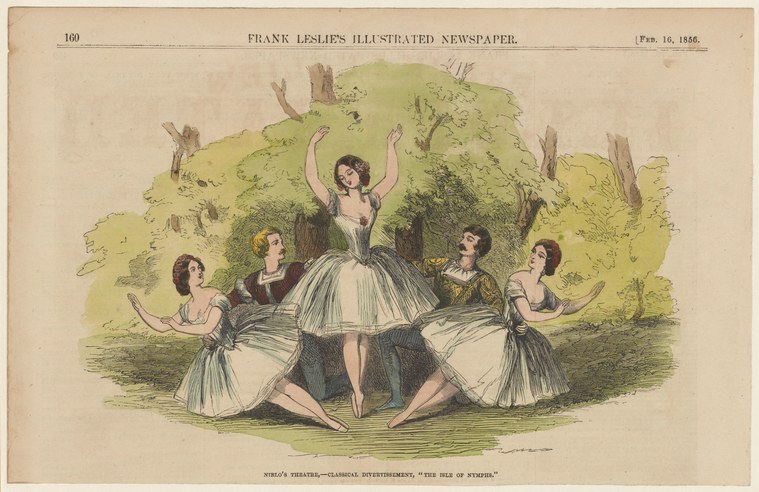
This image documents how Romantic ballet was consumed and circulated in 19th-century America through the popular press. It shows not only the choreography and tableau itself but also the commercial machinery that made European dance accessible to provincial audiences through reproductive prints distributed in newspapers.
What you are looking at
Five young women in diaphanous white dresses dance in a leafy woodland setting beneath tall trees with broken trunks. Four of the figures form a circle around a central dancer who stands with both arms raised in triumph or exultation. The women wear simple, high-waisted neoclassical gowns with minimal ornamentation, their hair dark and styled close to the head. The setting is rendered in soft greens and yellows, suggesting dappled forest light, with the broken tree stumps emphasizing an Arcadian or sylvan mood. The composition is symmetrical and theatrical, with the central figure dominant and the surrounding dancers arranged in balanced attendance. The image is hand-colored, likely a wood engraving or steel engraving from the mid-19th century.
The dancing
The five dancers occupy an open formation rather than a closed ballroom hold. The central figure stands nearly upright with both arms raised, shoulders back, in a pose of joy or liberation. The four surrounding dancers face inward, their arms extended toward the center figure or held at their sides in relaxed positions. All five are on their feet with weight distributed naturally rather than in the turned-out stance of ballet. The composition reads as participatory and communal rather than hierarchical—a circle of equals celebrating together.
The dance depicted
The title 'The Isle of Nymphs' and the costume, setting, and choreography all suggest a theatrical tableau or ballet of the Romantic era, likely from the 1830s–1850s. The sylvan setting, the nymphs (mythological figures), and the innocent gaiety point to ballets like *La Sylphide* or *Giselle*, which depicted sylphs, spirits, and nature beings in woodland scenes. However, the composition and arm positions depart from classical ballet technique. The dancers' poses suggest a scene of social rather than technical dance—perhaps a scene of celebration, awakening, or communal joy among supernatural beings. The image likely documents a moment from a specific theatrical production, capturing how Romantic ballet combined narrative charm with relatively accessible physicality for ensemble scenes.
How it was made
This is a hand-colored engraving or wood engraving, recognizable from the fine parallel lines of the shading, the crisp contours, and the delicate registration of color applied over a printed black line. The technique allowed mass reproduction for newspapers, periodicals, and illustrated books—this work comes from *Frank Leslie's Illustrated Newspaper*, a popular American weekly founded in 1855. The hand-coloring was likely applied in a workshop by assistants rather than by the original artist, following a template. This production method shaped the audience: middle-class readers of current events and theatrical news, not collectors or patrons. The image served to document and promote the ballet for those who had not seen it and to preserve a memory for those who had.
About this work
This is a theatrical tableau from a mid-19th-century ballet, most likely *La Sylphide* or a similar Romantic-era work. It captures five dancers in a woodland setting, arranged in a circle around a central figure with upraised arms—a composition that suggests both the mythological subject (nymphs in nature) and the theatrical convention of the ensemble celebration or awakening scene. The image was reproduced as a hand-colored engraving in a mass-circulation American newspaper, meaning it reached a broad audience hungry for images of the fashionable European spectacles that toured America. It is a record of how Romantic ballet was seen, marketed, and remembered in the 19th-century press.
How to look at it
Look first at the composition: the circle of five figures and the raised arms of the central dancer create a moment of unity and celebration. The artist has chosen to freeze a moment of joy rather than technical difficulty—there are no pointe shoes visible, no arabesque or grand développé, but instead a pose of emotional expression. Notice how the surrounding dancers frame and serve the central figure without being subordinate to her; this is a democratic composition that reflects the Romantic era's idealization of nature and innocence. The broken trees and soft forest light reinforce the otherworldly, magical mood that was essential to Romantic ballet's appeal.
The artist
The engraving is uncredited in the catalogue record. *Frank Leslie's Illustrated Newspaper* employed a stable of staff engravers and artists, many of them anonymous or working collaboratively. The hand-coloring was likely executed by a workshop team rather than a single artist. The image's style and technique are consistent with the in-house production standards of the newspaper in the mid-1850s.
The period
The Romantic ballet era (1830–1860s) celebrated supernatural beings—sylphs, spirits, nymphs—and exotic or pastoral settings. Works like *La Sylphide* (1832) and *Giselle* (1841) were among the most successful and widely toured ballets of the age. They reached American audiences through traveling European companies, and American newspapers seized on these spectacles as symbols of cosmopolitan culture. By the 1850s, when this engraving was printed, illustrated news weeklies like Leslie's had made theatrical imagery a staple of popular culture. Dance and the visual arts were intertwined in the press—prints and engravings documented performances for readers who could not attend them live.
Where it lives
The work is held in the New York Public Library's collection of prints depicting dance. It appeared in *Frank Leslie's Illustrated Newspaper*, a weekly pictorial news magazine published in New York from 1855 onward. Such illustrated newspapers were the primary vehicle for circulating images of theater and celebrity in mid-19th-century America.
Dance in this work
Questions about this work
Is this from a real ballet?
Almost certainly yes. The title, costumes, and setting are consistent with *La Sylphide* or similar Romantic ballets popular in the 1830s–1850s. The image was printed in a news context, documenting an actual theatrical production rather than a fantasy. However, without a publication date or production credit in the newspaper, we cannot identify the specific performance or company.
Why do these dancers look so different from classical ballet?
Romantic ballet prioritized narrative, emotion, and ensemble scenes alongside technical virtuosity. This image captures an ensemble tableau—a moment of collective joy—rather than a solo or a display of turnout and extension. The poses are more naturalistic and emotionally expressive, which was entirely appropriate for the genre and period.
How was this image made and distributed?
It is a hand-colored engraving, a technique that allowed mass reproduction. The newspaper's staff engravers created the black line, and workshop assistants hand-applied watercolor or gouache. This process was expensive but profitable because thousands of copies could be sold to subscribers—making theater accessible to people who could never afford to attend.
More dance artwork





