49 works in this view — arrow keys or swipe to move between them.
Dance in Art
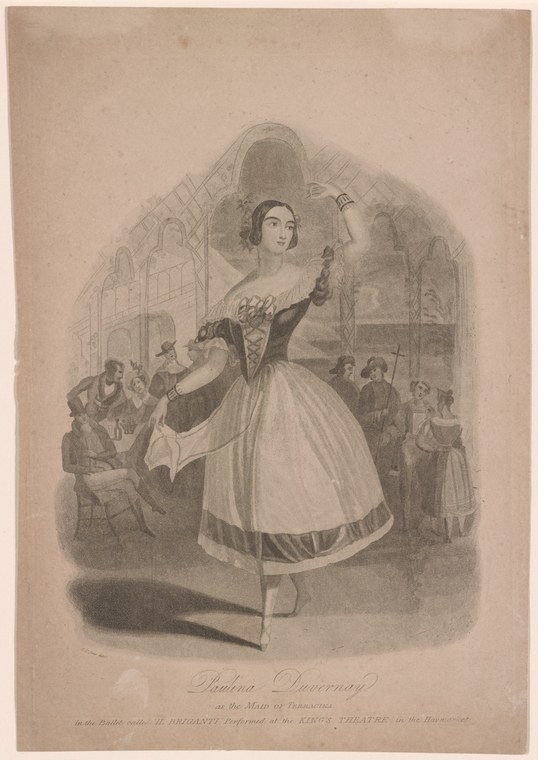
Paulina Duvernay as the maid of Terracina, in the ballet called Il briganti, performed at the King's Theatre in the Haymarket
Unknown artist
- Collection:
- Prints depicting dance
- Source:
- New York Public Library
- Rights:
- Public domain — free to use, share and adapt.
- Recorded as:
- Public Domain
This print is one of the few surviving visual documents of a working Romantic-era ballerina in a specific named role, making it invaluable for understanding the repertory and visual presentation of mid-19th-century ballet. It shows that even minor roles in narrative ballets were recorded and marketed to the public, revealing the commercial scale and celebrity culture of the period. For historians of dance, it is a rare chance to see actual costume, pose, and staging from the era rather than to rely on written description or later paintings.
What you are looking at
A young woman in a pale tulle skirt and dark corseted bodice stands en relevé at the center of a grand architectural interior, arms raised expressively. She is performing for an audience seated in the shadowed background within what appears to be a theatre or ballroom with classical columns and a vaulted ceiling. The composition places her in sharp light against the darker surround, her body angled in contrapposto, creating a sense of suspended motion. The engraving technique renders the scene in fine gray tones, with careful cross-hatching to model the folds of her skirt and the play of light across the stage floor. Several figures sit or stand watching from the sides and background, their forms less detailed, establishing the theatrical context. The title inscription at bottom identifies her as Paulina Duvernay performing the role of the maid in Il briganti.
The dancing
The principal figure is a single dancer in a pose that reads as both stable and momentary—feet in a relevé position with the body held upright, head tilted slightly back, both arms raised to approximately shoulder height with hands active and expressive. The pose suggests neither a static presentation position nor full extension; rather, it captures a moment of turning or traveling movement characteristic of Romantic-era technique. The figure's frame is frontal and open to the viewer, the corseted bodice defining the torso while the voluminous skirt floats around her in silhouette.
The dance depicted
This is a record of a performance within the Romantic ballet tradition, circa 1840s, capturing Paulina Duvernay in a named role from the ballet Il briganti. The image shows the conventions of theatrical ballet at the King's Theatre, Haymarket—the emphasis on the ballerina as the focal point, the lightness of the tulle skirt (a marker of the Romantic era), and the technical vocabulary of the pose all point to the classical ballet vocabulary of that period. Duvernay was a celebrated ballerina of the 1840s, and this work documents the kind of dramatic, narrative ballet that was then dominant on the London stage. The pose and the theatrical setting leave no doubt that this is a dance performance, not a dramatic scene.
How it was made
This is an engraving, likely a commercial print produced for theatrical circulation and sale to audiences. The fineness of the line work, the subtle gradations of tone through cross-hatching, and the clarity of the inscription all point to a professional hand working in the reproductive tradition. Engravings of this type were published in theatrical annuals and sold as souvenirs, making them both accessible historical documents and instruments of celebrity promotion. The technique allowed for wide distribution and relatively inexpensive production compared to painted portraiture, placing this image within the culture of mass theatrical publicity.
About this work
This is a documentary print of a named stage performance: Paulina Duvernay as the maid of Terracina in Il briganti at the King's Theatre, Haymarket. It captures the visual language of Romantic ballet—the ethereal tulle skirt, the posed relevé, the solitary ballerina as object of the male gaze—and preserves both the moment of performance and the celebrity of a particular dancer. The engraving served multiple purposes: as a theatrical memento for paying audiences, as a record of a specific production, and as a vehicle for Duvernay's fame. It belongs in a dance gallery because it documents not only what a ballerina wore and how she stood, but the theatrical apparatus that framed her performance and the commercial machinery that recorded and circulated her image.
How to look at it
Observe the suspended moment the engraver chose: Duvernay is neither in a static pose nor at the apex of a jump, but rather in a pose of gentle elevation and openness, as if caught between positions. Notice the care taken to render the tulle skirt as a separate entity from the body, floating and dematerialized—this was a deliberate aesthetic choice of the Romantic period. The architectural setting is secondary but not insignificant; it anchors the performance within a particular, prestigious venue. The audience in the background, though shadowed, reminds us that this was a public, observed event, not a private presentation.
The artist
The artist is not recorded. This was a standard commercial print, likely produced by a London engraver specializing in theatrical subjects, a common occupation in the 1840s. Such prints were often unsigned or attributed only to the publisher, and their makers have been largely lost to history. The style and quality suggest a professional of competence but not exceptional distinction—the work is serviceable documentation rather than artistic interpretation.
The period
This engraving dates to the height of the Romantic ballet era, when Romantic aesthetics had transformed theatrical dance. The tulle skirt, the lightness of the pose, and the emphasis on the ballerina as a supernatural or ethereal figure reflect the aesthetic dominance of works like La Sylphide (1832) and Giselle (1841). The King's Theatre was one of London's two major dance venues, and the production of such prints was a standard part of theatrical commerce. Mid-19th-century ballet was increasingly a female-centered art form focused on the ballerina, a shift visible in the composition of this print.
Where it lives
The print is held in the New York Public Library's collection of prints depicting dance, indicating its value as a documentary artifact. Such theatrical prints were mass-produced and widely circulated; this example has survived in a institutional collection where it can be accessed as a historical record.
Dance in this work
Questions about this work
Who was Paulina Duvernay?
Paulina Duvernay was a celebrated ballerina of the 1840s, prominent in London's theatrical dance world during the Romantic era. She performed in major productions at the King's Theatre and was well-known to the contemporary dance audience. Beyond this print and a handful of other documents, little detail of her career survives, which makes images like this one particularly valuable.
What is Il briganti?
Il briganti (The Brigands) was a narrative ballet in the Romantic repertory. The title suggests a story drawn from banditry or adventure, a common subject for ballets of this era. Duvernay is identified as performing the maid of Terracina, a supporting character in a narrative built around dramatic characters and situations.
Why was she posed en relevé?
Relevé—rising onto the balls of the feet—was a fundamental technique in ballet and was considered visually elegant, suggesting lightness and elevation. It was used in both static poses and traveling steps. In Romantic ballet, relevé conveyed the weightlessness and otherworldliness the era prized, even in the roles of human characters like maids.
What does the tulle skirt tell us?
The voluminous tulle skirt is a signature of Romantic ballet. Tulle—a lightweight, translucent fabric—allowed skirts to float and move independently of the body, creating a visual impression of dematerialization and ethereality. Its presence here confirms this is a Romantic-era production, not Renaissance court dance or classical ballet of an earlier period.
More dance artwork





