49 works in this view — arrow keys or swipe to move between them.
Dance in Art
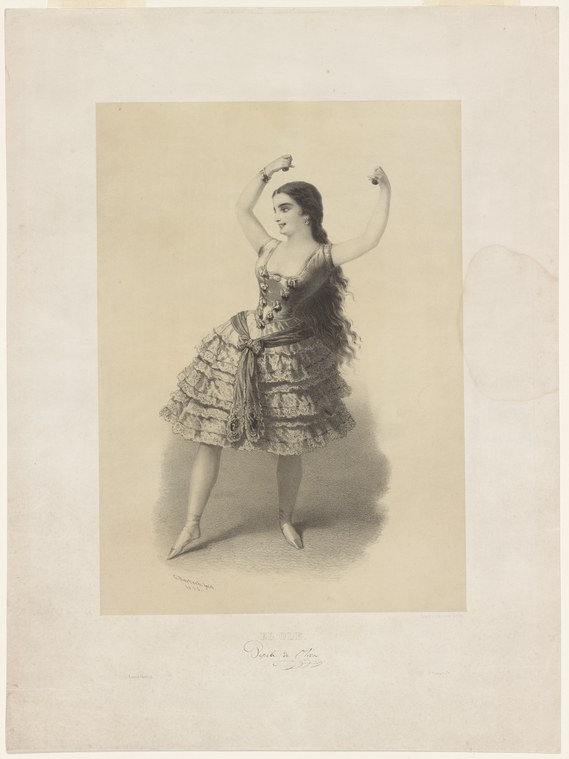
El ole, Pepita de Oliva [facsimile signature]
Unknown artist
- Collection:
- Prints depicting dance
- Source:
- New York Public Library
- Rights:
- Public domain — free to use, share and adapt.
- Recorded as:
- Public Domain
The work shows exactly how a Romantic-era ballerina was dressed and posed on stage—the silhouette, the ornament, the physical vocabulary—with a specificity that photographs of the era rarely capture. For historians of ballet, costume, and 19th-century performance, it is primary evidence of both choreographic convention and the lived experience of professional female dancers of this era.
What you are looking at
A single female dancer occupies the center of a cream-toned composition, presented against a subtle shadow that suggests depth and presence. She stands in a three-quarter pose, weight forward on her legs, body tilted slightly back. Her costume is elaborate: a dark corseted bodice with ornate beading or embellishment across the chest, over a tiered skirt of white or cream lace arranged in horizontal flounces that fall to mid-thigh. The skirt's construction—with its gathered, densely layered ruffles—creates a sculptural silhouette typical of mid-19th-century stage dress. Her dark hair falls loose past her shoulders. Most distinctively, both arms are raised to frame her head in a graceful arc, forearms angled forward and hands held aloft with fingers delicately extended. This pose suggests a moment of exultant display or a pause during a turn. The work is executed as a fine engraving or lithograph, with careful modeling of light and shadow across the fabric and figure.
The dancing
One female dancer alone on stage, shown at a moment that emphasizes vertical lift and arm placement. Her arms frame her head in a rounded arch, a classical pose suggesting control and elegance. Her weight appears to be primarily on one leg, creating a subtle contrapposto that suggests motion or anticipation of movement. Her torso is upright despite the backward tilt; her stance is narrow and refined. The pose conveys poise and technical command rather than explosive energy.
The dance depicted
This appears to be a work of theatrical-ballet, most likely depicting a moment from the Romantic ballet repertory of the 1840s–1860s. The facsimile signature 'Pepita de Oliva' suggests this may document a specific Spanish dancer of that era, though the costume and pose are consistent with European ballet convention rather than flamenco or Spanish national dance. The elaborate tiered skirt, the arm placement, and the solitary, composed presentation are all signatures of a classical pas or variation performed in a professional theater setting. The pose itself—arms raised and framing the head—is a standard finishing position or moment of repose in ballet vocabulary of this period.
How it was made
This work is a tinted or hand-colored engraving or lithograph, a medium well-suited to the commercial production and wide circulation of theatrical portraits in the mid-19th century. The fine, even modeling of tone and the careful attention to costume detail suggest a professional print made for sale to the ballet-going public—a common and economical way to preserve and market images of celebrated dancers. The technique allows for precise rendering of the dancer's pose and costume construction while permitting rapid reproduction for distribution.
About this work
This is a portrait print of a professional stage dancer, almost certainly from the mid-19th-century ballet theater. The dancer is shown in a composed, classical pose wearing an elaborate Romantic-era stage costume. The work documents both the technical vocabulary of ballet and the fashions of theatrical dance dress at a specific historical moment. It is one of thousands of similar dancer portraits published and sold to audiences throughout Europe and America during this period, serving both as a record of celebrated performers and as mementos of celebrated performances.
How to look at it
Observe the precision with which the artist has rendered the costume's construction—each tier of the skirt is distinct and carefully modeled. Notice the arm position: this is not a moment of movement, but of stillness or pause, a moment of display in which the dancer's technical mastery and poise are on view. The composition is deliberately formal and symmetrical, centering the figure and eliminating all distraction. This was the convention for professional dancer portraits of the era: not candid movement, but the pose that best showed the dancer's training, beauty, and status.
The artist
The artist is not recorded in the catalogue. The facsimile signature visible on the print itself may be that of the dancer (Pepita de Oliva) rather than the artist. Mid-19th-century dance prints were often produced by studios or commercial publishers rather than signed individually; attribution is often uncertain.
The period
This work dates to the heyday of Romantic ballet, when the ballerina—en pointe, in gossamer skirts, often playing supernatural or exotic characters—became the dominant figure in European and American ballet. This was the era of Marie Taglioni, Carlotta Grisi, and the works of Adolphe Adam and Jules Perrot. Pepita de Oliva, if the signature correctly identifies the subject, would have been a dancer active during the 1840s–1860s. The tiered lace skirt shown here is the costume silhouette that defined the period visually; it was far more elaborate and ornate than the ethereal tulle skirts of the century's early decades, reflecting both advancing costume technology and the consolidation of classical ballet vocabulary.
Where it lives
This print is held in the NYPL's Prints depicting dance collection, a comprehensive assemblage of dance iconography in print form from the 18th century onward. As a commercial theatrical portrait, it was likely sold individually to theatergoers or through print shops, making it a relatively common artifact of its era, though its artist remains unidentified in the current record.
Dance in this work
Questions about this work
Was Pepita de Oliva a famous dancer?
The facsimile signature on the print appears to reference Pepita de Oliva, but the catalogue record does not provide biographical information. She was likely a professional stage dancer active in the mid-19th century, but her career prominence is not documented in this record. Prints of this kind were produced for both celebrated stars and working professionals.
Why is the skirt so ornately layered?
The tiered construction was typical of Romantic-era ballet costumes and served both aesthetic and practical purposes. The multiple flounces created visual drama during movement, especially during turns, while the structured layers gave the skirt a sculptural silhouette on stage. This style dominated professional ballet from roughly the 1840s through the 1870s.
Is this a work of flamenco dance?
No. Despite the Spanish name (Pepita de Oliva), the costume, pose, and vocabulary are those of European theatrical ballet, not flamenco or Spanish national dance. The dancer is en pointe (though the feet are not clearly visible) and is wearing the tulle and lace costume of a European ballroom rather than the styled dress of Spanish dance.
How was this print made?
Based on the image, this is most likely a hand-tinted engraving or lithograph—a professional commercial print of the kind produced and sold in large numbers during the 19th century. The technique allowed for fine detail and permitted rapid reproduction, making such prints affordable to a wide audience.
More dance artwork





