49 works in this view — arrow keys or swipe to move between them.
Dance in Art
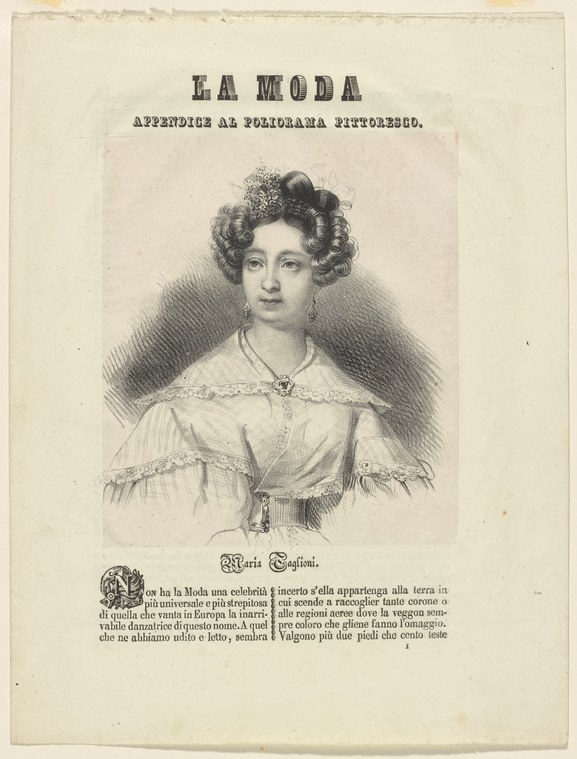
Marie Taglioni (fac. sig.)
Unknown artist
- Collection:
- Prints depicting dance
- Source:
- New York Public Library
- Rights:
- Public domain — free to use, share and adapt.
- Recorded as:
- Public Domain
Taglioni was the first major ballerina to achieve global celebrity status; this print is evidence of how extensively her image was reproduced and consumed as a cultural commodity in the 19th century. The portrait captures not her artistry in motion, but the cultural machinery that made Romantic ballet dancers into objects of public fascination and aspiration—a shift that shaped how dance has been valued and remembered ever since.
What you are looking at
A three-quarter-length portrait of a woman identified as Marie Taglioni, the celebrated Romantic-era ballerina, rendered as an engraving. She is shown in an idealized pose against a plain background with subtle shading that creates volumetric depth behind her figure. Her dark hair is arranged in the fashionable ringlets of the 1830s–40s, pinned up with what appears to be a decorative comb or ornament. She wears a high-waisted, off-shoulder dress in the Romantic style, with a broad collar or bertha of delicate gathered fabric that frames the shoulders and extends partway down the arms. The bodice is fitted and adorned with a brooch or clasp at the center front. Below is gathered or pleated fabric suggesting the skirt of a ball gown rather than a stage costume. Her gaze is direct and composed, meeting the viewer's eye with the composed dignity expected of a fashionable portrait of the period. At the foot of the image is an ornamental capital letter and Italian text—a biographical or descriptive passage.
The dancing
The figure is presented in stillness and formality rather than in motion. Her posture is upright and stationary, with shoulders relaxed back and arms held naturally at her sides, neither demonstrating a dance position nor a theatrical gesture. The portrait format and the absence of any stage setting or prop indicates this is not meant to capture her in performance, but rather to present her as a public figure and celebrity of her era—a society portrait rather than a dance documentation.
The dance depicted
Marie Taglioni (1804–1884) was the defining ballerina of the Romantic period and a principal dancer of the Paris Opéra. She was famous above all for her creation of the title role in *La Sylphide* (1832), a role that became synonymous with her name and that exemplified the weightless, ethereal aesthetic of Romantic ballet. This engraving appears to be a celebrity portrait rather than a record of her in character or costume; it presents her as a society figure in contemporary dress, not as a stage performer. The inscription and format suggest this was one of many popular prints circulated to satisfy public fascination with famous dancers of the era.
How it was made
This is an engraving or possibly a lithograph, rendered in the fine-line technique characteristic of 19th-century theatrical portraiture. The subtle cross-hatching in the background and the precise linear rendering of facial features and fabric are typical of steel or copper engraving. The soft modeling of light across the face and the delicate rendering of the gathered sleeves demonstrate the technical refinement expected of a commercial print intended for a fashionable audience. Such prints were inexpensive to produce in multiple impressions and were widely distributed, making famous performers accessible to the public as collectible souvenirs.
About this work
This engraving presents Marie Taglioni, the Romantic era's most celebrated ballerina, in a formal portrait rather than a performance image. Created to satisfy public appetite for images of theatrical celebrities, the print captures her as a society figure of the 1830s–40s in fashionable dress and hairstyle, not in the gossamer skirts and pointe shoes for which she was legendary. The work belongs in a dance gallery not because it documents technique or choreography, but because it reveals how Romantic ballet transformed individual dancers into public icons, and how the culture of celebrity dance was mediated and distributed through the commercial print market. The inscription in Italian suggests the work circulated beyond France, testament to Taglioni's international fame.
How to look at it
This is not a dance image in the technical sense—Taglioni is posed in stillness rather than frozen in motion. Instead, attend to what the portrait claims: her composed dignity, her fashionable dress, her direct gaze. The formal conventions of the portrait assert her status as a public figure whose face and person are of interest to strangers. The care taken with the rendering of fabric and features, the soft modulation of light, the ornamental border and inscription—all of these signal that this is a significant person, someone worth owning and displaying. That signal itself is part of dance history: Taglioni's transformation into a commodity was inseparable from her artistic achievement.
The artist
The engraver is not recorded. The inscription identifies the subject by name and includes a biographical passage in Italian, suggesting the print was produced by a commercial print house or publisher for general circulation. Such unnamed reproductive engravings were the standard medium for circulating images of performers in the 19th century; the engraver's skill lay in translation from a source image (likely a painting or drawing) rather than original invention.
The period
The 1830s–40s were the peak of Romantic ballet, when the form turned toward supernatural and ethereal subjects—sylphs, undines, and spirits—that showcased the ballerina's weightlessness and otherworldly grace. Marie Taglioni was the supreme exponent of this aesthetic, and her fame rivaled that of opera singers and theatrical actors. The demand for her image as a commodity was enormous; this print is one of hundreds produced across Europe to satisfy public appetite. Simultaneously, the technology of wood engraving and lithography was making reproduction faster and cheaper, democratizing access to celebrity portraiture. The Italian text of this edition suggests it was distributed throughout continental Europe and possibly Latin America.
Where it lives
This is a commercial print held in the Dance collection of the New York Public Library. The Library's Dance collection includes prints, playbills, photographs, and other ephemera documenting theatrical dance from the 18th century onward. This engraving is the kind of popular print that would have been sold in print shops and collected by enthusiasts; its presence in the Library's collection documents how such images were preserved as historical evidence of dance culture.
Dance in this work
Questions about this work
Is this Taglioni in costume or in her street clothes?
She is in fashionable street dress, not a stage costume. The off-shoulder gown is contemporary Romantic-era formal wear, not a ballet tutu or theatrical garment. This was a celebrity portrait intended for public consumption, not a record of a specific performance or role.
Who was Marie Taglioni and why is she famous?
Taglioni (1804–1884) was a Swedish-born dancer who became the defining ballerina of the Romantic period and the principal dancer of the Paris Opéra. She is most famous for creating the title role in *La Sylphide* (1832), a ballet about a young man bewitched by an ethereal sylph. Her lightness, grace, and technical mastery made her the model for the Romantic ideal of the ballerina as a weightless, otherworldly being.
Why are there so many prints of Taglioni?
She was a global celebrity at the height of Romantic ballet's popularity. Dance fans, like opera fans, collected prints and portraits of famous performers; publishers produced them in large quantities to meet demand. This engraving is one of many surviving examples of the merchandise market that developed around famous dancers in the 19th century.
What does the Italian text say?
The inscription provides biographical information about Taglioni and was likely added to give context to collectors unfamiliar with her. The presence of Italian text suggests this edition was distributed in Italy or other parts of continental Europe, demonstrating her international fame.
More dance artwork





