49 works in this view — arrow keys or swipe to move between them.
Dance in Art
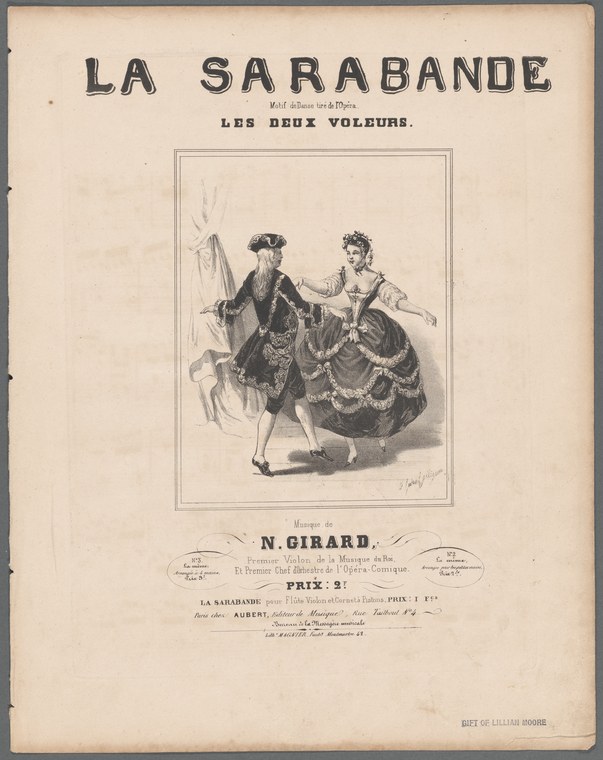
La sarabande: motif de danse tiré de l'opéra Les deux voleurs
Unknown artist
- Collection:
- Prints depicting dance
- Source:
- New York Public Library
- Rights:
- Public domain — free to use, share and adapt.
- Recorded as:
- Public Domain
This image preserves evidence of how the sarabande was understood and performed in the nineteenth century—not as a living folk practice but as a refined theatrical form that could authenticate opera through historical reference. For dancers and historians, it shows the continuity between baroque partnering conventions and romantic-era ballet technique, and demonstrates how prints functioned as the primary media by which dance imagery circulated before photography.
What you are looking at
This is a theatrical engraving depicting a moment from the operatic ballet *Les deux voleurs* (The Two Thieves), showing a sarabande in progress. A male dancer in dark coat and breeches stands in profile, one arm extended toward a female dancer who wears an elaborate pale gown with gathered skirts caught mid-movement. The woman's pose is graceful and composed, her body angled away from her partner, creating the characteristic spatial relationship of the sarabande. The figures occupy a shallow stage space defined by a simple rectangular frame; the background is plain, emphasizing the dancers' forms and the elegance of their carriage. The line work is precise and delicate, with careful attention to the articulation of limbs and the fall of fabric.
The dancing
The male dancer stands upright with good posture, his weight settled and his extended arm reaching toward but not touching his partner—a key feature of baroque partnering. The female dancer responds with elongated line through her torso and neck, her body held in that lifted, composed manner characteristic of eighteenth-century noble dance. Neither figure is in a closed ballroom hold; instead they exist in the formal, distanced partnering typical of baroque court dance. The woman's skirts are voluminous and captured in a moment of gentle swirl, suggesting measured, controlled movement rather than vigorous action.
The dance depicted
This is the sarabande, one of the most important dances of the baroque theatrical and court repertory. The sarabande was a stately, processional dance in triple meter, originating in Spanish popular tradition but adopted and refined by the French court and subsequently by European opera and ballet. It appears here as choreography within an opera-ballet, suggesting this was a staged theatrical performance for an educated, courtly audience. The image captures the essential character of the sarabande: dignified, slow, and formally partnered, with emphasis on the torso and upper body rather than footwork. The restraint and composure of both figures exemplify how this dance was understood by the mid-nineteenth century—as an emblem of aristocratic grace.
How it was made
This is a wood or steel engraving, a technique that allowed for fine linear detail and wide circulation through printing. The medium was ideal for theatrical documentation: it could be distributed to audiences as a souvenir of a performance, and the precise linework conveys both the elegance of the movement and the refinement of the performers' dress. The engraving technique creates a sense of clarity and permanence absent from sketches; this is a finished, official record of a staged moment. The maker's name—N. Girard—appears in a cartouche at the base, as does mention of the Paris Opéra Comique and a retail price (2 francs), indicating this was a commercial print for a broad if educated public.
About this work
This is a theatrical engraving documenting a sarabande from the operatic ballet *Les deux voleurs*, a work performed in nineteenth-century Paris. It belongs to a long tradition of dance prints that served as both performance records and courtly documents, extending the reach of theatrical spectacle into the homes of literate, cultured audiences. The sarabande itself was already a historical form by the time this print was made—a baroque dance revival within a romantic-era opera-ballet, suggesting both nostalgia for the courtly past and the nineteenth-century appetite for dance as a vehicle for historical and exotic fantasy.
How to look at it
Notice the careful distance between the partners and the formal alignment of their bodies—baroque dance, even when theatricalized, maintained reserve and hierarchical spacing. Observe how the engraver has captured the weight of the woman's skirts and the composed carriage of her upper body, which conveys the slow, measured triple-meter movement of the sarabande far more effectively than it could convey a quick, energetic dance. The moment frozen here is not one of extreme extension or virtuosity, but of dignified, sustained poise—the sarabande's essential character.
The artist
N. Girard was a Parisian engraver active in the mid-nineteenth century, working in the commercial print trade that documented opera, ballet, and theatrical spectacle for sale to the public. Little is known of his biography, but his work reflects the established practice of capturing stage moments for audiences who would experience the choreography through prints as well as, or instead of, live performance.
The period
The sarabande experienced a marked revival in the early nineteenth century as part of the romantic movement's fascination with historical and exotic dance forms. Opéra Comique in Paris became a major venue for these hybrid works, blending contemporary ballet technique with choreography styled after (or explicitly reviving) baroque court dances. This occurred during the height of romantic ballet's popularity, when La Sylphide and Giselle were dominating the stage; smaller operatic venues compensated through historical and narrative innovation rather than purely technical spectacle. The print medium was the primary way such performances reached audiences beyond the theater itself.
Where it lives
This print is held in the New York Public Library's collection of dance prints. It is a commercial theatrical print from the mid-nineteenth century, produced for sale to the theater-going public at 2 francs and likely distributed through Parisian print shops associated with the Opéra Comique.
Dance in this work
Questions about this work
What is a sarabande?
The sarabande is a stately baroque dance in triple meter, originating in Spain but refined and elevated in the French court. By the nineteenth century it had become a historical form, revived in theatrical contexts to evoke the elegance and formality of the past. It emphasizes dignity, restraint, and formal partnering over flashy footwork.
Why is this from an opera-ballet, not a pure ballet?
In nineteenth-century Paris, the Opéra Comique and other smaller theaters used dance choreography—sometimes historical in style—to add variety and spectacle to operatic narratives. A staged sarabande would have been understood as both a historical reference and a theatrical embellishment, lending prestige and cultural sophistication to the work.
How do we know this is the sarabande and not another baroque dance?
The title on the print explicitly identifies it: 'La Sarabande: motif de danse tiré de l'opéra Les deux voleurs.' The image also shows the characteristic stately posture, formal partnering distance, and measured carriage associated with how the sarabande was understood by the mid-nineteenth century.
What can a dancer learn from this image?
The engraving shows the essential partnering frame and body alignment of baroque-derived dance: upright posture, distanced formal spacing, elongated line through the torso, and controlled movement of the skirts. It demonstrates that theatrical sophistication in this era did not depend on extreme extension or athletic display, but on composed elegance.
More dance artwork





