49 works in this view — arrow keys or swipe to move between them.
Dance in Art
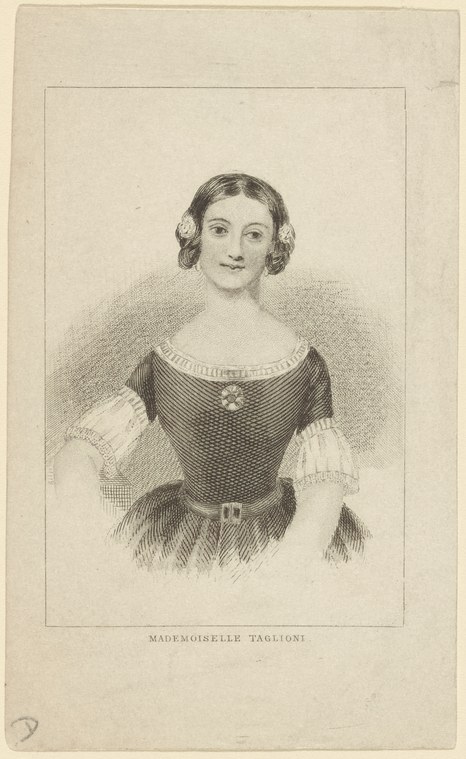
Mademoiselle Taglioni
Unknown artist
- Collection:
- Prints depicting dance
- Source:
- New York Public Library
- Rights:
- Public domain — free to use, share and adapt.
- Recorded as:
- Public Domain
Maria Taglioni defined Romantic ballet and was arguably the most famous dancer of her age; images of her in costume were globally distributed and owned by thousands. This print is evidence of how dance stars were created and circulated as commodities before photography, and of how Romantic ballet costume—despite its ethereal reputation—was in practice varied, theatrical, and tied to specific roles and productions.
What you are looking at
A three-quarter-length portrait of a young woman, shown from the waist up, facing slightly to the right. She wears a dark corseted bodice with horizontal striping or ribbing, and dramatically voluminous white sleeves that extend from mid-upper arm, caught and gathered at the wrist with dark bands. The neckline is broad and off-the-shoulder, edged with a light-colored trim. Her dark hair is parted in the center and styled in the fashion of the 1830s–1840s, with waves framing her face. She wears a small brooch or ornament at the center front of her bodice. The figure is rendered against a plain background with subtle shading that creates depth around the head and shoulders. The work is executed as a line engraving or steel engraving, with fine parallel hatching used to build form and tone throughout.
The dancing
The subject stands in a calm, frontal pose with shoulders relaxed and arms at rest. Her posture is upright and dignified, with no suggestion of active movement or dance gesture. The body position is entirely static, a formal portrait convention. The extreme width and gathering of the sleeves dominates the composition visually and would be characteristic of Romantic-era stage costume rather than street dress, suggesting this is a costume portrait of a performer.
The dance depicted
This is a costume portrait of a professional dancer, most likely a ballerina of the Romantic ballet era (1830s–1840s). The identifying caption reads 'MADEMOISELLE TAGLIONI,' referring to Maria Taglioni (1804–1884), the Swedish-born Italian dancer who became the most celebrated dancer of the Romantic period and a defining figure in ballet history. The off-shoulder neckline, corseted bodice, and dramatic white sleeves are consistent with Romantic ballet costume, though this particular arrangement suggests a specific role or production costume rather than the tutu-based costume for which Taglioni was most famous. The image documents how a major international dance star of the period was promoted and circulated as a public figure.
How it was made
This is a line engraving or steel engraving, a reproductive print made by incising fine parallel lines into a metal plate to create areas of tone and shading. The technique creates sharp detail and fine gradation, ideal for portraiture and suitable for mass circulation. Engravings of this kind were the primary medium for distributing images of celebrated performers before photography, allowing theaters and publishers to reach a broad audience. The quality of the engraving—fine and precise throughout—suggests this was a professional commercial print, likely issued as part of a series of theatrical portraits for collectors or theater patrons.
About this work
This is a costume portrait engraving of Maria Taglioni, the defining ballerina of the Romantic ballet era. It is one of countless reproductive prints that circulated in Europe during her career, documenting not the dancer in motion but the public image of the celebrity performer. The print belongs to the larger culture of theatrical portraiture—the nineteenth-century equivalent of publicity photography—through which dancers and actors were marketed, collected, and remembered. Such prints offer historians visual evidence of how professional performers were dressed, promoted, and perceived by their contemporary audiences.
How to look at it
View this as a costume document as much as a portrait. The engraver has taken time to render the texture of the fabric and the precise cut and drape of the sleeves; these details matter. The dark horizontal lines of the bodice and the gathering and banding of the sleeves were design choices meant to convey elegance and movement potential, even though the figure is still. The subtle shading around the face and shoulders shows skill in suggesting three-dimensional form. The inscription at the base—the only text—was the print's label and guarantee; it named the sitter and, by implication, guaranteed the accuracy of the likeness.
The artist
The artist is not recorded in the catalogue. The print is unsigned or the signature is not visible in this reproduction. The engraving was likely made by a professional theatrical portrait engraver working for a European publisher, probably in Paris (where Taglioni was based) or another major artistic center. Such prints were often anonymous commercial work, issued in editions for sale to the public.
The period
Maria Taglioni's career dominated European dance from the 1820s through the 1850s. She was a virtuoso of the new Romantic ballet vocabulary, and her fame coincided with the explosion of printmaking technology and mass theatrical publicity. In the same decades that Taglioni danced, engraved portraits of celebrated performers became a major commercial product—sold in theaters, by subscription, and through print shops. Costume portraits like this one were collected as souvenirs and evidence of one's attendance at or awareness of major theatrical events. The Romantic movement in art and literature valorized emotion, nature, and the supernatural; Romantic ballet moved toward pointe work, ethereal tutus, and otherworldly subjects (sylphs, spirits, ghosts). This particular costume—with its dark bodice and gathered sleeves—may belong to a specific role in a now-difficult-to-trace production.
Where it lives
This print is held by the New York Public Library in its collection of prints depicting dance. It is a commercial theatrical portrait, likely issued in the nineteenth century as part of a series or collection of performers' portraits.
Dance in this work
Questions about this work
Who was Maria Taglioni?
Maria Taglioni (1804–1884) was a Swedish-born dancer trained in Italy who became the most celebrated ballerina of the Romantic era. She pioneered pointe work and created iconic roles in ballets like *La Sylphide* (1832). Her fame was international; she danced across Europe and Russia and was the first major dance celebrity of the modern era, extensively documented in prints, paintings, and written descriptions.
Why is this a costume portrait rather than a performance scene?
Costume portraits were a major category of theatrical print in the nineteenth century. They served multiple purposes: as souvenirs for audiences, as publicity for the performer and the theater, and as fashion plates showing the latest theatrical styles. They were cheaper and faster to produce than narrative scene engravings, and they placed the star at the center without the expense of depicting supporting dancers or sets.
How do we know this is a professional theatrical print and not a private portrait?
The inscription in capital letters at the base—'MADEMOISELLE TAGLIONI'—is the key. This is a printed label, not a handwritten or drawn signature. It is the hallmark of a commercial print produced for distribution. The fine quality of the engraving and the theatrical costume (not street dress) confirm it was made for public consumption.
What do the sleeves tell us?
The off-shoulder neckline and gathered white sleeves are consistent with 1830s–1840s Romantic ballet and broader fashionable dress of the period, but this particular arrangement—the dramatic width, the dark banding—suggests a specific stage costume. Such sleeves could allow arm movement in port-de-bras (arm work) while remaining visually striking from the front. The costume documents Romantic ballet's aesthetic: ethereal, elegant, but also practical for a performer's body.
More dance artwork





