49 works in this view — arrow keys or swipe to move between them.
Dance in Art
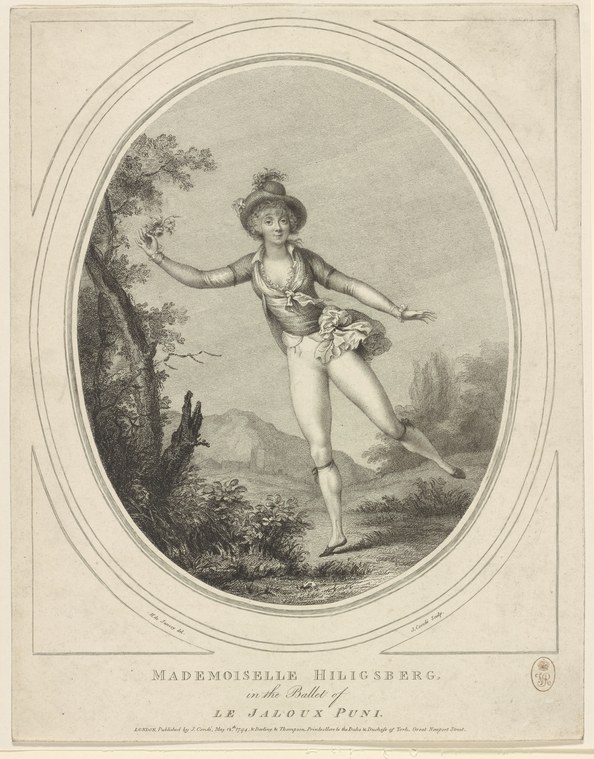
Mademoiselle Hiligsberg in the ballet of Le jaloux puni
Unknown artist
- Collection:
- Prints depicting dance
- Source:
- New York Public Library
- Rights:
- Public domain — free to use, share and adapt.
- Recorded as:
- Public Domain
This engraving is a rare documentary record of a named performer and a lost ballet, evidence that the theatrical dance of this period was valued enough to circulate in print. For dance historians, it provides visual documentation of costume, body position, and aesthetic ideals at a moment when ballet was undergoing profound reform away from the older, more ornate traditions. For art historians, it exemplifies the formal and technical sophistication of 18th-century theatrical portraiture in print.
What you are looking at
A young female dancer poses alone on a rocky stage set, captured mid-movement in an engraving rendered in fine linear hatching. She wears a short classical tunic with a draped bodice, a decorative headpiece, and heeled shoes; her costume is minimal and classical rather than the elaborate skirts of Romantic ballet. The setting is a Mediterranean or Arcadian landscape with cypress trees, rocky outcrops, and distant mountains rendered in atmospheric perspective. She is caught in a balletic attitude: one leg extended behind her, the other supporting, one arm gesturing expressively upward while the other curves gracefully. The composition is framed within a double oval cartouche in the formal neoclassical manner. The title below reads "Mademoiselle Hiligsberg in the ballet of Le jaloux puni" (The Jealous Man Punished), suggesting this documents a specific performer in a specific production, now lost to record.
The dancing
The dancer stands in a single-leg supporting position with the working leg extended in an arabesque or attitude derrière, the body pitched slightly forward in the upper torso. The arms are in a classical frame: one raised expressively toward the tree, the other extended lower and to the side, creating an open, receptive upper body. The weight is clearly on the supporting leg; the extended leg is articulated with pointed foot. This is balletic vocabulary, not pantomime or folk gesture—the frame and line suggest training in court dance or early theatrical ballet conventions.
The dance depicted
This engraving documents a named dancer, Mademoiselle Hiligsberg, performing in *Le Jaloux Puni*, a theatrical ballet whose full history is not readily recoverable from this image alone. The pose and costume align with late 18th-century theatrical dance: the neoclassical tunic and minimal ornament suggest the reformed aesthetic associated with Jean-Georges Noverre and his followers, while the balletic attitude and grace indicate serious dance training rather than pantomime. The classical setting and mythological subject matter (implied by the rocky, Arcadian landscape) were typical of this period. Without additional documentation, we cannot establish the ballet's date, composer, or choreographer from the image, but the engraving itself is evidence that Hiligsberg was a performer of sufficient renown to be commemorated in print.
How it was made
This is an engraving, a print made by incising lines into a metal plate (copper, likely) and inking the plate so that the incised lines hold ink and transfer to paper. The fine, parallel hatching visible throughout creates tone and modulation without solid blacks. The artist demonstrates skillful control of light and shadow, modeling the dancer's body, the landscape's recession, and the atmospheric effects with careful line work. The oval frame and formal presentation suggest this was one of a series documenting notable dancers or productions, a common format in the 18th and early 19th centuries for circulating images of stage performers to an educated public. The quality of execution suggests a professional printmaker working from a drawing or painting.
About this work
This engraving documents a moment in the stage history of European theatrical dance around the turn of the 18th century. Mademoiselle Hiligsberg, frozen in a graceful balletic pose, represents the classical reform movement in dance that rejected heavy ornamentation and complex pantomime in favor of pure balletic line and expression. The work is a record of a specific dancer and production now lost to historical memory—the ballet *Le Jaloux Puni* does not appear in standard dance histories—yet the image itself is a precious artifact. It shows how a skilled dancer of the period moved, how she was costumed, and how her performance was valued enough to document in a formal print for public circulation.
The engraving belongs to a tradition of theatrical portraiture in dance, in which named performers were commemorated in print form. Such images served as advertisements, souvenirs, and records of the era's aesthetic values. This particular work exemplifies the neoclassical turn in late 18th-century dance: the idealized landscape, the severe and elegant costume, and the emphasis on balletic grace over narrative complexity all mark a period of significant reform in how dancers moved and presented themselves on stage.
How to look at it
Look first at the dancer's body and the extreme simplicity of her costume: no elaborate skirts, no heavy ornament, just a tunic and heeled shoes. This simplicity was revolutionary and intentional—it allowed the audience to see the line of the body and the articulation of the movement. Notice the specific pose: one leg supporting, one extended, the arms in an open, expressive gesture. This is a moment that showcases the dancer's control, turnout, and line—the core values of the reformed theatrical dance of this period. The setting—the Arcadian landscape with distant mountains—is not a realistic backdrop but a symbolic one, placing the dancer in an idealized, timeless world. The oval frame emphasizes the dancer as a portrait subject, not merely a figure in a scene, and suggests that this print was meant to be collected and displayed as a record of a famous performer and production.
The period
This engraving dates to the era of Jean-Georges Noverre's *Lettres sur la danse* (1760) and the broader neoclassical reform of theatrical dance in the late 18th century. During this period, dance was moving away from the heavily codified, ornate vocabularies of the Baroque and early Rococo toward a cleaner, more expressive, more emotionally direct aesthetic. Dancers were increasingly trained in classical technique (the positions and movements that would eventually become codified as ballet), and theatrical costumes were simplified to emphasize the body's line and movement. The subject of this ballet—*Le Jaloux Puni*—suggests a dramatic or semi-dramatic work suited to the emerging genre of *ballet d'action*, in which the narrative was conveyed through choreography and mime rather than through sung dialogue as in older court ballets. Mademoiselle Hiligsberg was likely a performer of some celebrity; the commissioning of a formal engraving to commemorate her in a specific role indicates that star dancers of this period had enough public profile to justify such documentation.
Where it lives
This engraving is held in the New York Public Library's collection of prints depicting dance. It appears to be one of a series documenting notable stage performers and productions, a common format for theatrical commemoration in the 18th and early 19th centuries. The formal title and presentation suggest it was a commercial print, likely sold to theater-goers and collectors.
Dance in this work
Questions about this work
Who was Mademoiselle Hiligsberg?
Beyond this engraving, little is recorded about her. The fact that she was commemorated in formal print suggests she was a notable performer of her time, likely active in European theaters in the late 18th or early 19th century. The print itself is the primary historical record of her significance.
What is *Le Jaloux Puni*, and when was it performed?
The title translates as "The Jealous Man Punished," suggesting a ballet with a narrative theme. It does not appear in standard dance history references, so its choreographer, composer, premiere date, and venue are unknown. This engraving is likely one of the few surviving records of the work's existence.
What is significant about her costume?
The short, simple tunic was part of the neoclassical reform of dance in the late 18th century. Earlier dancers wore heavy, ornate skirts that obscured movement; this simplified costume allowed the audience to see the dancer's body, line, and articulation. It represents a major shift in aesthetic values.
Is this definitely an engraving?
Yes. The fine parallel lines visible throughout the image are characteristic of the engraving technique, in which lines are incised into a metal plate. The artist used careful hatching to create tone and shadow, a hallmark of skilled engraving work.
More dance artwork





