49 works in this view — arrow keys or swipe to move between them.
Dance in Art
Marie Taglioni [facsimile signature]
Unknown artist
- Collection:
- Prints depicting dance
- Source:
- New York Public Library
- Rights:
- Public domain — free to use, share and adapt.
- Recorded as:
- Public Domain
Taglioni is foundational to ballet history: she was the first dancer to make pointe work her signature, the first to dance roles that required seeming to defy gravity, and the first to be transformed by the romantic movement into an ideal of femininity and otherworldliness that shaped ballet for the next two centuries. This print is direct evidence of how she was seen and sold to her public—not as a woman performing tricks, but as a creature from another realm. Understanding this image is essential to understanding why ballet developed as it did and why the romantic aesthetic still dominates classical ballet training and repertory today.
What you are looking at
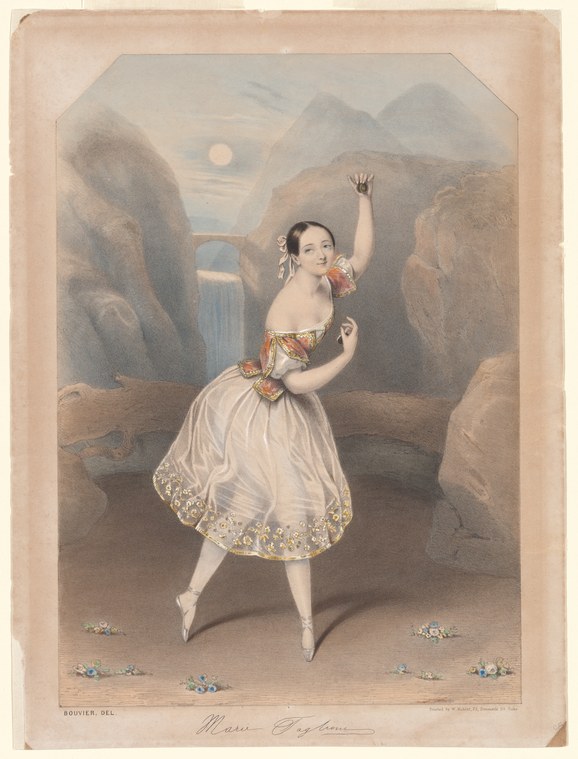
A young female dancer stands alone in a mountainous landscape, captured mid-movement in a moment of ethereal grace. She wears a short white tutu with ornately decorated hem, a coral-pink bodice with ribbon detail at the waist, and her dark hair is pulled back with a ribbon. Her right arm extends upward in an elegant arc, her gaze following it, while her left arm reaches across her body. She stands en pointe on her right leg, her left leg lifted behind her in an attitude or similar position. The setting is a romantic, moonlit ravine with craggy rock formations framing the figure; a full moon glows in the misty sky above. Scattered flowers dot the rocky ground at her feet, adding to the dreamlike, otherworldly quality. The composition and ethereal quality suggest a moment from a classical ballet narrative, possibly depicting a supernatural or elemental creature.
The dancing
A single dancer is shown in a supported balance, standing en pointe on her right leg with the left leg lifted in a classical position—likely an attitude derrière or similar. Her upper body leans back slightly, with the right arm raised and extended in an elegant line, the left arm positioned across the body. The line from extended fingertips through the lifted leg creates a fluid, elongated silhouette. Her weight appears fully committed to the supporting leg, with a clear sense of turnout from the hips. The body demonstrates the elongation and control essential to classical ballet technique of the era.
The dance depicted
This is a portrait of romantic-era ballet, most likely depicting Marie Taglioni or a role in her style. The signature at the base suggests this is indeed a representation of Taglioni, the Swedish-Italian dancer who revolutionized ballet in the 1830s–1840s. The costume—short tutu, pointe work, the pale romantic aesthetic—and the supernatural setting (fairies, sylphs, spirits were her hallmark roles) point directly to works like *La Sylphide* (1832), the defining ballet of the romantic period in which Taglioni danced the lead. The moonlit, isolated landscape is the standard iconography of sylph ballets: a nocturnal, magical realm inhabited by spirits rather than mortal dancers. The pose suggests a moment of flight or weightless suspension characteristic of how romantic ballet sought to make the dancer seem ethereal and otherworldly.
How it was made
This is a hand-colored lithograph, a reproductive medium that allowed wide circulation of theatrical imagery in the nineteenth century. The delicate coloring—soft pinks, pale greens in the foliage, luminous blues in the sky and moonlight—would have been applied by hand to a lithographic stone print, making each copy slightly unique. Lithography was the dominant medium for theatrical portraits and dance prints from the 1820s onward, cheaper and faster than engraving and capable of capturing soft tonal effects and atmospheric perspective. The signature and printing mark visible at the bottom confirm this as a commercial theatrical souvenir, the kind sold at theaters and through print shops to allow audiences to take home an image of a favorite performer.
About this work
This is a theatrical portrait print of Marie Taglioni, the Swedish-Italian dancer who dominated European ballet from the 1830s to the 1840s and defined the romantic movement in dance. The image captures her in a characteristic pose from one of her signature roles—most likely the Sylph from *La Sylphide*—suspended in a moonlit, supernatural landscape. Taglioni was celebrated for her seemingly weightless, ethereal technique and for popularizing the pointe shoe and the short tutu that became emblems of classical ballet. This print circulated widely among theater audiences of the period and represents how romantic-era dancers were marketed and remembered: not as athletes or technicians, but as otherworldly spirits and muses. The work documents both a specific performer and a whole aesthetic ideal—ballet as transcendence from the corporeal world.
How to look at it
Attend to the moment in the movement the artist has chosen: not a fixed pose but the apex of a jump or rise, where the dancer seems suspended, weight distributed impossibly high. Notice how the body is elongated and thinned through the torso, the line unbroken from the crown of the head through the raised arm and down the supporting leg—this is a deliberate distortion meant to emphasize grace over anatomical realism. The moonlit, empty landscape isolates the figure and makes it monumental; there is no architectural frame or crowd, only nature and sky. This compositional choice—the solitary dancer in an enchanted place—became the standard formula for romantic ballet prints and posters. The artist has understood and endorsed the romantic ideal: the dancer as spirit, not athlete.
The artist
The artist is not recorded in the catalogue. However, the signature-style notation and printing mark suggest this was produced by a commercial print publisher, likely in Paris or London, where the bulk of theatrical lithographs of this period were made. Hand-colored lithographic portraits of Taglioni were produced in quantity by multiple publishers during her performing career (1832–1847); this is one of many versions and variants. The unsigned or incompletely attributed status is typical of theatrical reproductive prints, which were often unsigned or credited only to the publisher, not the artist who executed the color work.
The period
This print dates from the height of the Romantic movement in European dance and art, roughly 1830s–1840s. In ballet, romanticism meant a turn away from the virtuosity and court elegance of neoclassical ballet toward themes of supernatural beings, unattainable love, and the triumph of spirit over matter. Marie Taglioni epitomized this shift. In visual art, the same period saw lithography emerge as the dominant commercial medium for theatrical imagery, enabling the rapid, affordable circulation of performer portraits. The moonlit, emotionally charged landscape and the emphasis on the dancer's weightlessness reflect broader romantic-period aesthetics—a fascination with the night, the spiritual, the feminine ideal, and the tension between the real and the imaginary. Taglioni's image was reproduced obsessively during her lifetime, making her arguably the first celebrity performer in the modern sense.
Where it lives
This print is held in the New York Public Library's collection of prints depicting dance. It is a commercial theatrical souvenir from the nineteenth century, one of hundreds of lithographic portraits of Taglioni and her contemporaries produced for sale to theater audiences.
Dance in this work
Questions about this work
Who was Marie Taglioni?
Marie Taglioni (1804–1884) was a Swedish-Italian dancer who became the most famous performer of the romantic era in ballet. She was the first to make pointe work central to her technique, pioneering the use of the slipper (pointe shoe) as we know it. Her roles—especially the Sylph in *La Sylphide*—defined romantic ballet's aesthetic of weightlessness and otherworldliness. She was celebrated across Europe and was arguably the first international dance superstar.
What is the Sylph, and why does it matter?
*La Sylphide* (1832), choreographed by Filippo Taglioni (Marie's father), tells the story of a mortal man who falls in love with a sylph—an air spirit—and pursues her into a magical realm. It was the defining work of romantic ballet and remained central to the repertory for nearly two centuries. The Sylph role required the dancer to seem weightless and ethereal, qualities Taglioni embodied through her technique and artistry. The ballet established a template for romantic narratives that ballet has followed ever since.
Why does she look like she's floating?
She appears to be dancing en pointe (on the tips of her toes), a technique that creates an illusion of weightlessness and otherworldliness. Romantic-era ballets used pointe work to make dancers seem to defy gravity and appear as spirits rather than human beings. The artist has further emphasized this by showing her at the apex of a jump or rise, suspended mid-movement, in an empty moonlit landscape that enhances the sense of levitation.
How was this image made and circulated?
This is a lithograph—an image drawn on a stone, inked, and printed—that was then hand-colored. Lithography was the dominant commercial printing technique for theatrical portraits in the nineteenth century because it was cheaper and faster than engraving and could capture soft effects and atmospheric detail. Publishers produced hundreds of such prints, which were sold at theaters, through print shops, and by mail order to fans. This was how theater audiences in the 1830s–1840s took home images of their favorite performers.
More dance artwork





