49 works in this view — arrow keys or swipe to move between them.
Dance in Art
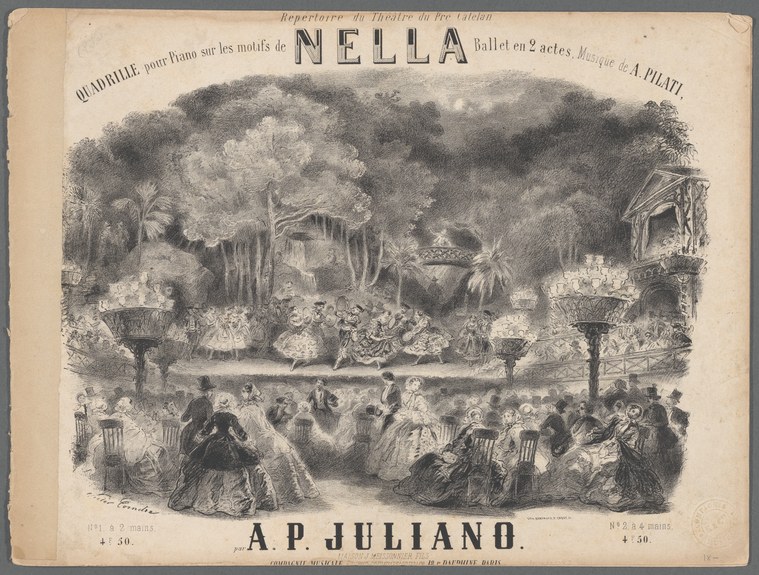
Quadrille pour piano sur les motifs de Nella: ballet en 2 actes, musique de A. Pilati
Unknown artist
- Collection:
- Prints depicting dance
- Source:
- New York Public Library
- Rights:
- Public domain — free to use, share and adapt.
- Recorded as:
- Public Domain
This print reveals how 19th-century ballet incorporated social dances—particularly the quadrille—as theatrical subjects, and how those dances were visualized and promoted to paying audiences. For historians of ballroom dance, it is direct evidence of how the quadrille was actually danced and framed in performance; for ballet historians, it shows the genre's continued engagement with social forms even as it developed increasingly virtuosic technique.
What you are looking at
This is a lithograph illustrating a scene from the ballet *Nella*, a two-act work with music by A. Pilati. The composition depicts an idyllic garden or park setting populated by elegantly dressed figures in mid-19th-century costume. At the center, couples and groups engage in social dancing beneath towering trees; the foliage is rendered in soft, billowing tones that create an atmosphere of romantic fantasy. The foreground is occupied by seated spectators in formal dress—women in voluminous skirts, men in dark coats—who frame the dance space. A classical pavilion or temple structure appears at right, and ornamental urns and fountains punctuate the manicured landscape. The entire scene is suffused with the genteel, dreamlike quality characteristic of Romantic ballet imagery: this is not raw movement but a vision of courtship, leisure, and social grace set in an enchanted garden.
The dancing
The dancers throughout the composition are posed in the upright, dignified carriage typical of 19th-century ballroom and theatrical dance. Several couples visible in the middle distance appear to be moving in closed hold or in the formal configurations of a quadrille—the titled source of the piano reduction. The women wear full skirts that fall to the ankle; the men are in tailcoats. No pointe shoes or ballet practice costume is evident. The postures are those of social dancing rather than classical ballet technique: the bodies are vertical, the movement appears to be horizontal and lateral across the floor, and the overall impression is of refined social choreography rather than virtuosic elevation.
The dance depicted
This is a quadrille, a formally structured set dance for four couples arranged in a square or longways formation. The quadrille was the dominant ballroom dance of the 19th century and was frequently adopted for theatrical ballet scenes; indeed, the title page explicitly identifies this as a *Quadrille pour piano*, a piano reduction of ballet music. The composition shows the quadrille as a theatrical fantasy—set in an Arcadian landscape rather than a ballroom—but the figures are clearly engaged in the actual steps and figures of the dance: the couples process, face, and turn in the configurations demanded by the form. This print documents both the dance itself and the convention of transforming it into Romantic spectacle by relocating it to a garden or pastoral setting.
How it was made
This is a lithograph, a process that allowed for soft tonal gradation and romantic effect through stone-printed imagery. The technique is evident in the delicate handling of the trees, the subtle shading of the figures' dress, and the atmospheric perspective that renders the distant pavilion and landscape in fainter tones. Lithography was the dominant medium for theatrical imagery and promotional prints in the 19th century: it was fast, could be printed in quantity, and reached a broad urban audience—dancers, theatre-goers, and amateurs interested in popular music and dance. The print appears to be the cover or title page of a published piano score, linking visual spectacle directly to the music and dance it represents.
About this work
This lithograph is a document of the ballet *Nella* as it would have been staged in the mid-19th century, captured here in the form of a piano-score cover. It shows a moment of social choreography—a quadrille—translated into Romantic theatre through costume, setting, and the genteel postures of the dancers. The work sits at the intersection of ballroom dance and theatrical ballet, genres that were far more closely related in the 19th century than they appear today. It is a record not of dance in the street or at court, but of dance as commercial spectacle and as an object of polite consumption by the urban middle class.
How to look at it
Attend to the formal arrangement of the couples and their vertical, dignified carriage: this is how the quadrille was supposed to look, and the artist has frozen the dancers in a moment of processional clarity so that the form of the dance is readable. Notice also the frame of seated spectators: the print documents not just the dance but the social context in which it was watched and valued. The pastoral setting—garden, fountain, temple—is a Romantic convention that transforms a courtly social form into a vision of timeless grace. Compare the postures and dress here with images of actual ballroom dancing from the same period to see how the theatrical version idealized and romanticized the social practice.
The period
The quadrille achieved its greatest popularity and cultural visibility in the 1830s–1860s, the era of Romantic ballet. While classical ballet (exemplified by the work of Taglioni and Elssler) was developing virtuosic pointe work and narrative spectacle, the quadrille remained the social dance of the ballroom and a frequent subject for theatrical adaptation. This print dates from that period. Lithographic prints of this kind were a major vehicle for the dissemination of dance culture: they advertised ballets, documented costume and choreography, and allowed amateur musicians and dancers to recreate scenes at home. The image of the quadrille as an Arcadian fantasy—rather than a literal ballroom event—is characteristic of Romantic aesthetics, which sought to elevate social forms by embedding them in poetic or mythological landscapes.
Where it lives
This print is held in the New York Public Library's collection of prints depicting dance. It functions as a musical score cover—a title page or wrapper for a piano arrangement—and belongs to the category of theatrical promotional and documentary imagery that libraries and archives collected in order to document performance culture.
Dance in this work
Questions about this work
Is this a ballet or a ballroom dance?
It is a quadrille, a social ballroom dance, performed here as a theatrical ballet. In the 19th century, these forms overlapped more than they do today: ballroom dances like the quadrille were standard subjects for theatrical choreography and were performed both at court and on stage. This image shows the dance in a theatrical (fantastical garden) setting, but the actual steps and formation are those of the social quadrille.
What is the source for the image and text?
This is a lithographed cover for a piano score: a musical reduction of the ballet *Nella*, by composer A. Pilati, arranged for amateur or salon performance. Such covers were essential marketing tools for theatrical works, allowing them to reach audiences beyond the opera house or ballet theatre. The text and image together—title, composer, arranger—document what the work was and how it was promoted.
How do I know this is a quadrille and not some other dance?
The title page explicitly identifies it as a 'Quadrille pour piano sur les motifs de Nella.' The visual composition also supports this: the couples are arranged in the formal processional configurations typical of the quadrille, and their upright posture and sideways motion across the floor are characteristic of that dance, not of the vertical, ascending vocabulary of classical ballet technique.
What is the artistic style or period of this image?
This is a Romantic-era lithograph, likely from the 1830s–1860s, when the quadrille was at the height of its cultural prominence and when Romantic ballet was the dominant theatrical form. The soft, atmospheric style of the lithograph, the pastoral setting, and the idealized poses of the dancers all reflect Romantic aesthetics. The women's skirts and hairstyles suggest the mid-19th century.
More dance artwork





