49 works in this view — arrow keys or swipe to move between them.
Dance in Art
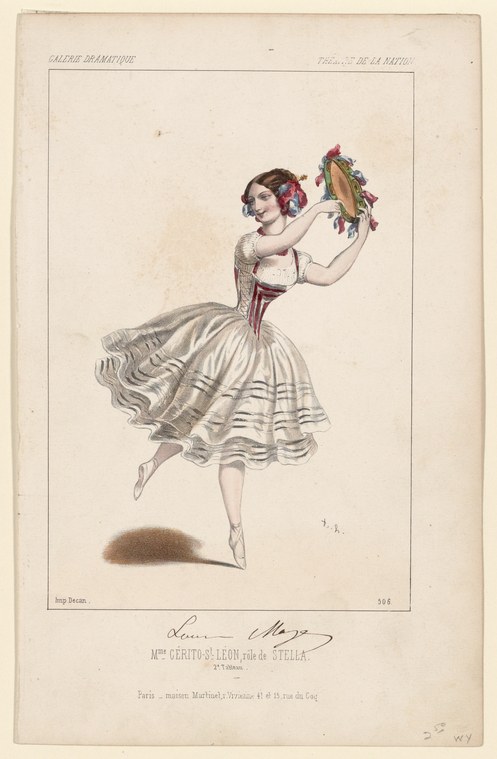
Mme Cérito-St.-Léon, rôle de Stella, 2e tableau
Unknown artist
- Collection:
- Prints depicting dance
- Source:
- New York Public Library
- Rights:
- Public domain — free to use, share and adapt.
- Recorded as:
- Public Domain
This print records a specific moment in nineteenth-century ballet history through the gaze of its own time: we see not only what Cérito-St.-Léon danced but how her performance was packaged, marketed, and commemorated. The image is technical evidence of Romantic ballet vocabulary—the jump, the arm position, the costume—and reveals that even in a single-figure souvenir image, the dancer's body was understood as narrative, presentation, and display rather than as movement alone.
What you are looking at
A young female dancer is captured mid-leap in this hand-colored engraving, her body suspended in a moment of apparent weightlessness. She wears a mid-nineteenth-century costume: a fitted corset-like bodice in pale tones with a full, voluminous skirt composed of multiple horizontal pleats or flounces that billow around her as she jumps. Her dark hair is styled and adorned with flowers or ribbons. She holds aloft in her raised right arm a small bouquet of flowers tied with ribbon, extending it away from her body in a gesture of offering or display. The dancer is shown in three-quarter view against a neutral background, with only a shadow beneath her suggesting ground. The composition emphasizes the lift and ethereality of the pose—her left leg appears to bend beneath her while the right extends—and the technical feat of the jump itself.
The dancing
A single dancer, isolated against the background. Her arms are asymmetrically positioned: the right arm raised and extended holding the bouquet, the left arm lowered at her side. Her body appears to spring upward with considerable height, the legs bent in a gathered position rather than in a fully extended jump. Her head is held erect and turned slightly in the direction of the raised arm. The posture suggests control and deliberate artistry rather than uncontrolled elevation.
The dance depicted
This is theatrical ballet of the Romantic era, most likely a scene from a mid-nineteenth-century ballet d'action. The single sustained leap with the body held in a gathered, collected position, the turned-out legs, and the asymmetrical arm gesture with the floral attribute are all hallmarks of Romantic ballet technique. The title names the performer and the role (Stella from the second tableau of what appears to be a ballet), indicating this is a souvenir or promotional image of a specific moment from a known work. The bouquet, a common feature of Romantic ballet imagery, often signals a moment of presentation or conclusion within the narrative.
How it was made
This is a hand-colored engraving or possibly lithograph from the mid-nineteenth century. The technique of engraving allowed fine detail in the costume and anatomical description while the hand coloring—visible in the flesh tones, the blue-grey pleating of the skirt, the pink flowers, and the pale bodice—was applied after printing. This form of production was standard for dance souvenirs and theatrical publicity of the period, allowing multiple copies to be created and distributed to patrons and collectors. The combination of precision in the line work and the delicate, jewel-like color application is characteristic of prints made to commemorate ballet performances.
About this work
This is a Romantic-era ballet souvenir engraving commemorating a specific performer, Cérito-St.-Léon, in a specific role and scene. The image captures the aesthetic and technical vocabulary of Romantic ballet: the ethereal leap, the elaborate costuming with its distinctive full skirts, and the moment of classical restraint and control that defined the style. It is both a portrait of a celebrated dancer and a document of how that dancer's art was understood and valued by her contemporaries—not as a naturalistic representation but as a stylized image of grace, technical mastery, and theatrical presence. Such prints circulated widely among theater audiences and collectors, making them important evidence of how ballet was seen and celebrated in the nineteenth century.
How to look at it
Look at the moment the artist has chosen to freeze: not a moment of arrival or descent, but the peak of the jump, when the dancer's body is gathered and composed. Notice how the raised arm with the bouquet defines the asymmetry and the direction of the gaze. This is not a snapshot of uncontrolled motion but a carefully posed image of control and presentation—the dancer's expression and focus are directed outward toward the audience, as if presenting the bouquet. The costume, with its precision-drawn pleating and hand-colored detail, is as much the subject of the image as the body within it.
The artist
The engraver is not recorded in the catalogue. The signature or publication mark on the print may identify the workshop. Unsigned or otherwise unattributed dance prints of this type were a mass-market product of nineteenth-century Paris and London, produced by engraving firms whose names appear on the sheet rather than those of the image-makers themselves. Attribution by style and inscription alone is difficult; such prints were often collaborative works and frequently copied or restruck without careful records of authorship.
The period
This print dates to the height of the Romantic ballet era (roughly 1830s–1850s), when the aesthetic of the ethereal, otherworldly ballerina reached its peak. The voluminous skirt, the pointe work implied by the height of the jump, and the solitary female figure as the center of spectacle are all signatures of Romantic ballet at mid-century. Marie Taglioni, Fanny Elssler, and their contemporaries, including Cérito, defined this visual language. At the same time, colored theatrical prints and lithographs became a major form of popular visual culture, allowing middle-class audiences to own images of celebrated performers and to participate in the cult of the dancer. The image is also typical of its medium: the hand-coloring process, labor-intensive but economical for multiple copies, was gradually being displaced by chromolithography but remained standard practice for high-quality theatrical souvenirs.
Where it lives
This print is held in the New York Public Library's collection of prints depicting dance. It is a commercial theatrical souvenir from the nineteenth-century print market, part of the mass circulation of dance imagery that connected performers, performances, and audiences across geographic distance.
Dance in this work
Questions about this work
Who was Cérito-St.-Léon?
Fanny Cerrito (1817–1909) was an Italian-French Romantic-era ballerina celebrated for her technical virtuosity and dramatic presence. She performed throughout Europe and was known for her roles in works such as *Ondine* and *Étoile du Nord*. She married French dancer and choreographer Saint-Léon, though marriage did not end her career. The hyphenated name on this print likely indicates a married or professional partnership.
What is the 'second tableau' mentioned in the title?
Romantic ballet was typically organized as a sequence of scenes or tableaux, each advancing the narrative. The 'second tableau' indicates this was a moment from midway through the ballet, after the first scene. Within each tableau there might be multiple dances and dramatic moments; this print captures a specific high point.
Why is the dancer holding flowers?
Flowers in Romantic ballet carry symbolic meaning—they signify femininity, innocence, natural beauty, and often mark moments of triumph or presentation. The bouquet held aloft suggests either an offering, a moment of audience acknowledgment, or a symbolic gesture within the narrative of the ballet.
How was this image made?
This is a hand-colored engraving. The outlines and details were first engraved into a metal plate, which was then inked and printed onto paper. After printing, a colorist applied watercolor or gouache by hand to tint each impression. This labor-intensive process allowed for high-quality, detailed images while still producing multiple copies for sale to theater audiences.
More dance artwork





