49 works in this view — arrow keys or swipe to move between them.
Dance in Art
The games
Unknown artist
- Collection:
- Prints depicting dance
- Source:
- New York Public Library
- Rights:
- Public domain — free to use, share and adapt.
- Recorded as:
- Public Domain
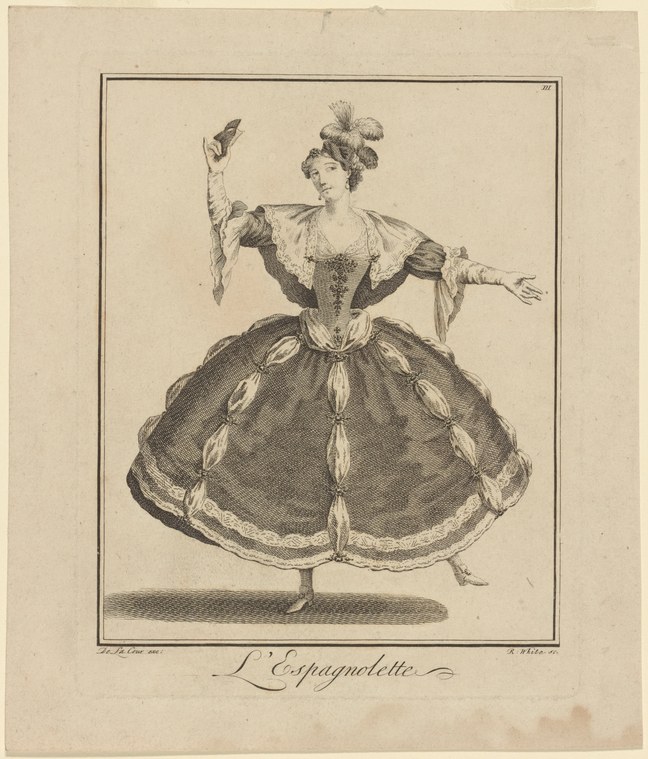
This work documents the visual language of 18th-century theatrical dance and the performance of character types—in this case, a Spanish dancer—that entertained European courts and stages. For dance historians and costume historians, it is evidence of how professional performers dressed and how they were understood by the artists and audiences who recorded them. The fineness of the engraving and its preservation in an institutional collection indicates it had enough cultural value to be kept, copied, and circulated—marking it as a document of what people wanted to see and remember about dance.
What you are looking at
A single female dancer in an elegant interior or stage space, captured in a moment of animated performance. She wears an elaborate gown with a dramatically voluminous skirt composed of deep shading and ornamental details—what appears to be multiple layers or decorative panels arranged radially around her figure. Her bodice is fitted and embellished, with puffed or draped sleeves. Her hair is styled high and dressed with feathers or ornamental plumes. She holds one arm aloft at shoulder height, hand delicately positioned, while the other extends to her side with a graceful gesture. Her body is presented in a spirited pose suggesting movement or playful energy—the skirt billows outward as if caught mid-twirl. The setting is minimal; a simple baseline grounds her, and the composition is framed by a double border typical of prints. The drawing style is fine and detailed, employing cross-hatching and line work to create volume and texture, particularly in the rendering of the fabric.
The dancing
The dancer's frame is upright and composed, her weight appears to be on one leg while the other is engaged beneath the expansive skirt, suggesting a turning movement or a pose held with dynamic tension. Her arms frame her body asymmetrically—one lifted in an arc, the other extended lower—which creates a sense of spirited, deliberate performance rather than natural rest. The articulation of her hands and fingers shows careful attention to gesture. The proportions and posture suggest a trained dancer with refined deportment, the kind of controlled elegance expected in the theatrical or court dance tradition.
The dance depicted
The costume, pose, and style strongly suggest 18th-century theatrical dance, most likely a French court or stage divertissement. The title 'L'Espagnolette' suggests a Spanish character dance, which was a stock item of entertainment in European courts and theatres of this period. The figure may represent either a theatrical performer in a Spanish-themed role or a character from a larger theatrical work. The elaborate costume, careful styling, and refined gesture indicate this was a professional or highly skilled amateur performer, likely dancing before an aristocratic audience. The playful energy of the pose—the lifted arm, the sense of movement captured in the billowing skirt—suggests a dance designed to entertain through elegance and wit rather than technical virtuosity in the modern sense.
How it was made
This is a line engraving or etching, executed in fine detail with careful use of cross-hatching and linear shading to build form and texture. The technique allowed for precise rendering of the elaborate costume and facial features, and the fineness of the line suggests this was created for circulation among a cultured audience—collectors of prints, artists, and patrons. The framing border and the formal presentation indicate this was a finished work intended for sale or distribution, likely as part of a series or album of theatrical costume studies. The quality of execution suggests a skilled reproductive engraver, possibly after a drawing by another artist.
About this work
This is a print depicting a single dancer in theatrical Spanish costume, titled 'L'Espagnolette,' from an unknown 18th-century engraver held in the New York Public Library's collection of prints depicting dance. The work captures a moment of performance—a woman in an elaborate, layered gown and feathered headdress held in a pose of animated grace, one arm aloft, the skirt rendered in voluminous detail. The engraving technique and formal presentation suggest this was a work of some circulation, intended to document theatrical fashion and entertainment for an educated audience.
The image belongs in a gallery of dance in art because it is direct evidence of how theatrical dance was visualized and valued in the 18th century—not as a record of technical movement, but as an image of charm, costume, and character. It tells us what was considered beautiful and entertaining in dance: the refinement of the figure, the drama of the costume, and the playful embodiment of a foreign character. For historians of theatre, dance, and visual culture, this print is a primary source for understanding the aesthetics and social context of stage entertainment in the period.
How to look at it
Notice how the artist has frozen the moment not at the apex of a movement, but in a pose of deliberate presentation—the dancer is showing herself to the viewer, not caught in the flow of action. The enormity and detail of the skirt is meant to impress; it is rendered with as much care as the face and hands. Look at how the asymmetrical arm position creates a sense of liveliness and personality, as opposed to a merely symmetrical formal pose. The feathered headdress and the costume as a whole are signals of theatrical artifice and character—this is not a woman in everyday dress, but a performer in a role. The print technique allows for a kind of precision and detail that celebrates the visual spectacle of the costume.
The artist
The engraver is unknown. The style and technique are consistent with 18th-century French or French-influenced printmaking. The work was likely created after a drawing by another artist—possibly a painter or choreographer documenting a specific performer or role. Without attributions or signatures visible in the image, the artist's practice and context cannot be established, though the quality and care of execution indicate professional training and likely commercial success.
The period
In the 18th century, theatrical dance in European courts and stages was dominated by the French tradition and the dominance of the ballet d'action—narrative dances that combined mime, costume, and refined technique. Spanish character dances ('Espagnolettes') were a popular subcategory of entertainment, imported from Iberian court culture and adapted for French and Italian stages. The period saw increasing circulation of prints documenting theatrical costume and performance, as engravings became a key medium for distributing images of celebrated performers to a literate and cultured public. This print sits at the intersection of theatrical history, costume history, and the history of print culture—a moment when dance was increasingly documented for circulation and memory.
Where it lives
This print is held in the New York Public Library's collection of 'Prints depicting dance.' The collection is a curated assembly of images documenting dance across periods and cultures, and this work sits within it as evidence of 18th-century theatrical practice. The NYPL catalogue record for this work is minimal—title, collection, and source are recorded, but artist, date, medium, and other details are unknown or not recorded.
Dance in this work
Questions about this work
What does 'L'Espagnolette' mean?
'Espagnolette' is French for a small Spanish woman or a Spanish-style character or dance. In 18th-century European theatres, 'Espagnolettes' were popular character dances, often performed by women in elaborate Spanish costume. The term could refer either to the character type or to the performer playing the role.
Was this a real person or a fictional character?
That cannot be determined from the print alone. The work may document a specific celebrated performer in a famous role, or it may be a generalized image of a character type. The lack of a name or signature on the print, and the unknown artist, make it impossible to say whether this represents an actual person or a theatrical type.
What does the costume tell us about the dance?
The costume—the fitted bodice, the voluminous layered skirt, the high hair and feathers—tells us that this was theatrical entertainment for an aristocratic audience, designed to display elegance, wit, and foreign character. The impracticality of the skirt (it could barely move) suggests the dance prioritized visual spectacle and graceful gestures over technical footwork or athletic movement.
Why is she holding her arms that way?
The asymmetrical arm position—one lifted and one extended—was a convention of refined theatrical gesture in the 18th century. It creates a sense of liveliness and personality, and the careful positioning of the hands shows training and control. This pose is meant to be both pleasing to look at and expressive of character—in this case, playful or flirtatious Spanish charm.
More dance artwork





