49 works in this view — arrow keys or swipe to move between them.
Dance in Art
Thesée
Unknown artist
- Collection:
- Prints depicting dance
- Source:
- New York Public Library
- Rights:
- Public domain — free to use, share and adapt.
- Recorded as:
- Public Domain
This engraving reveals how baroque court culture choreographed power and legitimacy through formalized gesture and spatial hierarchy. Dancers and historians studying the intersection of theatrical spectacle, political ceremony, and movement in the 17th century will find here a visual record of how bodies in formal dress were arranged and moved to communicate deference, majesty, and divine ordination.
What you are looking at
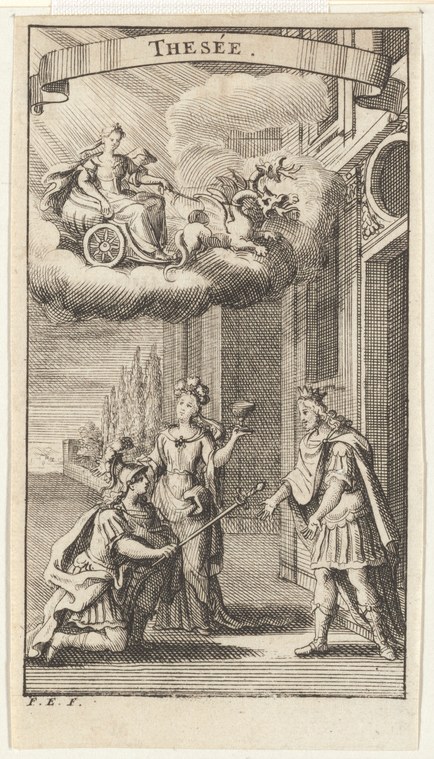
This is an allegorical engraving in two registers. The lower scene shows a woman seated on an architectural throne or elevated seat, gesturing toward a standing male figure in Roman military dress who extends his hand toward her. Two attendants flank the composition—one kneeling to the left, one standing to the right. The architectural setting features classical columns and massive stone walls. Above, in a cloud-borne vision, a chariot drawn by two figures in flight carries a crowned woman in triumph, attended by additional figures. The entire composition is framed by a banner inscribed "THESÉE" at the top. The print employs fine crosshatching and parallel line work typical of 17th-century engraving, creating dramatic chiaroscuro effects that emphasize the spatial separation between the earthly and celestial realms.
The dancing
The lower scene presents a formal, stately interaction: the seated woman holds an open, receptive posture with one hand raised in acknowledgment or blessing toward the standing man. His approach is formal and deferential, his body angled toward her. The attendants assume postures of submission and service—one kneels in supplication, the other stands in a respectful attitude. The upper scene shows the triumphant woman in the chariot with arms raised or extended in a gesture of exultation, her body lifted and buoyant. None of these figures display the balletic frame or technical virtuosity of trained dancers; instead they embody classical theatrical poses of hierarchy, deference, and apotheosis.
The dance depicted
This is not a depiction of social or theatrical dance in the conventional sense, but rather a visualization of dramatic action from a classical narrative—almost certainly Corneille's tragedy *Thésée* (1654) or similar dramatic source. The composition illustrates a moment of courtly recognition or admission, possibly Theseus's revelation of his identity to the Athenian court, followed by an allegorical vision of his apotheosis or divine favor. The 'dance' here is the formal, ritualized movement of court spectacle and heroic drama: the measured approach, the gesture of majesty, the tableau of submission and elevation. This is the language of court ballet or dramatic machine play rather than social or recreational dance—choreography in the service of narrative and allegory.
How it was made
This is an engraving, identifiable by the fine parallel line work (hatching and cross-hatching) used to model form and create tonal gradation. The technique suggests 17th-century production, likely French or Flemish, and the engraver's control of line pressure and density allowed for the subtle gradations visible in the drapery, architectural elements, and flesh tones. Engravings of this type were reproducible and relatively affordable, making them primary vehicles for the circulation of theatrical imagery and allegorical commentary among educated audiences. The two-register format—earthly action below, celestial or visionary realm above—is a common convention of allegorical printmaking.
About this work
This engraving illustrates a pivotal moment from *Thésée*, likely the work of a skilled 17th-century printmaker, using the formal visual language of court spectacle and allegorical drama. The image captures not a dance in the modern sense but the choreography of classical heroic theater: the ritualized gestures, the hierarchy of bodies in space, and the machinery of elevation and transformation that characterized court ballet and tragic spectacle. The composition demonstrates how deeply theatrical and political meaning were embedded in bodily posture and spatial arrangement during the baroque period.
The work belongs in a dance collection because it documents the formal vocabulary of movement in 17th-century courtly drama—the gestural grammar that shaped how bodies were arranged, approached, and elevated in narratives of power and divine favor. It shows us that 'choreography' in this period extended far beyond the ballroom or professional stage into the realm of political theater and visual ceremony.
How to look at it
Notice the strict formal geometry: the seated woman at the apex, the standing figure in measured approach, the attendants positioned in attitudes of service. This is not the fluidity of recreational dance but the grammar of power and hierarchy made visible through stance and proximity. Observe also the two temporal registers—the earthly transaction below and its celestial validation above—a common baroque device for showing how human actions participated in or reflected divine order. The artist chose a moment of mutual recognition or consent, not kinetic movement, suggesting that in classical dramatic theater, the meaningful 'action' lay in formal positioning and the exchange of gesture.
The artist
Unknown. The initials at lower left appear to read "F.B.F." but cannot be securely identified. The execution suggests a skilled professional engraver trained in the northern European tradition, working in the mid-to-late 17th century when allegorical theatrical prints were widely produced and circulated among courtly and educated audiences.
The period
The print dates to the period of French baroque court spectacle and the flourishing of allegorical drama. Corneille's *Thésée* was performed in 1654, and the 1650s–1690s saw intense investment in theatrical imagery and the visual documentation of dramatic narratives. This was the heyday of the court ballet and machine play—elaborate theatrical productions in which dance, spectacle, and allegory merged to serve political and dynastic ends. The formal postures and spatial arrangements visible here reflect the vocabulary of court ballet and the classical dramatic tradition, in which movement was highly regulated and every gesture carried semantic weight.
Where it lives
The work is held in the Prints collection of the New York Public Library, catalogued among works depicting dance. It is a single sheet impression, likely from a larger series of theatrical or allegorical engravings circulated in the 17th century.
Dance in this work
Questions about this work
Is this a dance?
Not in the modern sense, but yes in the baroque sense. The formal, ritualized approach and gesture are the choreography of court spectacle and dramatic theater. Every posture carries meaning, and the arrangement of bodies in space is precisely controlled—the vocabulary of court ballet applied to narrative spectacle rather than social dancing.
What is the source story?
The inscription *Thésée* indicates this illustrates a scene from a dramatic work about the classical hero—most likely Corneille's tragedy of that title (1654), one of the most celebrated French dramas of the baroque period. The composition likely shows a moment of recognition or apotheosis central to the plot.
Who made this?
Unknown. The initials at lower left are unclear, and the artist has not been securely identified. It is a 17th-century French or Flemish engraving, produced for circulation among educated, courtly audiences.
What does the upper scene mean?
The chariot in the clouds represents vision, apotheosis, or divine approval—a baroque convention for showing how earthly action participates in or reflects heavenly order. It elevates the moment of human recognition below into the realm of eternal significance.
More dance artwork





