49 works in this view — arrow keys or swipe to move between them.
Dance in Art
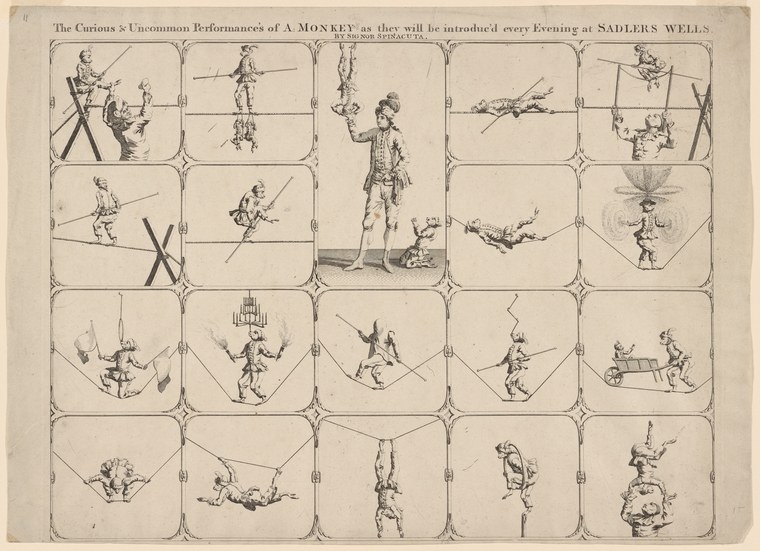
The curious and uncommon performances of a monkey: as they will be introduced every evening at Sadlers Wells by Signor Spinacuta
Unknown artist
- Collection:
- Prints depicting dance
- Source:
- New York Public Library
- Rights:
- Public domain — free to use, share and adapt.
- Recorded as:
- Public Domain
This image documents a largely forgotten tradition of animal acrobatics in popular theatre, and reveals how 18th-century audiences understood and valued bodily spectacle. It shows that acrobatic performance—now a recognized genre of partner dance and body work—has deep roots in entertainment culture, predating modern circus and extending to non-human performers. For historians of dance and physical culture, it expands the archive beyond the canonical and the human.
What you are looking at
This is an engraved broadside announcing acrobatic performances by a trained monkey at Sadler's Wells Theatre, depicted through twenty small vignettes arranged in a grid. Each panel shows the monkey in a different feat of contortion, balance, or aerial manoeuvre, suspended from ropes and bars or performing with props. The monkey is drawn with anatomical attention to its musculature and limbs, often inverted or twisted into extreme positions. A central figure—presumably Signor Spinacuta, the trainer—stands fully clothed in 18th-century dress, watching over the performances. The surrounding panels show the monkey alone, executing handstands, rope-walking, suspended splits, backward flips, and other feats that push the limits of primate flexibility. The whole is presented as a catalog of attractions, a visual advertisement of the novelty and skill on offer. The composition emphasizes the monkey's body as a site of wonder—articulate, controlled, and profoundly strange.
The dancing
The monkey is consistently drawn with exaggerated articulation: hyperextended limbs, inverted postures, and contortionist flexibility that frame it as a marvel of bodily control. In some panels it hangs by a single limb; in others it performs inverted splits or stands on its hands. The trainer is rendered in standard dress and upright posture, establishing human dominance and control over the animal spectacle. There is no partnered hold or conventional dance frame—these are solo acrobatic displays of extreme mobility and suspension.
The dance depicted
This is not dance in the theatrical sense, but acrobatic performance using the body as a vehicle for extreme feats of balance, contortion, and aerial suspension. The monkey's performances belong to the broader tradition of animal acts in variety theatre and fairground entertainment, where bodily spectacle—rather than choreography—was the draw. Such acts were popular at pleasure gardens like Sadler's Wells in the 18th century. The image documents not movement sequence but a catalog of possible poses and suspensions, each designed to astonish. Modern taxonomy would place this under acro-dance and aerial-dance, though the historical context is animal performance rather than human movement training.
How it was made
This is an engraving, almost certainly a wood engraving or copperplate engraving printed on paper as a broadside advertisement. The fine lines and careful shading show the engraver's hand; the publication of multiple vignettes on a single sheet suggests distribution as a promotional print—something to be posted or sold outside the theatre to advertise the novelty within. The technique allows for fine anatomical detail and repeatable mass production, meaning multiple copies could circulate. Such broadsides were common in 18th-century London, a cheap and effective way to announce attractions and draw crowds.
About this work
This broadside engraving advertises acrobatic performances by a trained monkey at Sadler's Wells Theatre, presented by Signor Spinacuta. It is neither a narrative scene nor a record of a single moment, but a catalog of marvels: twenty separate vignettes, each showing the monkey executing a different feat of contortion, balance, or aerial suspension. The work belongs to the culture of variety theatre and animal performance, where the body—whether human or animal—was displayed as a site of wonder and technical achievement. It sits at the intersection of theatrical advertisement, acrobatic spectacle, and natural history curiosity; the monkey is presented as both entertainer and anatomical marvel, its flexibility and control placed on display for paying audiences.
The image offers insight into 18th-century entertainment culture and the precursors of modern circus and acro-dance. The sophistication of the engraving and the systematic presentation of different poses suggest that this performance was considered noteworthy enough to warrant such careful promotion. Sadler's Wells, already famous for its water spectacles and acrobatic displays, drew audiences by offering bodily feats that pushed the boundaries of human (and, in this case, animal) capability.
How to look at it
Look at the progression and variation of poses: each panel isolates a single moment or position, creating a visual catalog rather than a narrative sequence. Notice the anatomical precision in rendering the monkey's musculature and joint articulation—the engraver took care to show exactly how the body contorts. The repeated figure of the trainer watching establishes human authority and control. Attend to the suspension apparatus in each panel: the ropes, bars, and frames that enable feats the body alone could not perform. This is acrobatic display made legible through technical detail.
The artist
The artist is not recorded. The work is a commercial broadside, likely produced by a London engraver or print publisher working for the theatre or the trainer. Such prints were ephemeral advertisements, and the engraver's name was often omitted. The quality of the work suggests a professional hand familiar with anatomical engraving and the production of theatre advertisements.
The period
This dates to the era when Sadler's Wells was transitioning from a music house to a spectacular entertainment venue, roughly the mid-to-late 18th century. The theatre was famous for acrobatic displays, rope-dancing, and other feats of bodily control—part of a broader vogue for physical spectacle in popular entertainment. Animal acts were common attractions; the presentation of the monkey's body as a marvel of flexibility aligns with contemporary curiosity about natural history and the limits of organic form. The engraving testifies to the commercial sophistication of theatrical promotion: detailed, technical, and designed to attract crowds through visual documentation of the impossible.
Where it lives
The work is held in the New York Public Library as part of its collection of prints depicting dance. It is an engraved broadside, a form of ephemeral advertisement produced for circulation and display in and around the theatre.
Dance in this work
Questions about this work
Was this monkey actually trained to do these things?
It is likely that a trained monkey did perform acrobatic feats at Sadler's Wells, but the broadside is promotional and may exaggerate or stylize the actual performance. The engraver prioritized visual spectacle and clarity over documentary precision. Sadler's Wells was known for genuine acrobatic displays, including animal acts, so the performances were probably real; whether the monkey executed every pose shown here cannot be verified from the image alone.
Who was Signor Spinacuta?
Signor Spinacuta is identified in the title as the presenter or trainer of the monkey. He is likely an Italian or Italian-named performer, following the convention of exotic appellations used to enhance the appeal of variety acts. He is not otherwise documented in surviving records, but his name and billing suggest he was a professional showman specializing in acrobatic or animal performance.
What was Sadler's Wells in the 18th century?
Sadler's Wells was a pleasure garden and entertainment venue in London, famous for water spectacles, acrobatic displays, and variety entertainment. It was a commercial theatre catering to popular audiences seeking novelty and physical spectacle. The venue became known for groundbreaking acrobatic and aerial acts, and later for pantomime and ballet.
Is this dance?
Not in the conventional sense. This is acrobatic performance—movement organized around feats of balance, flexibility, and suspension rather than choreography or music-driven rhythm. However, acro-dance is now a recognized performance genre, and this broadside documents an ancestor of that practice, showing how bodily spectacle has been valued in performance culture for centuries.
More dance artwork





