49 works in this view — arrow keys or swipe to move between them.
Dance in Art
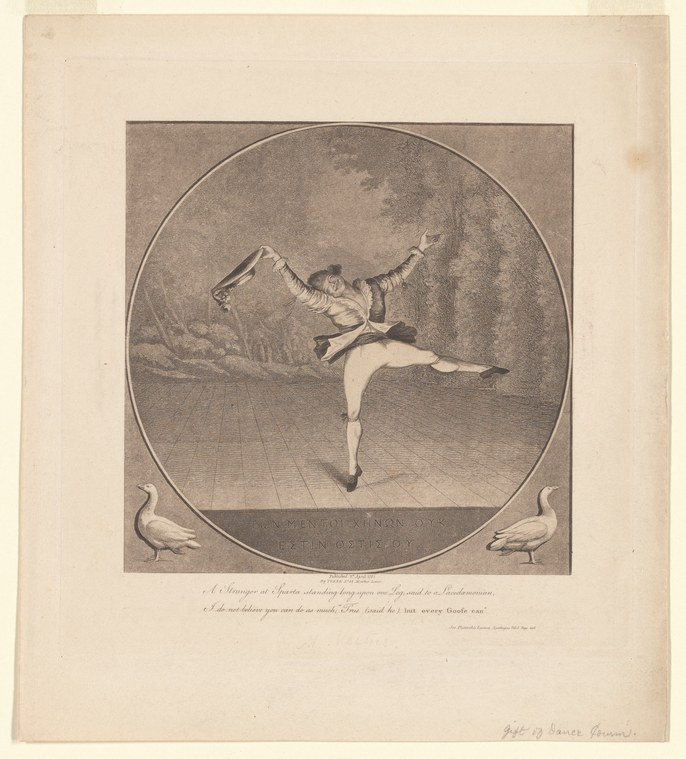
A stranger at Sparta standing long upon one leg,: said to a Lacedoemonian, I do not believe you can do as much; "True (said he) but every goose can"
Unknown artist
- Collection:
- Prints depicting dance
- Source:
- New York Public Library
- Rights:
- Public domain — free to use, share and adapt.
- Recorded as:
- Public Domain
For dancers and dance historians, this image documents the foundational techniques and aesthetic values of classical ballet at the moment when it was still forming as a codified practice. For art historians, it shows how reproductive printmaking was deployed to circulate images of contemporary performance culture. The pairing of the figure with a classical epigram and the geese demonstrates the wit and literary ambition that surrounded early-nineteenth-century dance in educated circles.
What you are looking at
A female dancer stands alone in the center of a circular composition, balanced on one leg in an extended attitude. She wears a short, pale tutu and a darker bodice, her hair styled in the fashion of the mid-nineteenth century. Her raised leg extends behind her in an elegant line, while her arms are positioned with one raised upward and the other extended outward, displaying the balletic port de bras. The background is a soft, atmospheric wash suggesting an interior space or stage. The circular frame is bounded by a double line, and at the bottom of the composition sit two geese facing one another—a visual reference to the epigram inscribed below. The print's soft tonality and the fine detail work suggest this is an engraving or etching rather than a drawing.
The dancing
The dancer demonstrates classical ballet posture: she stands en relevé (on the balls of the foot) with a single supporting leg, the working leg lifted and turned out in an extended arabesque or attitude derrière, the knee slightly bent. Her torso is upright with a marked turnout at the hip. The arm raised toward the back follows the S-curve typical of Romantic ballet's épaulement, while the extended arm shows the characteristic carriage of the period. The figure displays the characteristic proportions and musculature of a professional ballet dancer, with particular emphasis on the elongation of the line from supporting leg through the arch of the foot to the lifted leg.
The dance depicted
This depicts a moment in classical ballet technique, specifically the sustained balance on one leg that was central to early-nineteenth-century training and performance. The sustained leg position—whether arabesque or attitude—was a fundamental demonstration of technical control and grace that audiences associated with the new Romantic ballet aesthetic. The title's classical reference to Sparta and the proverb 'every goose can' suggests the work plays on the contrast between human refinement (the dancer's poised control) and animal simplicity (the geese). This is theatrical ballet of the Romantic era, likely from the 1830s–1850s when such single-figure studies of dancers became popular prints.
How it was made
This is an engraving or aquatint print, identifiable by its tonal gradations achieved through careful cross-hatching and the characteristic delicate line work of early-nineteenth-century reproductive printmaking. The soft modeling of the figure and background, particularly the subtle shading in the dancer's flesh tones and the tutu's translucence, is consistent with aquatint technique. The print would have been produced for a broad middle-class audience interested in contemporary theater and dance; such prints were affordable, widely distributed, and often collected in bound volumes or hung in parlors. The circular frame is a compositional choice that emphasizes the dancer as a singular subject of contemplation.
About this work
This is a theatrical print documenting a moment from Romantic-era ballet, a period when European dance was being transformed by new aesthetic values emphasizing ethereal grace, technical refinement, and an idealized feminine form. The engraving preserves both the physical technique of early-nineteenth-century ballet—the turnout, the balance, the carriage of the arms—and the cultural meaning such postures carried: demonstrations of civilized refinement, discipline, and beauty. The print belongs in a dance history archive both as a record of how dancers actually moved in this period and as evidence of how dance was consumed visually by the educated public.
How to look at it
Notice the moment the artist chose: not a leap or a turn, but a held position—a moment of stillness and balance that emphasizes control and line over virtuosic motion. The single-leg balance was a test of technique and a showcase for the elongated body line prized in Romantic aesthetics. Observe how the artist used the circular frame to isolate the figure, directing all attention to the posture and proportions of the body. The geese at the bottom, comical and earthbound, form a visual pun that underscores the human dancer's refinement.
The artist
The artist is not recorded in the holding catalogue. The style and technique are consistent with commercial reproductive printmaking in Britain or France between roughly 1825 and 1860. Such prints were often produced by engravers and publishers rather than signed as works of individual artistic authorship; they were collaborative products designed to capture and circulate images of celebrated dancers and performances.
The period
This print dates from the height of the Romantic ballet era (approximately 1830–1860), when European dance underwent a revolution in both technique and aesthetic. Dancers began performing en pointe, tutus shortened and lightened, and choreography emphasized ethereal, otherworldly qualities. Simultaneously, the print and engraving industries were thriving, allowing theaters and dancers to extend their reach beyond the performance space into homes and galleries. Prints of dancers—both portraits of celebrated performers and idealized studies of technique—were a major form of cultural consumption and helped establish the visual conventions we still associate with classical ballet.
Where it lives
This print is held in the New York Public Library's collection of prints depicting dance. It is part of a broader archive of theatrical and dance imagery from the nineteenth century, many of which are commercial prints produced in editions for public sale and consumption.
Dance in this work
Questions about this work
What dance position is the dancer demonstrating?
The dancer is balanced on one leg en relevé (on the balls of the foot), with the other leg extended behind in either an arabesque or attitude position. This was a fundamental technique in Romantic ballet and a signature pose for demonstrating a dancer's control, turnout, and line. Holding such a balance required years of training and remains central to classical ballet technique today.
Why are there geese at the bottom of the print?
The geese illustrate the epigram inscribed below the image, a classical reference to Sparta in which a stranger boasts that he can stand on one leg longer than a Lacedaemonian—who replies that every goose can do as much. The joke plays on the Spartan wit and, here, on the contrast between the refined technical achievement of the dancer and the trivial ability of an animal. It adds a layer of humor and classical erudition to what is otherwise a serious study of ballet technique.
When was Romantic ballet, and what made it different?
Romantic ballet flourished from roughly 1830 to 1860, beginning with ballets like La Sylphide. It introduced shorter tutus, dancing en pointe, and new narratives emphasizing the ethereal and supernatural. Dancers became idealized as spirits or sylphs rather than classical mythological figures. This print dates from that era and captures the technical refinement and aesthetic of the movement.
More dance artwork





