49 works in this view — arrow keys or swipe to move between them.
Dance in Art
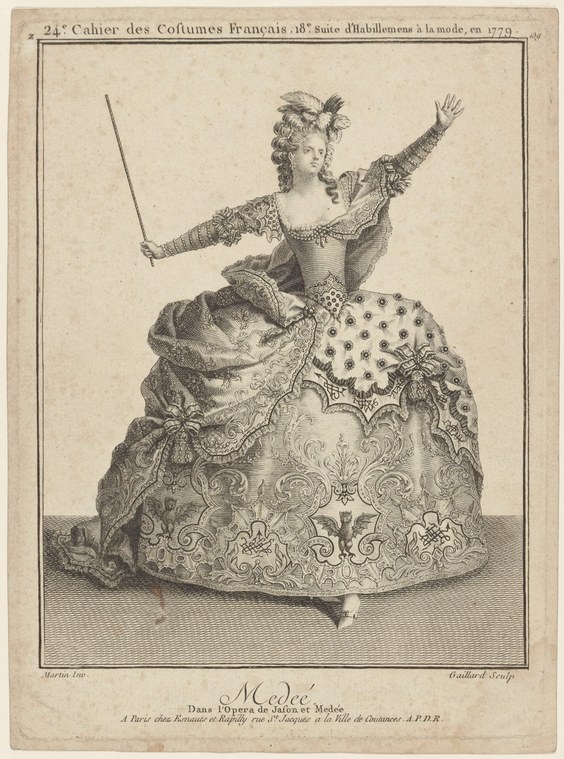
Medée, dans l'opéra de Jason et Medée
Unknown artist
- Collection:
- Prints depicting dance
- Source:
- New York Public Library
- Rights:
- Public domain — free to use, share and adapt.
- Recorded as:
- Public Domain
This image is rare documentary evidence of how a celebrated tragic female role was performed and costumed in late 18th-century French opera. It shows the physical presence and trained bearing of a professional stage performer at the moment of emotional climax, preserving not choreography but the embodied vocabulary of dramatic expression that preceded the technical specialization of dance. For historians of theatrical practice, costume, and the body in performance, it is a direct window into professional practice and the visual standards of a specific time and place.
What you are looking at
A single female dancer dominates the composition, posed in a dramatic contrapposto stance against a plain background. She wears an elaborate mid-18th-century court gown with a voluminous skirt decorated with scrollwork ornament and dotted patterning, the fabric caught up on one side to reveal the underskirt. Her bodice is tightly corseted and her arms are bare, muscled, and extended in an energetic gesture—the right arm raised high with hand opened in an expressive flourish, the left arm extended forward holding what appears to be a conductor's baton or wand. Her head is turned upward and back, crowned with an elaborate arrangement of feathers and ornament. The pose suggests a moment of exuberant action: neither repose nor a formal court presentation, but rather the captured apex of a dramatic theatrical gesture. The engraved technique renders every detail of the costume and musculature with precise linear clarity.
The dancing
A single female figure, full-length, stands with weight shifted onto one leg in a dynamic, asymmetrical pose. Her torso is upright and turned, her head thrown back with expressive force. The arms frame the composition dramatically—one raised above the shoulder with palm open, the other extended laterally at waist height, holding what may be a prop or attribute. The musculature of her bare arms and shoulder is carefully rendered, suggesting strength and trained movement. Her legs are partially concealed by the voluminous skirt, but the stance implies a wide base and engaged lower body rather than the balletic verticality of pure ballet.
The dance depicted
This is almost certainly operatic dance, specifically from a tragédie lyrique or similar Baroque stage work—the inscription names the role as Médée (Medea) from an opera on Jason and Medea. The costume, the theatrical setting, and the heraldic formality of the pose all align with the French Baroque theatrical dance tradition of the 1770s. The figure is captured mid-gesture rather than in a technical position, suggesting the gestural-dramatic mode of performance that characterized 18th-century theatrical dance before the rise of technical virtuosity. The muscular arms and the energetic raised gesture suggest a performer trained in the expressive mime and noble comportment of court and stage dance of the period.
How it was made
This is an engraving (ligne de taille technique), as evidenced by the parallel-line hatching used throughout to model form, shadow, and fabric texture. The clarity of the line work, the fineness of the mark, and the even density of the cross-hatching suggest a skilled professional engraver, likely French. The medium allowed for wide circulation as a print—this would have been published as part of a series ("24e Cahier des Costumes Français") documenting contemporary theatrical costume and performance. Engravings of this type served both as costume reference and as records of celebrated performers and roles.
About this work
This is a documented engraving from a French theatrical costume series, depicting the role of Médée from an operatic treatment of the Jason and Medea myth. The figure is shown in full theatrical regalia, captured in a moment of dramatic gesture that conveys both the formal elegance of 18th-century court dress and the physicality of Baroque-era stage performance. The work is a record of both costume practice and the gestural vocabulary of tragic female roles in French opera and tragédie lyrique of the 1770s. It belongs in a dance collection not because the image shows dance technique in the modern sense, but because it documents how the body was deployed expressively on the lyric stage of the period, and the physical training and deportment expected of professional opera performers.
How to look at it
Notice the precise moment the artist has chosen: not a static presentation pose, but a moment of dynamic action—the head thrown back, the arms in full extension, the body torqued with emotional force. The technique of engraving allows every detail of costume to be rendered with clarity: follow how the light-and-shadow effects of the hatching create volume in the fabric, the shimmer of the patterned skirt, the defined musculature of the bare arm. The contrast between the intricately ornamented lower body (skirt, petticoat, footwear) and the relatively bare upper body is deliberate—it allows the arm gestures and the face to dominate, making the emotional expression primary. This is how 18th-century theatrical design worked: the costume served the dramatic gesture, not the reverse.
The artist
The engraver is named in the plate as "Guillard Sculp." (Guillard sculpsit—Guillard engraved it). The series of which this is part, "Cahier des Costumes Français" (Portfolio of French Costumes), was a commercial publication documenting theatrical dress and celebrated performers of the Comédie-Italienne and related venues. Such series were published throughout the 18th century to satisfy demand from the theatre-going public for images of famous performers and roles. The professional quality of the engraving and the specificity of the documentation suggest Guillard was part of an established workshop producing such commercial prints.
The period
This engraving dates to the 1770s, a period of high refinement in French theatrical practice and court aesthetics. The tragédie lyrique was at the height of its formal development, blending drama, music, and dance in a hierarchy where gesture and expression served the text and the music. The female body in theatrical contexts was increasingly subject to formal training—the rise of the professional ballerina was underway, though this image predates the full technical vocabulary of Romantic ballet. The costume depicted here, with its corseted bodice and voluminous skirt, represents the theatrical aesthetic of noble dress, distinct from both courtly formality and the lighter fashions of everyday wear. The series to which this belongs reflects the commercialization of theatrical celebrity and the role of prints in disseminating images of performance across France and into Europe.
Where it lives
This engraving is part of the "24e Cahier des Costumes Français" (24th Portfolio of French Costumes), a commercial print series dating to the 1770s. It is held in the New York Public Library's Prints collection, which documents dance and theatrical performance across centuries. As a costume print, it belongs to the category of commercial theatrical documentation rather than fine art, though the skill of execution is high.
Dance in this work
Questions about this work
Was Medea a real dance role in 18th-century opera?
Yes. The Medea myth was a standard subject in tragédie lyrique and other operatic forms throughout the 17th and 18th centuries. Multiple composers set Jason et Médée or similar titles. The role of Medea was a starring tragic role for prima donnas, requiring both vocal and physical expressiveness. This print documents how one such performer was costumed and posed in the role.
Is this a real performer or an idealized figure?
The caption and series title suggest this documents an actual production and probably a celebrated performer, though we cannot identify which one from the engraving alone. The anatomical specificity and the named role suggest it is a record of actual theatrical practice rather than an ideal type. However, engravers conventionalized and idealized the bodies they depicted, so this represents a stylized but recognizable performance tradition.
What does the stick or wand in her hand represent?
This may be a conductor's baton, a theatrical prop (such as a scepter or magical wand—appropriate to the Medea myth), or an attribute of the character. Without more context on the specific production, it is difficult to determine. Its presence suggests the image documents a specific moment in the dramatic action rather than a generic costume display.
How is this different from ballet?
At this date, theatrical dance was not yet differentiated from theatrical gesture and mime the way it later became. This performer is trained and moving expressively, but the emphasis is on dramatic communication and the declamation of emotion rather than on technical dance virtuosity. The shoes, the footwear visible beneath the skirt, and the stance do not show the turned-out positions or the elevation that would characterize ballet of the early 19th century.
More dance artwork





