49 works in this view — arrow keys or swipe to move between them.
Dance in Art
Pas de deux
Unknown artist
- Collection:
- Prints depicting dance
- Source:
- New York Public Library
- Rights:
- Public domain — free to use, share and adapt.
- Recorded as:
- Public Domain
This image preserves a record of how a classical ballet moment was actually performed and what it looked like—the exact posture, the costume, the moment chosen for celebration. For historians of ballet technique and of the 19th-century stage, it is documentary evidence of the physical practice and the aesthetic values of its era, showing not what a choreographer imagined but what an audience saw.
What you are looking at
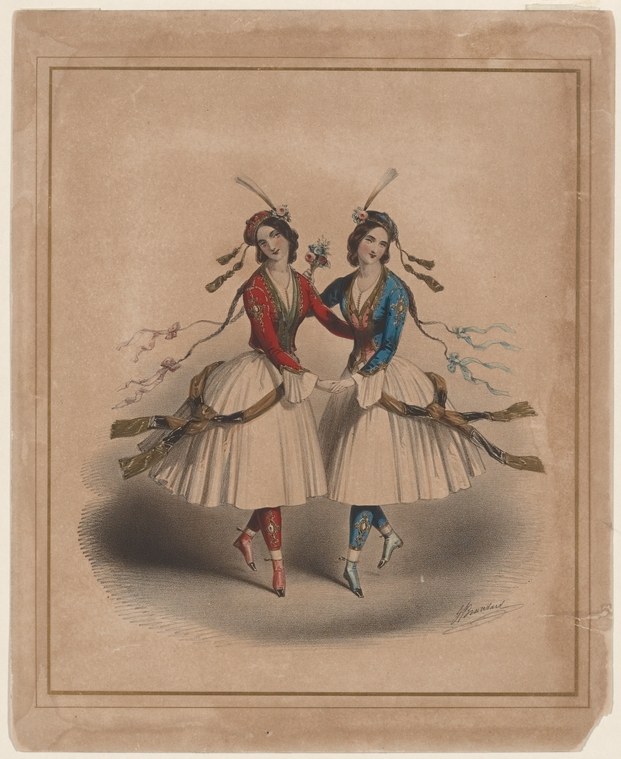
Two identical female dancers face each other in mirror symmetry, their bodies forming an X or butterfly shape across the composition. Each wears a pale, full-skirted tutu that extends to mid-calf, paired with a short bolero jacket—one red, one blue—and their hair is dressed with long feathered plumes. The dancers are poised on the balls of their feet, their bodies leaning slightly outward from the center, arms raised and extended, hands nearly touching. They stand on a shadowed ground plane rendered in soft grey, against a warm beige background framed by a simple double line. The precision of their symmetry and the lightness of their pose suggest a moment of balance and mutual regard—neither dancer appears to support the other's weight, yet their positioning creates an image of perfect equipoise.
The dancing
Both dancers stand in an identical position: legs straight and turned out, weight forward on the balls of the feet, torsos angled slightly backward from the waist, arms extended at shoulder height with hands approaching but not touching. The symmetry is absolute and deliberate—a mirror image rather than a natural interaction. The lifted port de bras and the turned-out legs suggest classical ballet training; the feathered headdresses and the full tutus are period costume elements. Neither dancer appears to be supporting weight or in a moment of dynamic movement; instead, they hold a posed, static configuration that reads more as a position to be admired than as a fraction of a step.
The dance depicted
This appears to be a theatrical ballet pas de deux, and the title confirms it. The symmetrical composition and the classical costume—particularly the pointe-ready silhouette, the tutus, and the formal bolero jackets—place it within 19th-century ballet. The perfect mirroring suggests either the opening of a variation or a formal entrance, possibly a 'symmetrical pas' in which both dancers perform identical choreography simultaneously. The feathered plumes and the contrasting jacket colors (red and blue) suggest this may represent a specific famous pair or ballet, though without further documentation the particular work cannot be identified. The pose itself—arms raised, bodies angled—is characteristic of romantic or classical ballet rather than pantomime.
How it was made
This is a hand-colored lithograph or engraving, recognizable by the soft modeling of the figures, the linear border, and the tonal gradations in the ground plane. The technique allowed for wide distribution as a popular print and suggests this was either a souvenir of a celebrated performance or a printed dance instruction image for the amateur market. The use of color to distinguish the two dancers—despite their identical poses—suggests the artist's intention to depict a specific pair or a named theatrical moment. The hand-coloring, evident in the tutus and jackets, indicates this was produced and finished for sale to a general audience, not merely as a working sketch.
About this work
A hand-colored lithographic or engraved print showing two identical female dancers in full classical ballet costume, posed in perfect symmetry face-to-face. The work documents a moment from theatrical ballet practice, likely from the mid-to-late 19th century, when such symmetrical pas de deux were a standard feature of the ballet d'action repertoire. The formal composition and the print medium indicate this was a popular or commemorative image, one of many thousands of dance prints produced for the growing dance-going public of the era. The precision of the symmetry and the classical vocabulary mark it as a work intended to celebrate and preserve a celebrated step or performed moment.
How to look at it
Note the absolute mirror symmetry of the composition—the red jacket on the left, the blue on the right, every limb echoed. This is not accidental but a deliberate formal choice, one that emphasizes harmony and mathematical precision rather than drama or character. Observe the slight backward tilt of the torsos: this is not a standing position but a moment of balance, weight forward on the balls of the feet, the body poised. The raised arms and the angle of the head suggest a moment of connection—not a touching moment, but a moment of mutual awareness. The feathered plumes catch light and movement even in stillness, which was their purpose on stage.
The artist
The artist is not recorded on the work, which is typical of popular dance prints of the period. The signature or initials visible in the image are difficult to read with certainty; many such prints were produced by commercial publishing houses that often did not credit individual artists. The style and technique are consistent with mid-19th-century European lithographic practice, but without clearer documentation the maker cannot be identified with confidence.
The period
The 19th century saw an explosion of dance-related prints aimed at the growing middle-class audience for ballet. After the success of Romantic ballet in the 1830s–1850s, particularly works like *La Sylphide* and *Giselle*, the image of the ethereal female dancer in a tutu became a commercial product. Print publishers capitalized on the popularity of celebrated dancers and famous moments, producing hand-colored lithographs and engravings for purchase as souvenirs, decoration, or instruction. By mid-century, such prints were a common form of popular visual culture, functioning much as theatrical photographs and playbills would later. The symmetrical pas de deux was a standard formal device in ballet, often appearing in finales or as a featured number, and this image documents that convention.
Where it lives
The print is held in the New York Public Library's prints collection related to dance. It is a popular, mass-produced work of the 19th century, one of many thousands of similar dance prints in institutional and private collections.
Dance in this work
Questions about this work
Is this two dancers or the same dancer twice?
These are two different dancers, posed in perfect mirror symmetry. The contrasting jacket colors (red and blue) and the artist's treatment of them as distinct figures confirm this. The symmetrical composition is a formal choice meant to represent a 'symmetrical pas de deux'—a set step in which both dancers perform the same movement in unison. This was a common formal device in 19th-century ballet.
What ballet is this from?
The catalogue record does not identify a specific ballet, and the image alone does not provide enough evidence to name it with certainty. The costume, pose, and formal composition place it within classical ballet of the mid-to-late 19th century, but to identify the exact work one would need to find the original publication or a signature.
Why are they wearing feathered plumes?
Feathered headdresses were standard costume elements in 19th-century ballet, particularly for formal divertissements and variations. They added height, caught light and movement on stage, and signaled to the audience that this was a special, celebrated moment. They were also a marker of theatrical costume rather than everyday dress, helping the audience distinguish between the ballet world and reality.
What kind of print is this?
This is a hand-colored lithograph or engraving, a standard form of popular theatrical merchandise in the 19th century. The soft modeling and tonal gradations suggest lithography. Such prints were produced in editions, hand-colored afterward, and sold as souvenirs, wall decoration, or references for amateur dancers.
More dance artwork





