49 works in this view — arrow keys or swipe to move between them.
Dance in Art
Semiramide
Unknown artist
- Collection:
- Prints depicting dance
- Source:
- New York Public Library
- Rights:
- Public domain — free to use, share and adapt.
- Recorded as:
- Public Domain
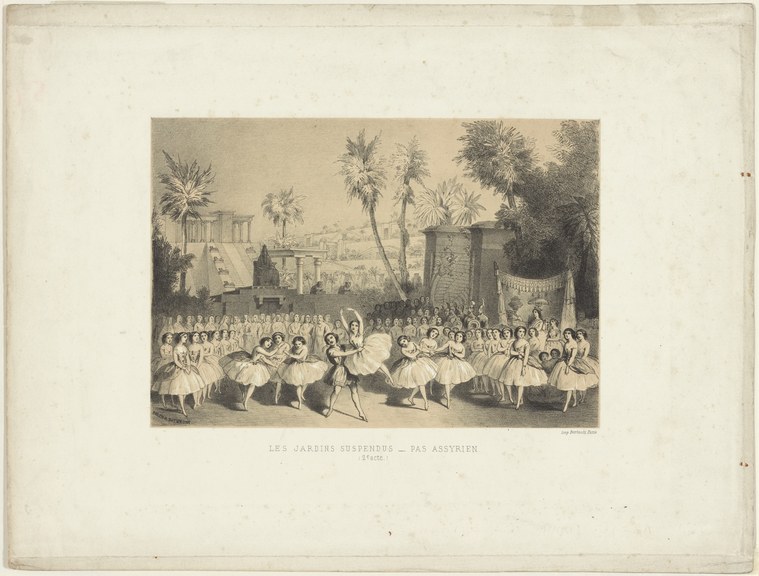
This image shows the Romantic ballet in full theatrical splendor and reveals how that spectacle was packaged and sold to the public through mass-produced prints. For dancers and choreographers, it documents the aesthetic language of mid-19th-century ballet: the body language, the costume, the compositional priorities, and the relationship between individual and ensemble. For historians, it is a window into how theatrical dance was remembered, circulated, and consumed in the pre-photographic era.
What you are looking at
A theatrical ballet performance set in an exotic, orientalist landscape. Dozens of female dancers in identical white tutus fill the stage in a loose, animated grouping, their bodies caught in various attitudes of movement—some with arms raised, others in profile, many appearing to leap or turn. The setting evokes a Mediterranean or Middle Eastern garden: tall palm trees frame both sides of the composition, and classical architecture—temples or palaces with columns—appears in a hazy middle distance. The stage floor is rendered in perspective, and the dancers occupy the full depth of the space, creating layers of movement. The lighting is soft and diffuse, typical of mid-19th-century theatrical printing, with the dancers' white costumes glowing against the darker architectural and natural elements. A decorative border runs beneath the image with a caption.
The dancing
The dancers are uniformly dressed in Romantic-era pointe work costumes: white tutus with fitted bodices, standing on or relevé to pointe shoes. Their arms move expressively, sometimes raised overhead or extended to the sides in port de bras. The grouping is informal and dense rather than strictly linear—bodies overlap, creating a sense of spontaneous collective movement rather than precise geometric formation. Several figures appear to be mid-leap, with legs extended or gathered beneath them. The repetition of identical costuming and silhouette emphasizes the corps de ballet aesthetic, while the varied poses suggest a choreographed ensemble moving through a stylized sequence.
The dance depicted
This depicts a Romantic ballet, almost certainly *Semiramide*, a work that existed in multiple versions during the 19th century. The title, palace setting, oriental costume, and corps de ballet in identical white tutus all align with the Romantic ballet canon. The specific iconography—the exotic locale, the dreamy diffuse lighting, the uniformed female ensemble—reflects the Romantic era's fascination with distant, fantastical worlds and the use of the corps de ballet as a visual spectacle. The dancing shown is characteristic of 1840s–1860s ballet technique: upright carriage, pointe work, and expressive arm movement within a classical frame. Without a signature or date, precise attribution is impossible, but the style of the engraving and the choreographic vocabulary suggest a French or Italian production from the mid-19th century.
How it was made
This is a steel engraving or possibly a lithograph printed in sepia or grey ink on cream paper. The fine linear hatching used to model the dancers' bodies and the soft tonal gradations in the background are characteristic of 19th-century theatrical prints. The technique allowed rapid reproduction and wide distribution of theatrical imagery to the concert-going public, who would purchase such prints as souvenirs of memorable performances. The image is mounted on a larger sheet of cream wove paper, typical of archival presentation in institutional collections. The precision of the line and the evenness of tone suggest professional execution by a commercial print house, not a unique work.
About this work
This is a theatrical print documenting or imaginatively representing a Romantic ballet performance of *Semiramide*. The work belongs to a vast 19th-century tradition of theatrical prints that translated stage spectacle into reproducible imagery for a paying public. It captures the aesthetic priorities of mid-century ballet: an orientalist fantasy setting, the deployment of many identically dressed female bodies as a visual corps, and the illusion of ethereal, airborne movement rendered through the conventions of engraving.
The print is a primary document of Romantic ballet culture—not a record of a specific performance necessarily, but an idealized image of how this ballet appeared and what it meant to its contemporary viewers. It shows us what audiences came to see: exotic escapism, technical female dancing en pointe, and the massed beauty of the corps de ballet as a visual phenomenon in itself.
How to look at it
Look first at the uniformity: every dancer wears the same costume and inhabits a similar physical vocabulary, yet each figure is individually posed, creating a paradox of unity and variation that is central to the romantic corps de ballet. Notice the depth of field—dancers recede into the background, creating an illusion of a large ensemble filling a real stage space. The arm gestures are particularly worth studying: they are expressive and varied but constrained within the classical vocabulary of port de bras, showing how Romantic ballet married technical discipline to emotional expression. Finally, attend to the setting: the palms, the architecture, the soft light all work together to create a mood of escape and fantasy that the dance itself is meant to fulfill.
The period
This print belongs to the height of the Romantic ballet era, approximately 1840–1870. During this period, ballet shifted decisively away from male-centered court spectacle toward the visual dominance of the female dancer, particularly the corps de ballet as a unified aesthetic object. The Romantic movement in the arts had made the ethereal, the exotic, and the dreamlike central to artistic value, and ballet seized this aesthetic wholeheartedly. Orientalist settings—harems, palaces, temples in imagined distant lands—became standard subjects, reflecting both colonial fascination and the desire to distance ballet from contemporary realism. The pointe shoe, only recently standardized, became essential to the Romantic aesthetic of weightlessness and otherworldliness. Theatrical prints like this one were a crucial medium of cultural distribution; theaters and print publishers worked together to create and sell iconic images that reinforced public memory of performances and helped market future productions.
Where it lives
The work is part of the New York Public Library's prints collection documenting dance. It is catalogued as a theatrical print depicting dance but with minimal identifying information. Such prints were typically published as commercial editions, often without a specific date or artist attribution on the object itself.
Dance in this work
Questions about this work
Is this depicting a real performance or an imagined one?
Almost certainly it is an imagined or idealized theatrical image rather than a document of a specific performance on a specific night. Such prints were often created after the fact or used generic theatrical subjects to capture the visual appeal of a work or genre. They were marketing objects as much as records.
Why are all the dancers wearing identical costumes?
This is the corps de ballet, the ensemble of female dancers who performed together. Identical costumes unified them visually and made their collective movement a spectacle in itself. The Romantic era made the corps de ballet a major attraction—audiences came to see the coordinated beauty of dozens of women in the same dress, moving together.
What does 'Semiramide' mean, and why this subject?
Semiramide is a legendary Assyrian queen, a figure from ancient history and myth. Exotic, powerful, and distant, she was an ideal subject for Romantic ballet, which favored oriental and historical settings that allowed escape from contemporary reality. Several ballets used this title across the 19th century.
How was this print made, and why does it matter?
This is a steel or copper engraving, a technique that allowed hundreds of copies to be printed and sold affordably. Before photography, such prints were the primary way theatrical spectacle was reproduced and circulated. They made ballet visible to people who might not attend the theater and helped create public memory of famous productions.
More dance artwork





