49 works in this view — arrow keys or swipe to move between them.
Dance in Art
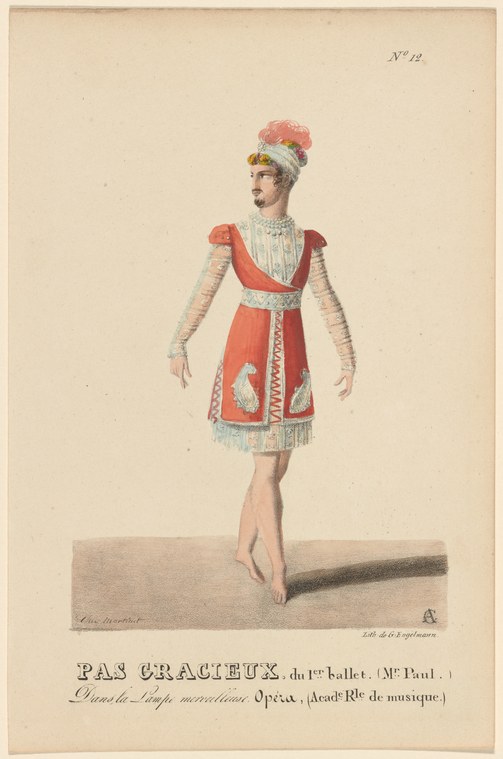
Pas gracieux du 1er ballet. (Mr. Paul) Dans La lampe merveilleuse, opéra, Acad'e R'le de musique
Unknown artist
- Collection:
- Prints depicting dance
- Source:
- New York Public Library
- Rights:
- Public domain — free to use, share and adapt.
- Recorded as:
- Public Domain
This image documents the visual and material culture of late 18th-century French ballet at the Académie Royale de Musique, showing how dancers were costumed and presented to audiences in narratives combining music, spectacle, and movement. It is a primary source for understanding the aesthetics of costume design, the orientalist fantasies that shaped ballet subjects, and the professional networks through which theater designs were distributed and recorded.
What you are looking at
A single female dancer stands in profile against a pale background, posed in a moment of stillness rather than dynamic movement. She wears a striking red tunic dress with white pleated underskirt and decorative white panel appliqués on the front, paired with a white pleated chemise visible at the neckline and under the arms. Her arms hang naturally at her sides, palms forward. A tall feathered headdress in shades of coral and cream sits atop her head. Her legs are bare and her stance is upright and formal, with weight evenly distributed. A thin shadow line grounds her figure on the stage. The presentation is that of a costume plate or character study rather than a narrative scene—the dancer is presented as a figure to be examined, her dress and adornment the focus.
The dancing
A single dancer, posed standing with neutral arm carriage and weight centered. The posture is upright and dignified, without the turnout or épaulement characteristic of classical ballet technique. The arms are relaxed rather than held in ballet positions. The dress is full and constructed to frame the body, with the red tunic drawing the eye upward to the headdress. There is no indication of a specific step or movement phrase—this is a presentation of a character in repose.
The dance depicted
The inscription identifies this as a pas from the first ballet of *La lampe merveilleuse* (The Marvelous Lamp), an opera-ballet presented at the Académie Royale de Musique. The costume—red tunic, exotic headdress, bare legs—suggests an orientalist or fantastical character typical of late 18th-century French ballet theatricals, but the pose itself is not identifiable as a specific step or technique. The figure's formal presentation and the absence of dynamic movement indicate this is a costume design or character identification plate rather than a depiction of choreography in action.
How it was made
This is a hand-colored engraving or etching, identifiable by the fine line work visible in the background, the precision of the figure's outline, and the applied watercolor or gouache in the costume details and flesh tones. The technique allowed for the wide distribution of costume designs among theaters, subscribers, and dance professionals across Europe. The signed notation at the bottom left suggests this was a professional publication—likely a theater record or print series documenting opera-ballet productions and their performers' costumes.
About this work
This is a costume plate from a late 18th-century French opera-ballet, documenting the character and dress of a dancer in *La lampe merveilleuse*. It belongs to a tradition of theatrical prints that recorded both the spectacular costume design and the performer's presentation to audiences. The work captures a moment not of dancing but of display—the dancer as a visual spectacle framed by exotic dress and orientalist fantasy, typical of the period's appetite for narrative ballet with fantastical themes. Such prints circulated among the theater world, the aristocracy, and collectors of dance ephemera, making the work part of the material culture through which ballet was consumed and remembered.
How to look at it
Look at the headdress first: its height and construction announce this as an exotic or supernatural character, not a classical figure. Note the precision of the costume's construction—the layering of skirts, the placement of appliqués, the contrast between the bold red and white—which would have read clearly from the theater audience's distance. The dancer's pose is static and formal, inviting you to read her as a character type or costume study rather than as a moving body. The bare legs, unusual for female dancers of later centuries, were characteristic of this era and marked both novelty and a kind of theatrical nakedness meant to signify otherness.
The artist
The artist is not recorded in the catalogue. The signature or attribution mark visible in the lower left corner is not clearly legible in reproduction. The print likely comes from a professional theater workshop or commercial print house attached to or serving the Académie Royale de Musique in Paris, where such documentation was a standard practice.
The period
This work dates to the era of late 18th-century French ballet, when the form was dominated by narrative productions—often featuring exotic or mythological settings—rather than abstract choreography. The Académie Royale de Musique (later the Opéra) was the principal venue for such spectacles. Orientalist themes and fantasy narratives were central to ballet plots of the period, and costumes were increasingly elaborate and architecturally complex. The practice of issuing engravings of costumes and performers served both to publicize productions and to circulate designs among professionals and patrons.
Where it lives
The work is held in the New York Public Library's collection of prints depicting dance, catalogued as part of its theater and performance archives. It is a single-sheet colored engraving, typical of the promotional and documentary prints that theaters commissioned and distributed during the 18th century.
Dance in this work
Questions about this work
Who was the dancer in this print?
The catalogue does not identify the performer. The inscription names the ballet and the character (first ballet of *La lampe merveilleuse*) but not the dancer. Such costume plates sometimes bore the performer's name, but this one does not appear to, at least not legibly.
What was *La lampe merveilleuse*?
It was an opera presented at the Académie Royale de Musique (the Paris Opéra) in the late 18th century. The title translates as 'The Marvelous Lamp,' suggesting a narrative plot with fantastic or orientalist elements. The work combined music, ballet, and spectacle, as was standard for French opera of the period.
Why is the dancer wearing such a tall headdress?
The headdress signals exotic or supernatural character—a visual shorthand for 'other' within the conventions of late 18th-century theater design. It would have been visible from the back of a large theater and would have immediately communicated the character type to the audience. Orientalist and fantasy costumes relied heavily on such dramatic head ornaments.
Is this a painting or a print?
It is an engraving, hand-colored with watercolor or gouache. The fine lines and precise detail visible in the background and outline are characteristic of engraved work. Hand-coloring was standard for theatrical prints of this era, making each copy unique while maintaining the reproducible base image.
More dance artwork





