49 works in this view — arrow keys or swipe to move between them.
Dance in Art
The marble maiden
Unknown artist
- Collection:
- Prints depicting dance
- Source:
- New York Public Library
- Rights:
- Public domain — free to use, share and adapt.
- Recorded as:
- Public Domain
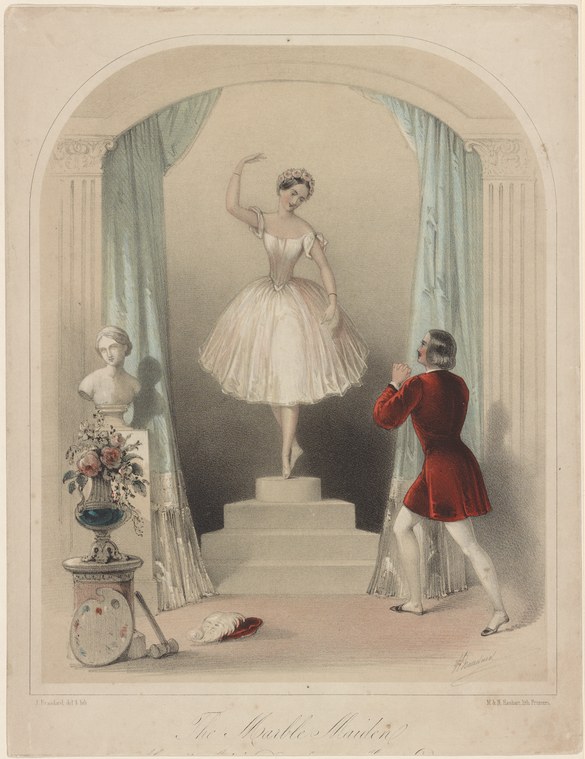
This print offers a rare, detailed visual record of how early Romantic ballet was imagined and marketed to audiences: the emphasis on ethereal poses, white dress, and the equation of the dancer with precious sculpture. It also documents the gendered nature of dance spectatorship and desire in the period—the dancer as object of male admiration, positioned above but in service to the gaze below.
What you are looking at
A pale female figure in a white ballet dress stands elevated on a pedestal within a columned neoclassical interior, posed in a graceful attitude with one arm raised. She is framed by blue-green curtains and flanked by two male spectators: on the left, a young man in light dress who gazes upward at the figure, and on the right, a man in a red jacket and white breeches who appears to be applauding or gesturing in admiration. The setting suggests a drawing room or gallery space with fluted columns, classical architectural details, and refined furnishings including a pedestal with flowers. The composition treats the dancing figure as both artwork and spectacle—a 'marble maiden' simultaneously living and statue-like, the object of male appreciation and wonder.
The dancing
The central dancer stands in an elevated, almost sculptural pose—weight on one leg, the other raised, torso lifted, one arm extended upward in a gesture of grace or presentation. Her posture suggests controlled, balletic carriage with the elongation and lift characteristic of early 19th-century theatrical dance. The two men below frame her vertically: one looking upward with admiration, the other actively gesturing. The spatial hierarchy—the woman raised, the men at ground level—reinforces the painting's conceit that she is a work of art.
The dance depicted
The figure is almost certainly engaged in Romantic ballet or a balletic pose that emphasizes ethereal, weightless beauty. The white dress, the elevated position, the attitude of the body, and the period setting all point to early-19th-century theatrical ballet tradition, likely European (French or English, given the neoclassical taste). The title 'The Marble Maiden' suggests the Romantic era's fascination with animate statuary—the fantasy of sculptures coming to life, a theme that recurs in Romantic ballet and literature. Whether this depicts an actual performance or an allegorical fantasy is ambiguous; the theatrical framing and architectural precision suggest a professional stage, but the domestic scale and the men's poses suggest a private viewing or imaginative scene.
How it was made
This is a hand-colored engraving or lithograph, as evidenced by the delicate tonal washes (particularly in the flesh tones, the blue-green drapery, and the soft shadows), the precise linear work defining the architectural details and folds of fabric, and the overall finish characteristic of early-19th-century reproductive prints. The technique allowed for wide circulation of theatrical imagery among the middle and upper classes; such prints were sold individually and in series to document performances and performers. The hand-coloring suggests a higher-end print, made for patrons of dance and the arts.
About this work
This is an early-19th-century hand-colored engraving or lithograph depicting a young woman in a white ballet dress poised on a pedestal, framed as both a dancer and a living sculpture. The scene embodies the Romantic era's obsession with the intersection of dance, sculpture, and desire—the fantasy of the inanimate made animate, the performer as artwork. Two male figures, stationed below and to the sides, gaze upward in wonder and applause, establishing a hierarchy of spectatorship in which the female dancer is simultaneously performer and fetishized object.
The print belongs to the tradition of theatrical documentation and celebrity culture that grew rapidly in the 19th century, when engravings and lithographs of celebrated dancers circulated widely through print shops and private collections. 'The Marble Maiden' captures a specific cultural moment in which ballet had become an art form defined by the illusion of weightlessness, otherworldliness, and feminine beauty—and in which that illusion was consumed and circulated through mass media.
How to look at it
Note the moment the artist has chosen: not mid-movement or in the midst of an action, but in a held pose—an attitude of stillness that paradoxically defines Romantic ballet technique. The dancer is frozen in a moment of display, her body an elegant line. Observe how the architecture and the male spectators frame her as both subject and artwork: she is literally elevated, as if in a museum or gallery. The artist has captured not just a dancer but a fantasy—the conceit that a living woman can become a beautiful object, static and perfect, for aesthetic consumption.
The period
The work dates to the era of European Romantic ballet, roughly 1820s–1840s, when the pointe shoe became standard and the female dancer in a white, ethereal costume became the ideal of theatrical beauty. This was the age of Marie Taglioni, Fanny Elssler, and the cult of the ballerina as supernatural being—a figure that embodied Romantic fascination with the unattainable, the otherworldly, and the feminine ideal. The neoclassical architectural framing reflects the taste of the period's educated classes, for whom ballet was part of a cosmopolitan, refined leisure culture. Hand-colored prints of celebrated dancers and scenes were a major medium of popular culture and helped standardize the image of the Romantic ballerina across Europe and beyond.
Where it lives
The work is held in the New York Public Library's collection of prints depicting dance, indicating its status as a documented artifact of theatrical history and popular visual culture. It is a mass-produced or semi-mass-produced print, designed for circulation and collection.
Dance in this work
Questions about this work
What does 'marble maiden' mean?
The title refers to the Romantic-era fantasy of a statue coming to life—in this case, a beautiful sculpture that is simultaneously a living, dancing woman. It reflects 19th-century fascination with the boundary between art and life, and the idea that a perfect ballerina could be as beautiful and unchanging as marble sculpture. This conceit was common in Romantic ballet narratives and imagery.
Is this depicting a real performance or a fantasy?
The image is ambiguous by design. The architectural precision and theatrical framing suggest a stage, but the domestic scale and the direct, admiring gazes of the two men suggest an imaginative or allegorical scene rather than a documented performance. It is likely a romantic fantasy or idealization rather than a record of a specific dancer or show.
Why is the dancer elevated on a pedestal?
The pedestal reinforces the print's central conceit: the dancer-as-artwork, worthy of display and contemplation like a sculpture in a gallery or museum. It also elevates her above the male spectators, establishing a spatial and aesthetic hierarchy in which she is both unreachable and the focus of desire.
What does the white dress tell us about the period?
The white tulle or gauze dress was the standard costume for the Romantic ballerina from the 1820s onward. It was designed to enhance the illusion of weightlessness and ethereality—qualities that were central to the aesthetic ideal of the era. The dress became so iconic that it helped define the dancer's role and image across Europe.
More dance artwork





