49 works in this view — arrow keys or swipe to move between them.
Dance in Art
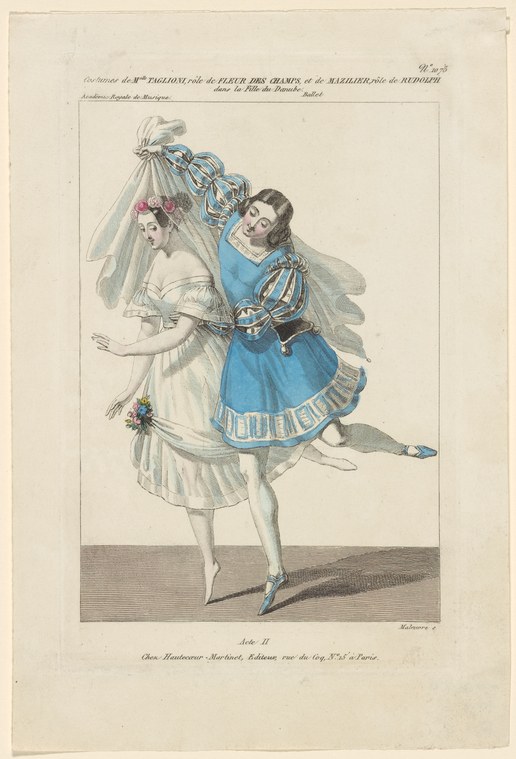
Costumes de Melle Taglioni, rôle de Fleur des champs, et de Mazillier, role de Rudolph dans La fille du Danube, ballet, acte II, Académie royale de musique
Unknown artist
- Collection:
- Prints depicting dance
- Source:
- New York Public Library
- Rights:
- Public domain — free to use, share and adapt.
- Recorded as:
- Public Domain
This print documents Marie Taglioni at the height of her fame and influence, preserving a specific choreographic invention—the lift—that became a signature vocabulary of Romantic ballet and remains central to classical ballet today. It also reveals how ballet was consumed by the public: through prints bought as souvenirs, these images shaped how people remembered and understood the dances they had seen (or heard about), making theatrical dance a portable, shareable artifact rather than an ephemeral event.
What you are looking at
A hand-colored engraving depicts two dancers in a moment of theatrical performance, likely from a Romantic ballet. The male dancer, dressed in a brilliant blue military-style jacket with gold trim and epaulettes, lifts his female partner high in the air. The woman wears a white romantic tutu with a fitted bodice and a delicate veil or headdress adorned with pink flowers; her skirts billow around her as she is held aloft. The male dancer's leg extends behind him in a graceful line, his body angled to support the lift. Both figures are rendered with anatomical precision and caught mid-movement against a neutral ground. The engraving uses subtle color—pale washes of blue, pink, and gold—over fine line work, creating a delicate record of a specific choreographic moment.
The dancing
The lift is the dominant gesture: the male dancer supports the female dancer's entire weight with apparent ease, his arms extended upward and his torso angled for balance, while the woman's body is held horizontal and extended. Her arms reach outward in an open, expressive position; his supporting arm is straight and stable. The female dancer's pointed feet and the line of her extended leg suggest trained technique and balletic vocabulary. Both figures display the upright carriage and refined proportions expected of Romantic-era ballet dancers. The composition emphasizes verticality and weightlessness—the lift as a moment of transcendence rather than strain.
The dance depicted
This is a scene from a Romantic ballet, most likely depicting a dramatic moment of courtship or transformation. The title identifies the dancers as Mlle Taglioni in the role of Fleur des champs (Flower of the Fields) and Mazillier as Rudolph, from *La fille du Danube* (*The Daughter of the Danube*), act II. The lift and the ethereal quality of the woman's costume—the white tutu, the veil, the flower crown—are hallmarks of Romantic ballet aesthetic, emphasizing supernatural beauty and the male dancer's devotion. Taglioni was the leading ballerina of the Romantic era, and this image documents a signature moment of her art: the apotheosis lift, a technological marvel of the period that demonstrated both male partnering skill and the illusion of female weightlessness.
How it was made
This is a hand-colored engraving, a mass-production technique that allowed multiple prints to be sold and distributed to ballet audiences and theatrical enthusiasts. The fine line work is rendered through copper-plate engraving, and the color—applied by hand after printing—shows the precision and delicacy valued in mid-19th-century theatrical documentation. The technique permitted circulation far beyond the theater itself: a Parisian balletgoer, a provincial admirer, or a collector in another country could own a record of a specific performance. This was one of the primary ways ballet imagery reached the public before photography; such prints were often sold in theater foyers and through print shops.
About this work
This is a hand-colored engraving documenting a moment from *La fille du Danube*, a Romantic ballet performed at the Paris Opéra (Académie royale de musique) in the mid-19th century. It records the partnership between Marie Taglioni, the most celebrated ballerina of the Romantic era, and the male dancer Mazillier, capturing a signature choreographic moment—a vertical lift that embodies Romantic ballet's aesthetics of weightlessness, elevation, and male devotion to an idealized female form. The print circulated among theater audiences and ballet enthusiasts as a souvenir and record of live performance.
The work belongs in a gallery of dance because it documents not just a pose but a complete technical and artistic achievement: the coordinated skill of two trained bodies, the choreography of a specific ballet, and the visual language through which Romantic ballet communicated its themes of transcendence and desire. It is evidence of how 19th-century ballet was consumed, remembered, and circulated in the culture beyond the theater itself.
How to look at it
Observe the exact instant the artist chose: the lift at its apex, when the woman appears weightless and the man's body forms a perfect structural line to support her. Notice the careful proportionality of both bodies—neither looks strained or distorted by the effort. The composition asks you to read this not as acrobatics but as a moment of grace and transcendence: the woman's open arms and upturned face, the male dancer's stable but seemingly effortless support, and the surrounding white space that makes the pair appear suspended. The veil and flower crown, the precise line of the tutu, and the military jacket are all period-specific markers of Romantic ballet aesthetic; together they tell you this is neither classical antiquity nor contemporary (for the 1840s) social dance, but theatrical fantasy.
The artist
The artist is not recorded in the catalogue; however, the print bears the signature or mark of a commercial engraver working in Paris in the mid-19th century, a period when theatrical prints were a major commercial output of the printmaking industry. Such works were typically produced collaboratively—an artist drew or painted the original, an engraver transferred the design to the copper plate, and a colorist applied pigment. This division of labor allowed rapid production of multiple copies for distribution.
The period
This print dates to the height of Romantic ballet in Europe, approximately 1840s–1850s. *La fille du Danube* premiered in 1836; the work belongs to the first generation of narrative ballets centered on a supernatural or tragic heroine—a formula established by *La Sylphide* (1832). This was the era of the technologically perfected lift, made possible by advances in male technique and training, and the era of the white romantic tutu and pointe shoes as standard ballet costume. In printmaking, hand-colored theatrical engravings were the dominant form of theatrical documentation and publicity before photography became standard in the 1860s–1870s.
Where it lives
This print is held in the New York Public Library's collection of prints depicting dance. It is one of many similar hand-colored theatrical engravings produced in Paris and circulated internationally in the 19th century, typically sold as souvenirs to ballet audiences or collected by theaters, impresarios, and wealthy enthusiasts.
Dance in this work
Questions about this work
Who was Marie Taglioni?
Marie Taglioni (1804–1884) was a Swedish-Italian ballerina who became the most celebrated dancer of the Romantic era. She premiered *La Sylphide* in 1832, a role that defined her art and established many conventions of Romantic ballet. She was famous for her lightness, her pointe work, and her ability to embody supernatural characters. She danced throughout Europe and was a model for ballerinas of her generation and beyond.
What was the significance of the lift in Romantic ballet?
The lift became a central motif of Romantic ballet, symbolizing the male dancer's devotion and the female dancer's supernatural weightlessness and beauty. Technically, it demonstrated advances in male training and partnering skill. Choreographically and aesthetically, it expressed Romantic ideals: the transcendence of physical law, the sublimation of desire, and the male figure as support for an idealized feminine form.
What was *La fille du Danube*?
*La fille du Danube* (*The Daughter of the Danube*) premiered in 1836 at the Paris Opéra, with choreography by Filippo Taglioni (Marie's father) and music by Adolphe Adam. It follows a supernatural heroine, a water-nymph daughter of the Danube River, who falls in love with a mortal prince. The ballet blends folk elements and supernatural fantasy, typical of Romantic ballet narratives. Marie Taglioni danced the title role throughout the 1830s and 1840s.
How were theatrical prints made and distributed?
In the 19th century, theatrical prints were made by engraving a design onto a copper plate, which was then inked and printed on paper. The resulting monochrome prints were then hand-colored by colorists, often in an assembly-line process. These prints were sold in theater foyers, print shops, and to collectors, serving as souvenirs and as advertising for upcoming performances. They allowed audiences to remember specific dancers and roles, and spread knowledge of ballet far beyond the cities where performances occurred.
More dance artwork





